
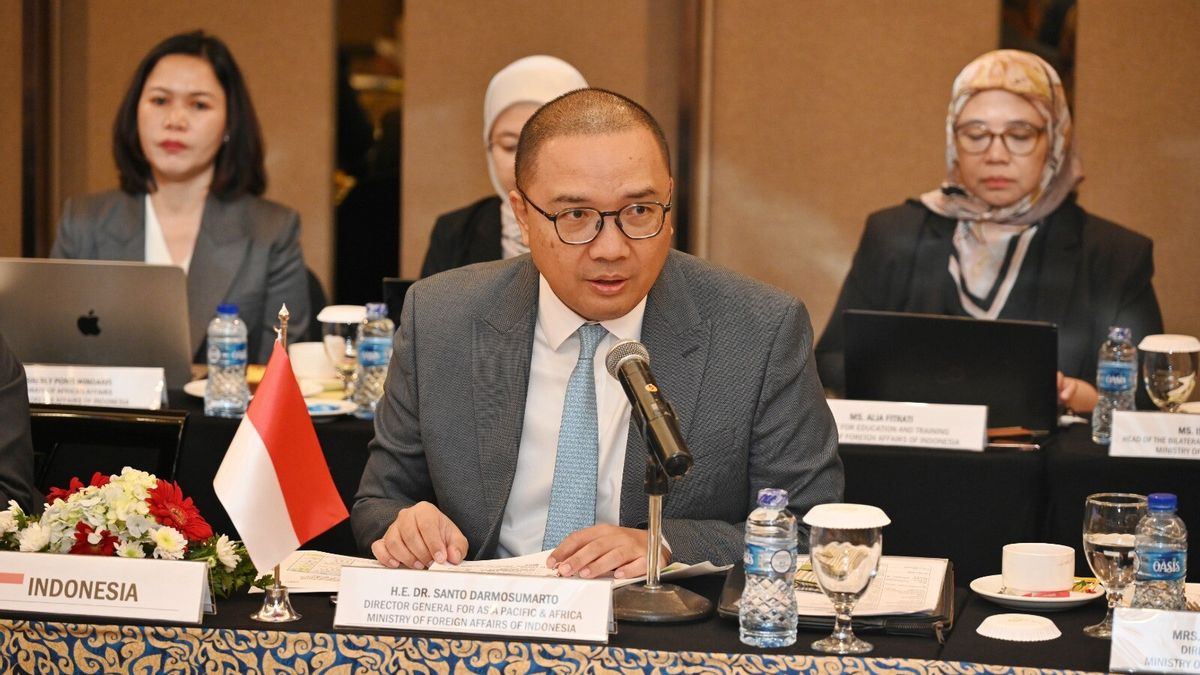


JAKARTA - Partnership with Ethiopia as a growth center and gateway to East Africa is very strategic for Indonesia, amid a more complex global landscape, said Ambassador Dr. Santo Darmosumarto.
Indonesia and Ethiopia reaffirmed their commitment to strengthening strategic partnerships as fellow Global South countries through the holding of the 2nd Meeting of the Indonesia-Ethiopia Bilateral Consultation Forum held last week, Thursday (7/5).
The Indonesian Ambassador, who is also the Director General of Asia Pacific and Africa (Aspasaf) of the Indonesian Ministry of Foreign Affairs, led the meeting together with the Director General of Middle East, Asia, and Pacific of the Ethiopian Ministry of Foreign Affairs. Ambassador Dewano Kedir.
During 65 years of diplomatic relations, Indonesia and Ethiopia have built a close friendship that has now evolved into a results-oriented partnership. This 2nd FKB meeting reaffirms the determination of both countries to make bilateral cooperation more adaptive to the current global geopolitical dynamics.
"In the midst of a global landscape that is increasingly complex, which requires strong diplomacy and broader partnerships, a partnership with Ethiopia as a growth center and gateway to East Africa, is very strategic," said the Director General of Aspasaf, launching the Indonesian Ministry of Foreign Affairs' statement, Tuesday (12/5).
In the economic field, both countries recorded a positive trend in bilateral trade which reached 138.6 million US dollars in 2025, an increase of around 40 percent compared to 2024.
In addition, currently five Indonesian companies have operated or are in the process of investing in Ethiopia. In the future, both parties agreed to make trade and investment one of the main focuses, including exploring the establishment of a Preferential Trade Agreement (PTA) and a Bilateral Investment Treaty (BIT) to expand market access and encourage outbound investment Indonesia to Ethiopia.
To support economic activities and people-to-people contact, both parties also discussed strengthening connectivity, including expanding the implementation of the Bilateral Air Service Agreement (BASA) through Ethiopian Airlines. In the agricultural sector, both countries agreed to encourage cooperation on priority commodities such as palm oil, coffee, cloves, soybeans, and wheat, as well as various capacity-building programs in the fields of livestock and food security.
In the political field, Indonesia and Ethiopia emphasized the importance of increasing high-level visits and strengthening regular dialogue mechanisms, including the utilization of the FKB as a strategic forum to discuss priority issues and evaluate the follow-up of cooperation.
In the social and cultural development sphere, both countries agreed to deepen cooperation in higher education, health, tourism, and development cooperation. Indonesia encourages the further utilization of the network of universities as well as scholarship programs and capacity building for Ethiopian students and professionals, as a long-term investment for the relationship between the two countries.
In turn, Ambassador Dewano Kedir emphasized the importance of strengthening the follow-up to the results of the meeting.
"Ethiopia highly appreciates the friendship relationship with Indonesia and sees this forum as a platform to expand cooperation in priority areas," said Ambassador Dewano.
At the end of the meeting, the two heads of delegation signed an Agreed Minutes which will serve as a guide for the implementation of bilateral cooperation in the future, including commitments to various cooperation initiatives in priority sectors.
Both parties welcomed the plan to hold the 3rd Meeting of the Bilateral Consultative Forum in Ethiopia.
After carrying out the FKB, the Director General of the Ministry of Foreign Affairs of Ethiopia also paid a courtesy visit to the Deputy Minister of Foreign Affairs of the Republic of Indonesia, Arrmanatha C. Nasir.
The meeting reaffirmed the commitment of both countries to deepen the long-standing relationship, as well as exploring new cooperation opportunities, including in the poultry industry.
The English, Chinese, Japanese, Arabic, and French versions are automatically generated by the AI. So there may still be inaccuracies in translating, please always see Indonesian as our main language. (system supported by DigitalSiber.id)


