
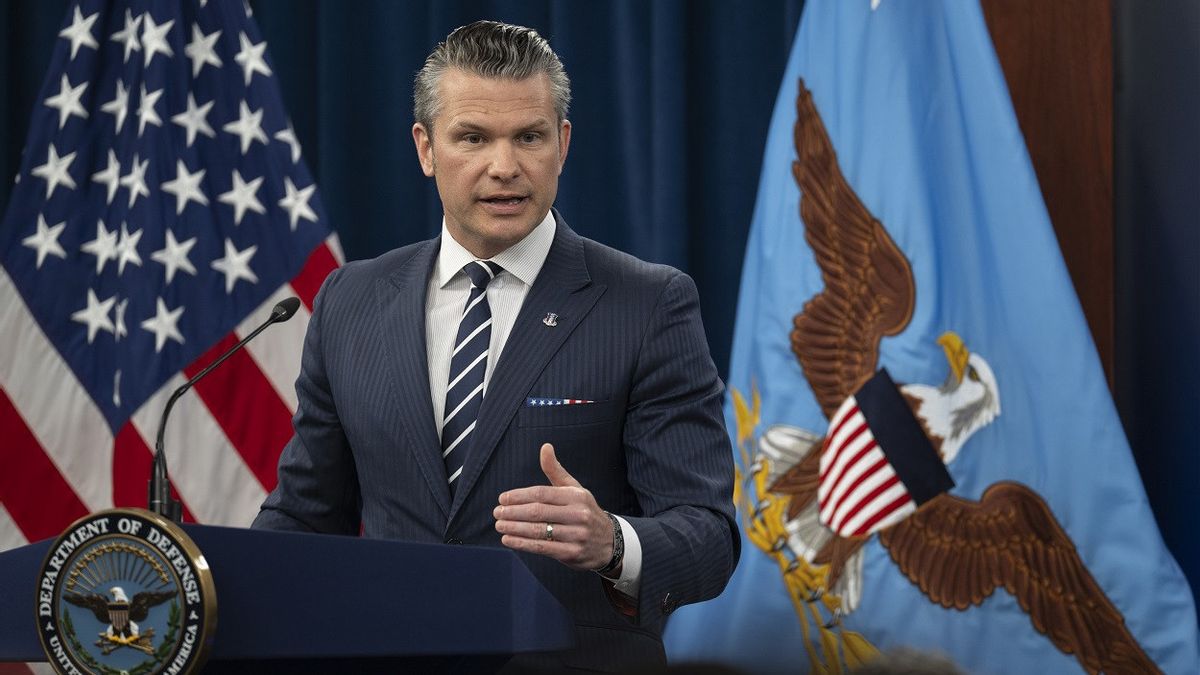


JAKARTA - United States Defense Secretary Pete Hegseth said on Tuesday that the ceasefire with Iran had not ended, even though the two countries were engaged in mutual attacks while vying for control of the Strait of Hormuz.
Pentagon chief Hegseth said the US had secured passage through the vital waterway and that hundreds of merchant vessels were lining up to pass through, as Washington seeks to break Iran's stranglehold on the Strait of Hormuz since the conflict began on February 28.
"We know Iran is embarrassed by this fact. They say they control the strait. They don't," Hegseth said at a Pentagon news conference, launching Al Jazeera from Reuters (5/5).
Previously, the US military said it had sunk six Iranian small boats and intercepted Iranian cruise missiles and drones, after President Donald Trump sent the navy to escort the stranded tanker through the Strait of Hormuz in a new campaign called "Project Freedom."
Several merchant ships in the Gulf reported explosions or fires on Monday, the first day of the operation.
Meanwhile, Joint Chiefs of Staff Chairman General Dan Caine said Iran attacked Oman once on Monday and launched three attacks on the United Arab Emirates, before adding that at least so far, "today is calmer."
General Caine said that since the ceasefire was announced on April 7, Iran had fired on commercial vessels nine times and seized two container ships. Iran has attacked US forces more than 10 times, he added.
However, the attacks were "below the threshold to restart major combat operations at this time," General Caine told reporters.
Asked if the ceasefire with Iran still applied, Defense Minister Hegseth said: "No, the ceasefire has not ended."
"We said we would defend and defend aggressively, and we really have done that. Iran knows that, and ultimately, the president can make a decision on whether something will escalate into a violation of the ceasefire," he said.
The US operation is Trump's latest attempt to force an end to international energy supply disruptions caused by Iran's blockade of the strait, which before the war transported a fifth of global oil and liquefied natural gas.
The US Navy also imposed a maritime blockade on Iran, which prevented ships from heading to Iran or leaving Iranian territory.
Both military operations are aimed at pressuring Iran to reach an agreement to end the conflict on President Trump's terms.
However, Iran has denied this, saying there is no military solution to the crisis, and has threatened to continue fighting for as long as necessary.
The US military said on Monday that two US merchant ships managed to pass through the strait, with the support of a guided missile destroyer of the Navy.
Iran denied the crossing had taken place, although shipping company Maersk said the US-flagged Alliance Fairfax left the Gulf under US military escort on Monday.
General Caine estimated that 22,500 sailors on more than 1,550 commercial vessels trapped in the Gulf, were unable to transit.
"US CENTCOM, along with partner countries, is actively communicating with hundreds of ships, shipping companies, and insurance companies," Hegseth said, referring to the US military's Central Command, which leads operations in the Middle East.
"All these ships from around the world want to get out of the Iranian trap that has trapped them," he said.
The English, Chinese, Japanese, Arabic, and French versions are automatically generated by the AI. So there may still be inaccuracies in translating, please always see Indonesian as our main language. (system supported by DigitalSiber.id)
Most Popular Tags
#Prabowo Subianto #donald trump #Febrie Adriansyah #8791 #giias 2026Popular


