

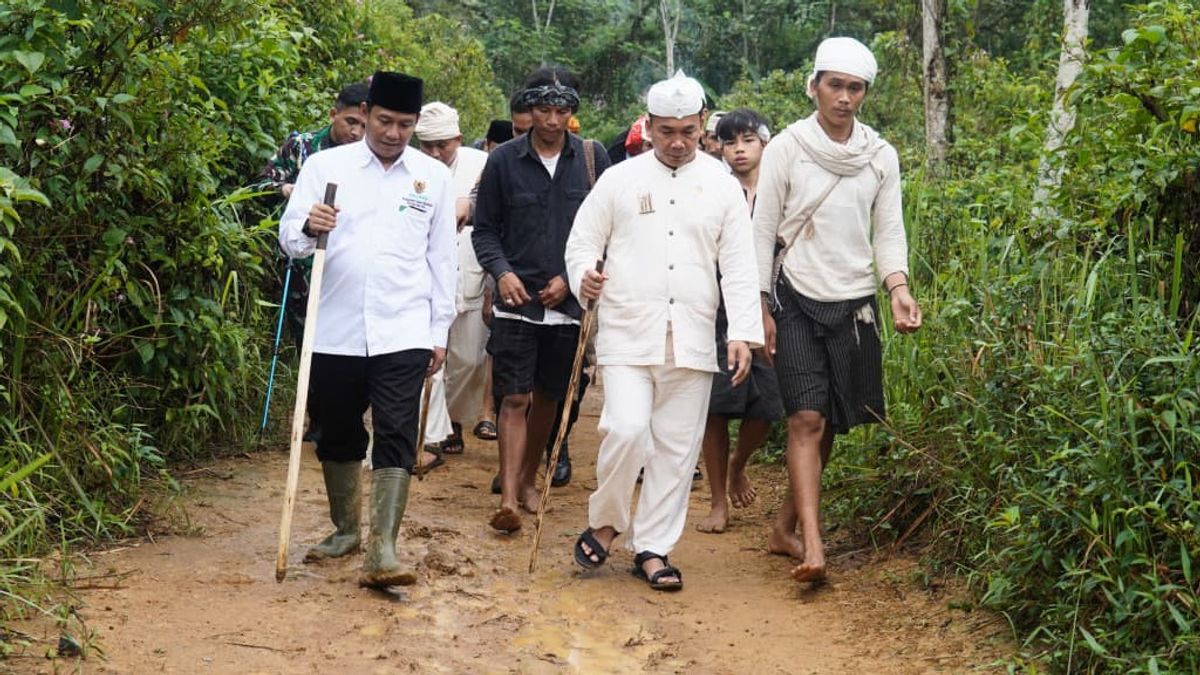


BANTEN - The steps were slow to penetrate the rocky path. There was no sound of the vehicle engine. Only the mountain wind, the sound of the leaves rubbing against each other, and the breath slowly began to get heavy when following the contours of the hills towards Kampung Cikeusik, the territory of the Baduy Dalam tribe.
Around 15.00 WIB, the Minister of Population and Family Development/Head of BKKBN, Dr. Wihaji, S.Ag., M.Pd. started the journey from Baduy Luar to Baduy Dalam. The journey was not just a working visit. It was like a journey to a way of life that goes slower, quieter, but holds many lessons about family, simplicity, and respect for life and nature.
After about thirty minutes of travel, the group's steps stopped for a moment in a simple hut to maintain togetherness. No one was walking too fast, no one was left behind. Sweat began to fall, but the steps continued to move with one big goal: ensuring that the state is present even in the indigenous areas that have long lived away from the hustle and bustle of modern development.
At 17.15 WIB, the entourage finally arrived at Cikeusik Village. There, Minister Wihaji was greeted warmly by the jaro or village head. There were no honorary chairs. There was no rank. Everyone sat equally on the floor of the stilt house, lesehan like their own family.
The State Comes by Way of Listening
Minister Wihaji chose to stay one night in Baduy Dalam, a thing that is rarely done by state officials. The night fell over Cikeusik without electricity and city lights. The lighting only came from damar - a dim hanging vegetable oil lamp.
"We are happy that there is a leader who wants to come and stay here. Usually guests come in the morning and go home in the afternoon, but now they are staying with us," said Mr. Asid or Aki Icali (60), a resident of the Baduy Dalam tribe.
In the middle of the night's silence, the conversation flows warmly accompanied by the aroma of wood smoke from the furnace. This is where the state is present not through a big ceremony, but through the willingness to sit together, listen to stories, and appreciate the life of the indigenous people as it is. The next day, Minister Wihaji met with the pu'un, the highest adat leader, as a symbol that family development cannot be separated from respect for traditions that have been maintained for generations.
The English, Chinese, Japanese, Arabic, and French versions are automatically generated by the AI. So there may still be inaccuracies in translating, please always see Indonesian as our main language. (system supported by DigitalSiber.id)


