

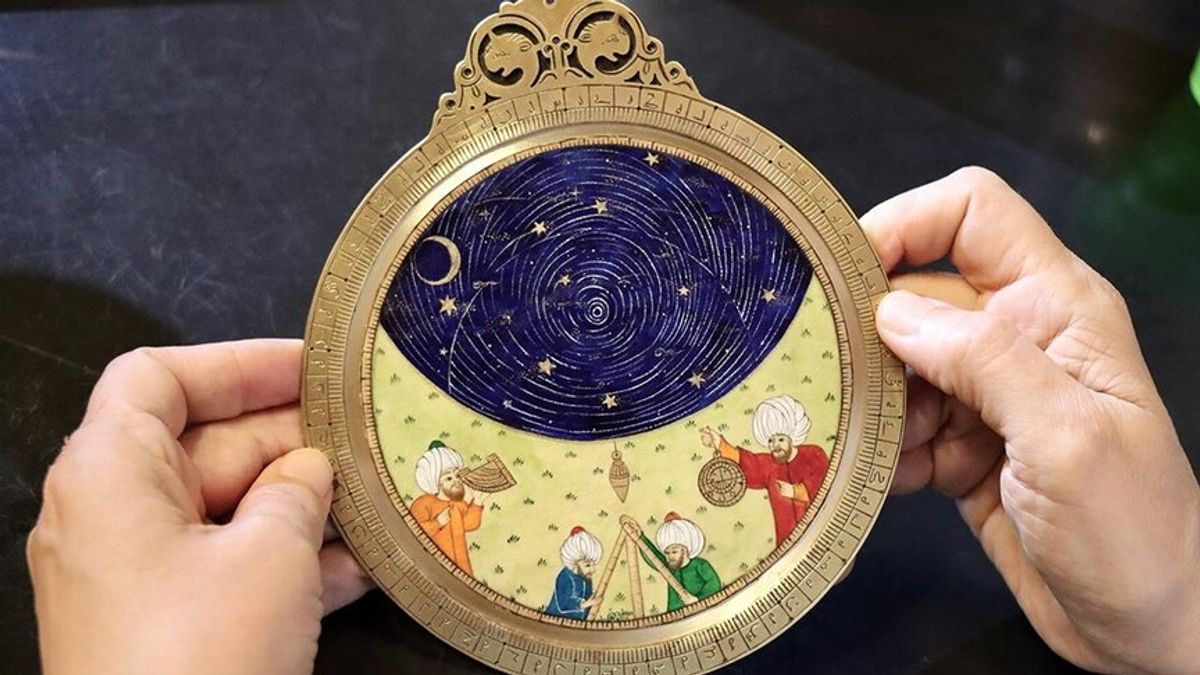


JAKARTA - A rare 17th-century brass astrolabe, once part of the royal collection of Jaipur, India, will be auctioned by Sotheby's in London on April 29. Its value is estimated at 1.5 million to 2.5 million pounds sterling, or around Rp35 billion to Rp58 billion with a rate of around Rp23,300 per pound.
Launching an Anadolu Agency report, Tuesday, April 28, the relic of the Mughal era attracted attention because of its size, complexity, and historical value.
The astrolabe was once in the collection of Sawai Man Singh II, the Maharaja of Jaipur. After he died, the object was inherited by his wife, Maharani Gayatri Devi, before it later entered a private collection.
Astrolab is an ancient astronomical device in the shape of a metal-coated disc. In the past, this tool was used to read the time, map the stars, determine the direction of Mecca, and track the movement of the sky.
This tool was first developed by ancient Greek astronomers around the 2nd century BC. In the 8th century, the astrolabe spread to the Islamic world and flourished in various regions, including Iraq, Iran, North Africa, and al-Andalus in Spain.
"Basically, the astrolabe is a two-dimensional projection of the three-dimensional universe. I compare it to today's smart phone because there are so many things you can do with it," said Dr. Federica Gigante of the Oxford Centre for History of Science, Medicine and Technology to the BBC.
This astrolabe was made in the early 17th century in Lahore, now in Pakistan, by two brothers, Qa'im Muhammad and Muhammad Muqim. At that time, Lahore became an important center for the production of scientific instruments in the Mughal Empire.
The item was ordered by a Mughal official, Aqa Afzal, who served during the time of Emperor Jahangir and Shah Jahan.
According to Benedict Carter, Head of Sotheby's Islamic and Indian Art Department, the astrolabe weighs 8.2 kilograms, has a diameter of almost 30 centimeters, and is about 46 centimeters high. Its size is almost four times that of a typical astrolabe from 17th century India.
This astrolabe contains inscriptions of 94 cities along with their geographical coordinates. There are also many star pointers connected to a complex decorative pattern. The inscription uses Persian and Sanskrit, a strong sign of cross-cultural traces at that time.
The parts are made very precisely so that they can produce accurate astronomical measurements.
"This thing is not just big, beautiful, and heavy. This astrolabe is so accurate that it can give the exact altitude of a celestial body," said Gigante.
The item is on display in London from April 24 until auction day.
The English, Chinese, Japanese, Arabic, and French versions are automatically generated by the AI. So there may still be inaccuracies in translating, please always see Indonesian as our main language. (system supported by DigitalSiber.id)


