

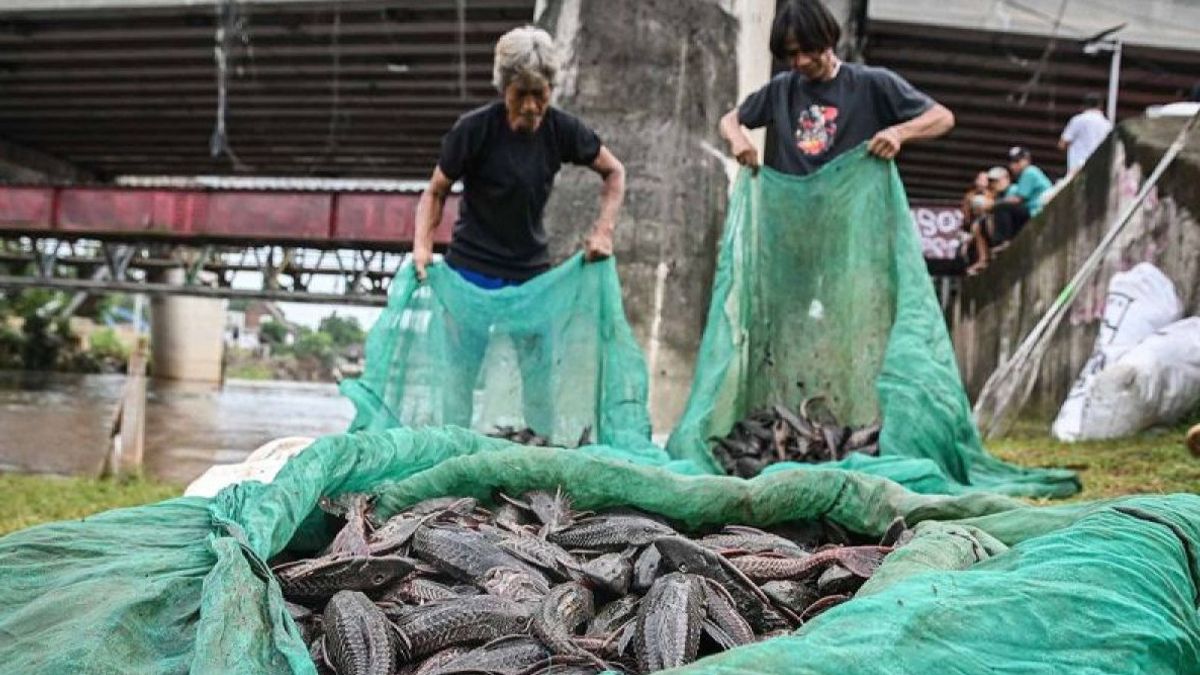


JAKARTA - Researchers from the National Research and Innovation Agency (BRIN), Dr. Haryono Suparjo, emphasized that until now, the mop-mop fish does not have a natural predator in Indonesia that is effective in controlling its population. This condition makes efforts to control this invasive species more focused on direct capture by humans.
"If you talk about natural predators, there are none so far. The structure of the body of the mop fish, which has a hard skin, makes it difficult for other fish to prey on it," said Haryono in an online discussion of Foksi last week.
He explained that the option of bringing predators from outside the risk of causing new problems in the ecosystem. Even local predators such as large fish and crocodiles are not necessarily effective in prey on sapu-sapu fish.
"If we bring in new predators, it could endanger other aspects. Even big fish like toman are not necessarily willing to eat sapu-sapu because of their very hard body structure," he explained.
According to Haryono, this condition makes the biological eradication approach difficult to implement in Indonesia. Therefore, the method recommended today is direct capture, both using tools and manually by the community.
"The recommendation is direct arrest. That is the most likely to suppress the population," he said.
The sapu-sapu fish itself is categorized as an invasive species, namely an invasive fish species that is capable of disrupting the balance of the ecosystem. Haryono said that this fish has a number of invasive characteristics such as high adaptability, rapid reproduction, and wide spread ability.
"This fish can live from low-lying areas to an altitude of 3,000 meters above sea level, from clean waters to polluted waters. Its reproduction is also very high, once laying eggs can produce 500 to 3,000 eggs," he said.
In Indonesia, the paddlefish has spread widely from Sabang to Merauke. Of the approximately 50 species of introduced fish, 18 of them have been categorized as invasive species, including the paddlefish dominated by Pterygoplichthys pardalis.
Furthermore, Haryono emphasized that control efforts must be carried out in a coordinated and sustainable manner. Arrest cannot be done partially, but must include the entire river basin (DAS) from upstream to downstream.
"If it is only done downstream, while upstream is not, then eggs and fry will be carried away by the current and the population will increase again. So it has to be comprehensive, based on the river basin," he said.
In addition, arrests also need to be carried out periodically and intensively, and involve various stakeholders, from the government to the community.
"It must be periodic, not once a year because the population recovers very quickly. And most importantly, all parties must be involved," concluded Haryono.
The English, Chinese, Japanese, Arabic, and French versions are automatically generated by the AI. So there may still be inaccuracies in translating, please always see Indonesian as our main language. (system supported by DigitalSiber.id)


