

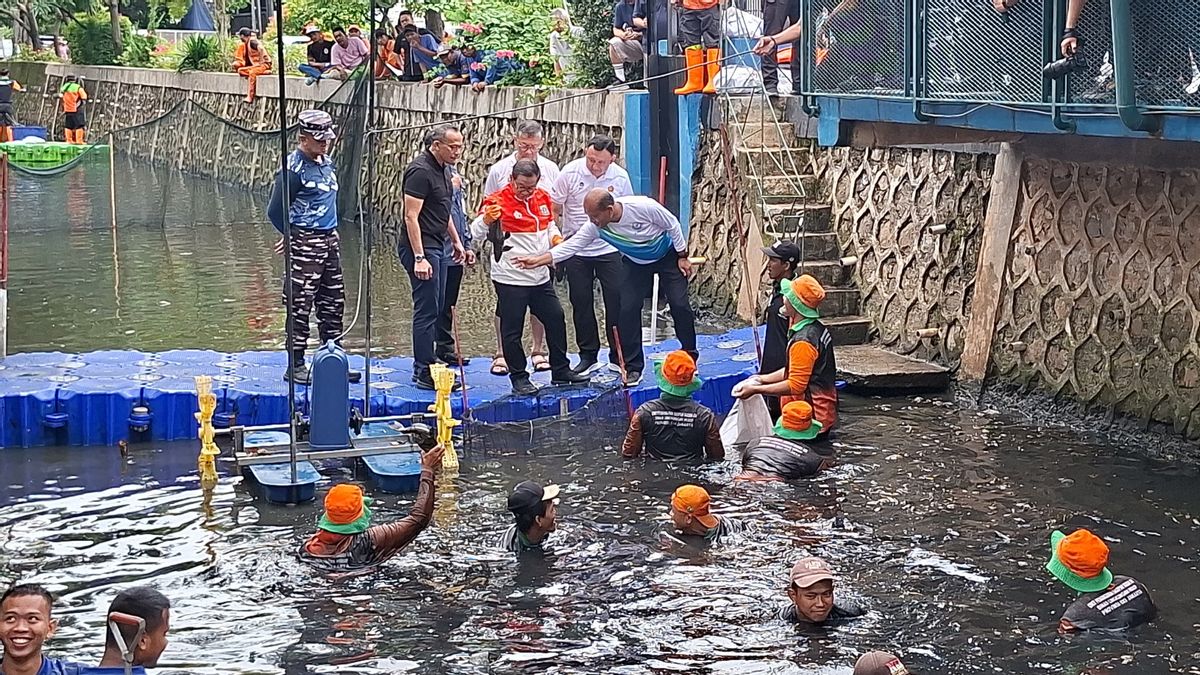


JAKARTA - The DKI Jakarta Provincial Government held a simultaneous sweep fishing arrest in five administrative cities in Jakarta. This activity was carried out to suppress the population of sweep fish which was considered to dominate the capital's waters, as well as cleaning the water channels.
DKI Jakarta Governor Pramono Anung directly led the capture activities in the Kelapa Gading area, North Jakarta. He said the current population of sapu-sapu fish was worrying.
Based on a study by the Ministry of Marine Affairs and Fisheries (KKP), the number of sapu-sapu fish in Jakarta is estimated to have exceeded 60 percent of the total fish population in the waters.
"From the results of the investigation from the KKP, it is estimated that more than 60 percent of the fish are now in Jakarta and all of them may also be in other areas," said Pramono in North Jakarta, Friday, April 17.
Pramono assessed that the presence of these fish threatens the ecosystem. Its invasive nature makes it difficult for local fish to survive because their eggs are eaten.
In addition, the fish is also considered dangerous if consumed. The government found a high enough residue content, namely above 0.3.
"It's very dangerous. If it is then consumed it will be dangerous and if it is left alone it will be damaged because it is always in making the house that he gnaws the walls and so on," said Pramono.
Pramono explained that this arrest movement was carried out to reduce the dominance of sapu-sapu fish, which had become too massive in the rivers and waterways of Jakarta. In the field implementation, the catch even exceeded the initial estimate.
"This place is so black they can survive, they can live and when the arrest was made, we initially estimated that there might be only about 150 kg and last time I saw it, I'm sure it was over 200 kg," explained Pramono.
The fish caught will not be used, but buried to avoid health and environmental risks. He emphasized that this step is an initial effort to restore the balance of the Jakarta water ecosystem, which is currently dominated by sapu-sapu fish.
Meanwhile, the Director General of Aquaculture Fisheries of the Ministry of Agriculture and Cooperatives, Haeru Rahayu, expressed his support for the DKI Provincial Government's steps. According to him, the control of the mop fish population currently does not have an ideal method other than direct capture.
He explained that both biological and chemical approaches still risk creating new problems. Therefore, the conventional method is considered the most effective for now.
"Biologically, we don't have a predator that directly eats it, even if there is one, it will have problems with the environment," he explained.
KKP, continued Haeru, is also preparing a revision of regulations to strengthen the control of sapu-sapu fish. "KKP is currently preparing the software in the form of a Ministerial Regulation, there is already number 19 of 2020 and currently being revised so that it can be more applicable in the context of controlling the sapu-sapu fish population," added Haeru.
The English, Chinese, Japanese, Arabic, and French versions are automatically generated by the AI. So there may still be inaccuracies in translating, please always see Indonesian as our main language. (system supported by DigitalSiber.id)
Popular


