

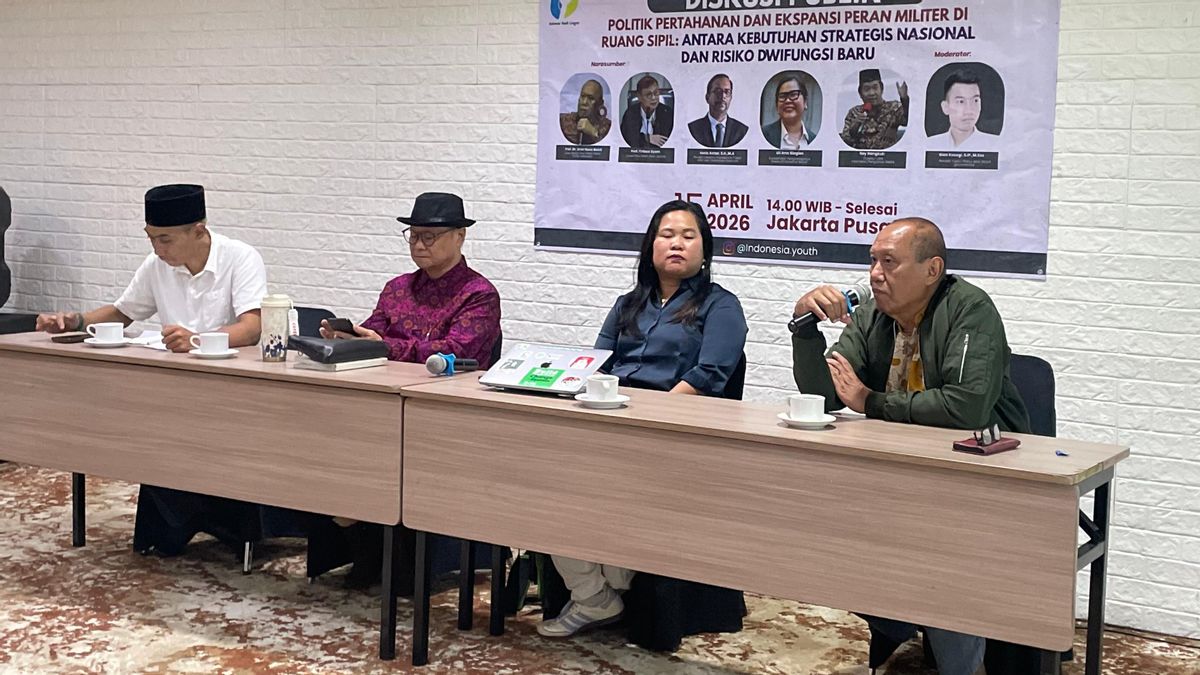


JAKARTA — Professor of Political Science and national political observer Ikrar Nusa Bhakti stated that there is a kind of adage within the Indonesian military: that the military believes it was not formed by the state, but rather that it formed the state.
This was conveyed by Ikrar Nusa Bakti in a discussion held by the Indonesia Youth Congress, entitled 'Defense Policy and the Expansion of the Military's Role in the Civil Space: Between National Strategic Needs and New Dual-Use Risks' in Jakarta on Wednesday, April 15, 2026.
According to Ikrar, if you look at the phenomenon of military expansion in civilian spaces in recent years, this is inseparable from the historical fact where there is competition between the Police and the Army.
"If there is a territorial expansion, then at the same time a Polda and Polres must be formed. Well, the military must also ask, why can the Police? While we don't?" said Ikrar.
He said, this must be seen as one of the historical evidences, where there is an inherent competition between the Police (civilian) and the Army (Military) since they were separated in the history of the Dual Function ABRI.
Meanwhile, Firdaus Syam, an academic of political science at the National University, said that the expansion of the military's role in the civilian sphere, such as handling food, food estates, and territorial additions, was not a necessity for the Indonesian people.
"After the reform, what this nation needs is how welfare, justice, and human rights are expanded. That's what's needed. Not the expansion of the military's role," explained Firdaus.
He emphasized that the political statehood and state management that are needed today are part of the strengthened civil spaces, in order to achieve the supremacy of law and civil supremacy.
"Democratic countries need a strong civil society, not a military that dominates in the civil sphere," said Firdaus.
In addition to Ikrar Nusa Bakti as a Professor of Political Science and Firdaus Syam as a Lecturer of Political Science at the National University of Jakarta, this discussion also featured a number of speakers, namely Ray Rangkuti as Executive Director of LIMA Indonesia; and Haris Azhar as Founder of Lokataru Foundation; and Uli Arta Siagian as Coordinator of the National Walhi Executive Campaign.
Meanwhile, participants who attended this activity were youth and student organizations, researchers, academics, and the general public.
The English, Chinese, Japanese, Arabic, and French versions are automatically generated by the AI. So there may still be inaccuracies in translating, please always see Indonesian as our main language. (system supported by DigitalSiber.id)


