

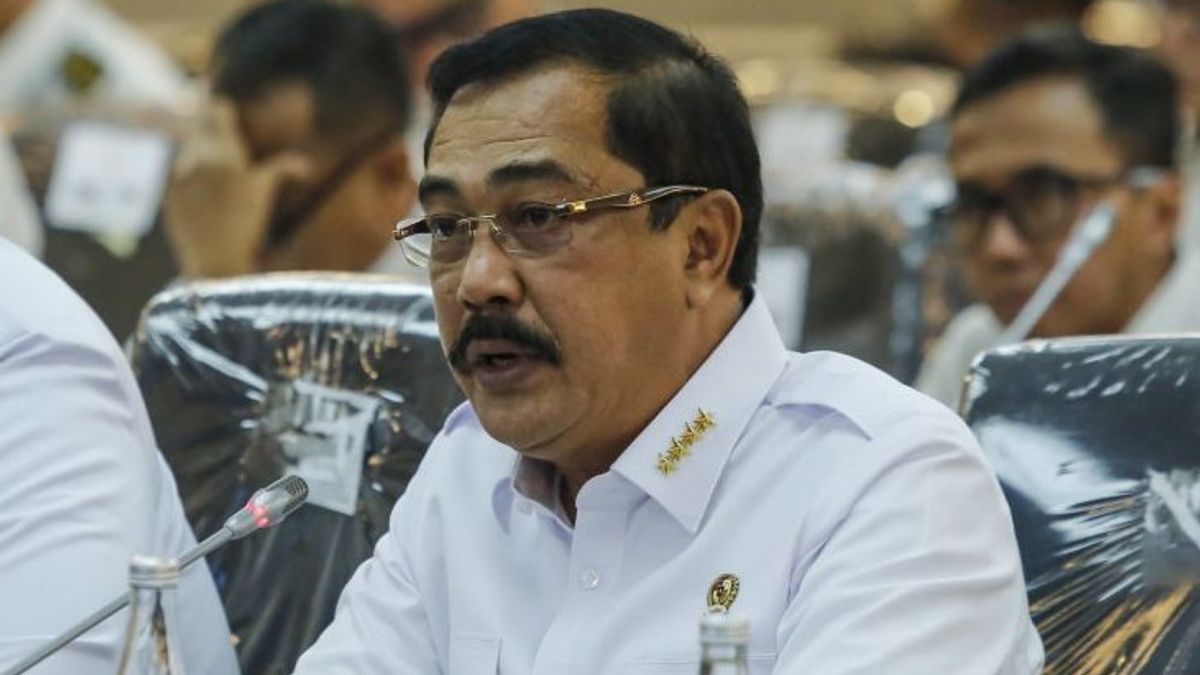


JAKARTA - The Minister of Immigration and Correction (Imipas) Agus Andrianto emphasized his ministry's commitment to eradicating the circulation of narcotics in correctional institutions (lapas) and state detention houses (rutan).
Agus said that various concrete steps were being taken to tighten supervision and close the gap in the circulation of narcotics in prisons and detention centers.
"We are committed to taking action without discrimination. If there are officers who are proven to be involved, strict sanctions will be imposed until the legal process is enforced," said Agus, quoted by Antara, April 10.
The former Head of the National Police's Criminal Investigation Unit explained that concrete steps taken included strengthening the security system based on technology through the installation of integrated surveillance cameras or CCTV as well as increasing the intensity of routine and incidental raids in cooperation with law enforcement agencies such as BNN, Polri, and TNI.
Then, in the internal aspect, he said, the enforcement of discipline and integrity of officers was the main concern. Kemenimipas ensures that any violations committed by individual officers will be dealt with firmly in accordance with applicable laws.
Agus revealed that there were a number of officers who were sentenced to disciplinary action up to the level of severe and dismissal because they were proven to be involved in the circulation of narcotics, even some of the residents of the bandar and high-risk (high risk) were transferred to Nusakambangan Prison.
"The relocation of urban and high-risk detainees has so far touched the figure of 2,284 people," he said.
According to him, the transfer of urban and high-risk inmates to Nusakambangan is not just a transfer. However, Agus continued, there are two goals, namely moving the "root cause" of narcotics in prisons and detention centers, it is hoped that this will clean the prisons and detention centers from drug interaction transactions.
Then, as a repressive and rehabilitative action for the high-risk inmates so that they realize their mistakes and can follow the training program well for when they return to society as independent inmates.
For this reason, he said, the Ministry of Social Affairs continues to strengthen the training program for the residents, including the rehabilitation and personality development program, to prevent re-involvement in drug abuse, in cooperation with relevant parties, both fellow government institutions and non-governmental organizations (NGOs).
Agus also emphasized that the problem of the circulation of narcotics in prisons and detention centers is a complex issue that requires comprehensive and collaborative handling.
He also said that he received input and opened a discussion room so that the handling of the problem of the circulation of narcotics in the prison and detention center could be resolved more optimally.
"We continue to evaluate and improve so that prisons and detention centers really become safe places of education, free from narcotics, and support the process of social reintegration of inmates," he said.
He also appreciated the attention and input given by Commission III of the DPR RI as part of the oversight function of the penitentiary system.
"We view this as a form of mutual concern in strengthening efforts to eradicate narcotics. All forms of narcotics circulation, whether involving inmates or individual officers, are serious violations and we will not tolerate them," said Agus.
The English, Chinese, Japanese, Arabic, and French versions are automatically generated by the AI. So there may still be inaccuracies in translating, please always see Indonesian as our main language. (system supported by DigitalSiber.id)


