
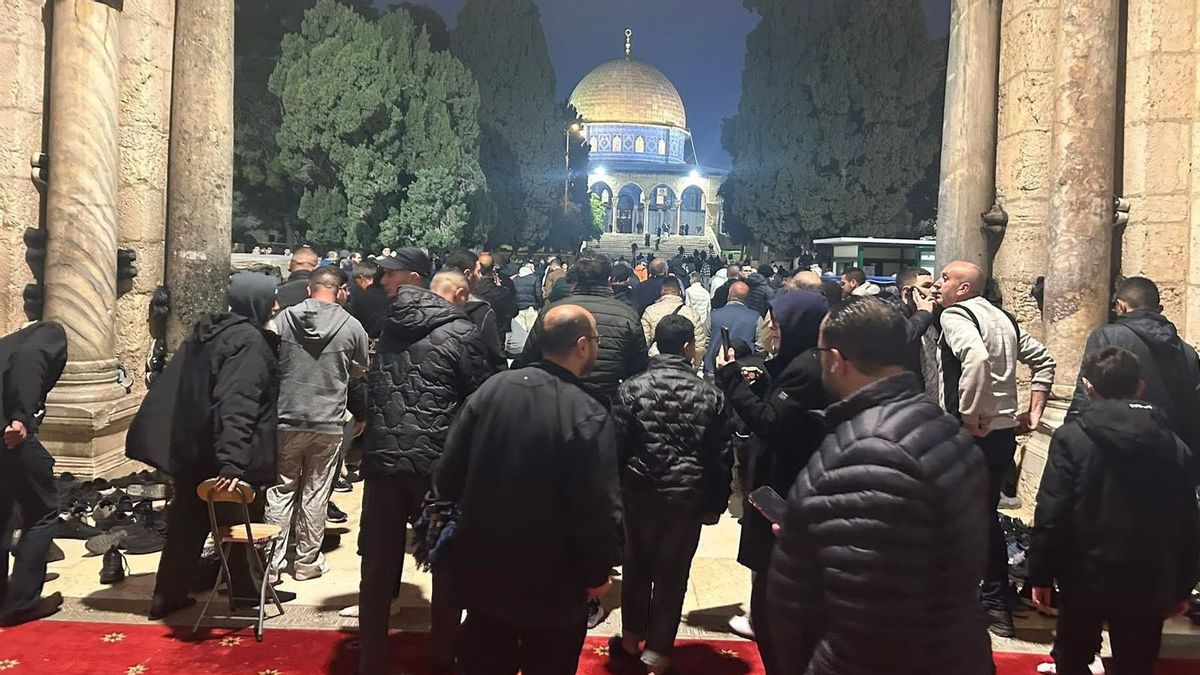


JAKARTA - Thousands of worshipers crowded the Al-Aqsa Mosque to perform the morning prayer on Thursday, after the 40-day closure imposed by Israel ended.
Around 3,000 Palestinian worshipers were able to perform the morning prayer at the Al-Aqsa Mosque Complex, forty days after it was closed by the occupation authorities.
The Jerusalem Provincial Government reported that thousands of worshipers were able to perform the Subuh Prayer at the Al-Aqsa Mosque, despite the strict actions of the occupation, which included identity checks, preventing a number of young people from entering, attacking several worshipers at the gates and trying to expel them from the mosque courtyard, reported from WAFA (9/4).
Meanwhile, Anadolu's correspondent on the ground said that the mosque, located in the Old City, reopened at dawn, allowing hundreds of Palestinian Muslims to enter the Al-Haram al-Sharif Complex.
When the gates opened with the Subuh Azan, a large number of worshipers flocked to the place, many of whom were seen crying and doing prostration of gratitude in the courtyard of the mosque.
Hundreds of Muslims marched for the Subuh Prayer, marking the first congregational worship in the place since its closure.
The provincial government also noted that the occupation police detained Munta Amara, a female activist who regularly prayed at the mosque, at one of the gates of Al-Aqsa, just hours after arresting another young man inside the mosque's courtyard.
The occupation army also attacked a number of young people and forced them to leave the Al-Aqsa Mosque complex, coinciding with the raids by the settlers.
It is known that Israel completely closed access to the Al-Aqsa Mosque on February 28, coinciding with its attack on Iran, only allowing mosque staff and officials from the Jerusalem Islamic Waqf to pray at the site, while other Palestinians were forced to worship in small mosques throughout the city.
Authorities also prevented the performance of Eid prayers at Al-Aqsa this year, marking the first restrictions since Israel's occupation of East Jerusalem in 1967.
In addition, Israel also closed the Church of the Holy Sepulchre, one of the holiest sites for Christians in Jerusalem, during the same period.
Israel itself extended the state of emergency until mid-April, but did not explain whether the mosque would remain closed during that period.
The English, Chinese, Japanese, Arabic, and French versions are automatically generated by the AI. So there may still be inaccuracies in translating, please always see Indonesian as our main language. (system supported by DigitalSiber.id)


