

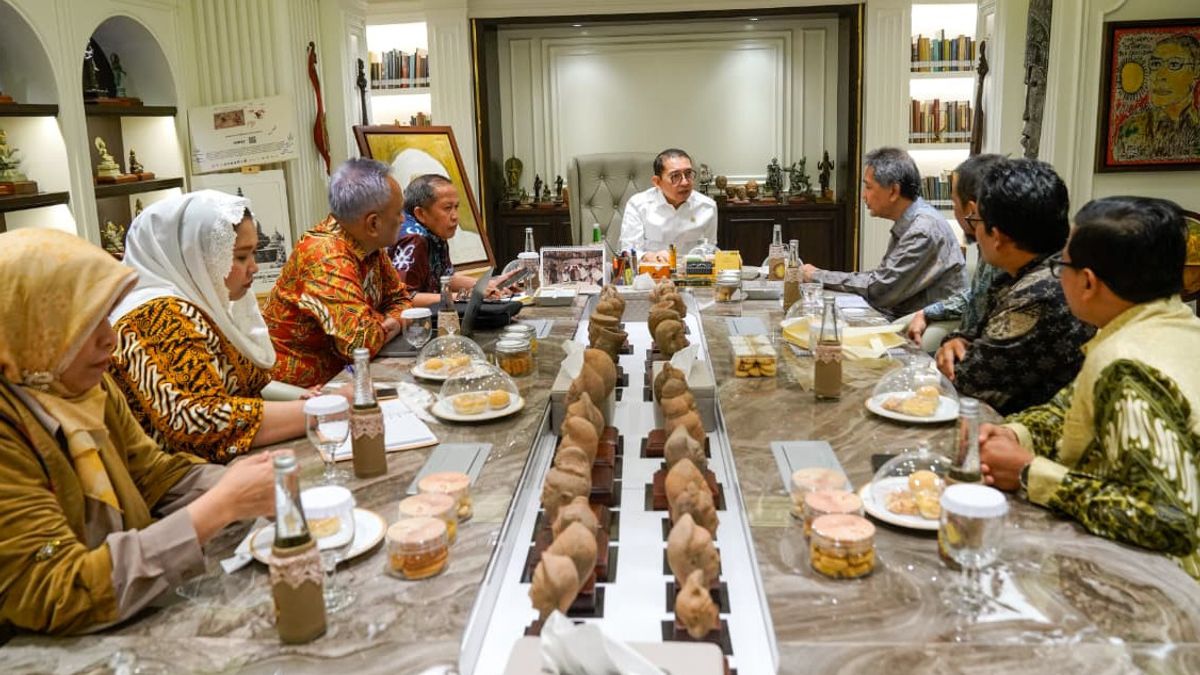


JAKARTA - The government has started to pave the way for pesantren not only to be seen as religious education institutions, but also as part of Indonesia's cultural heritage. This emerged in a meeting between Minister of Culture Fadli Zon and Rector of Darussalam Gontor University, Prof. Hamid Zarkasyi, at the Ministry of Culture Office, Senayan, Jakarta, Wednesday, April 8.
In the meeting, there were two things that were the focus, namely the plan to activate the Gontor Pesantren Museum and the proposal for pesantren to be included as an Indonesian Intangible Cultural Heritage. From the agenda, it can be seen that there is an effort to make pesantren not only a center for Islamic education, but also part of the cultural footprint that lives in the community.
Fadli said that the activation of pesantren museums could not be done as it was. According to the Minister, the museum must be built with a clear concept, ranging from architecture, display layout, lighting layout, to historical narratives supported by in-depth research. He cited the Rahmah El Yunusiyah Museum in Padang Panjang as a reference for an Islamic-themed museum that is simple, but still strong in terms of story.
"An example of an Islamic-themed museum, namely the Rahmah El Yunusiyah Museum in Padang Panjang, where the museum is the original home of Rahmah El Yunusiyah herself. Although simple, all of this can be made into an interesting museum," said Fadli.
He assessed that the Gontor Museum could serve as an example for other pesantren to build similar museums that record the history of Islamic education. Fadli also mentioned that the open museum model can be developed by utilizing existing buildings or landscapes, such as temples, caves, and rice fields.
Furthermore, Fadli said that the practice of studying religion in pesantren as a cultural expression that could be proposed as a cultural heritage. However, this step, said the Minister, requires cooperation between the central and regional governments, as well as adequate research on local peculiarities in each region.
"Pesantren must become an intangible cultural heritage of Indonesia, because it is included in good practices. We can also encourage pesantren to become a UNESCO world cultural heritage through proposals, because pesantren is a cultural expression and civilization that has its own characteristics," he said.
Hamid emphasized that Gontor showed that Islamic education has long been integrated into the Indonesian social landscape. "Education at Gontor has been around for 100 years, and we also hold many events that have an artistic feel, such as music festivals, films, and calligraphy," said Hamid.
The English, Chinese, Japanese, Arabic, and French versions are automatically generated by the AI. So there may still be inaccuracies in translating, please always see Indonesian as our main language. (system supported by DigitalSiber.id)


