

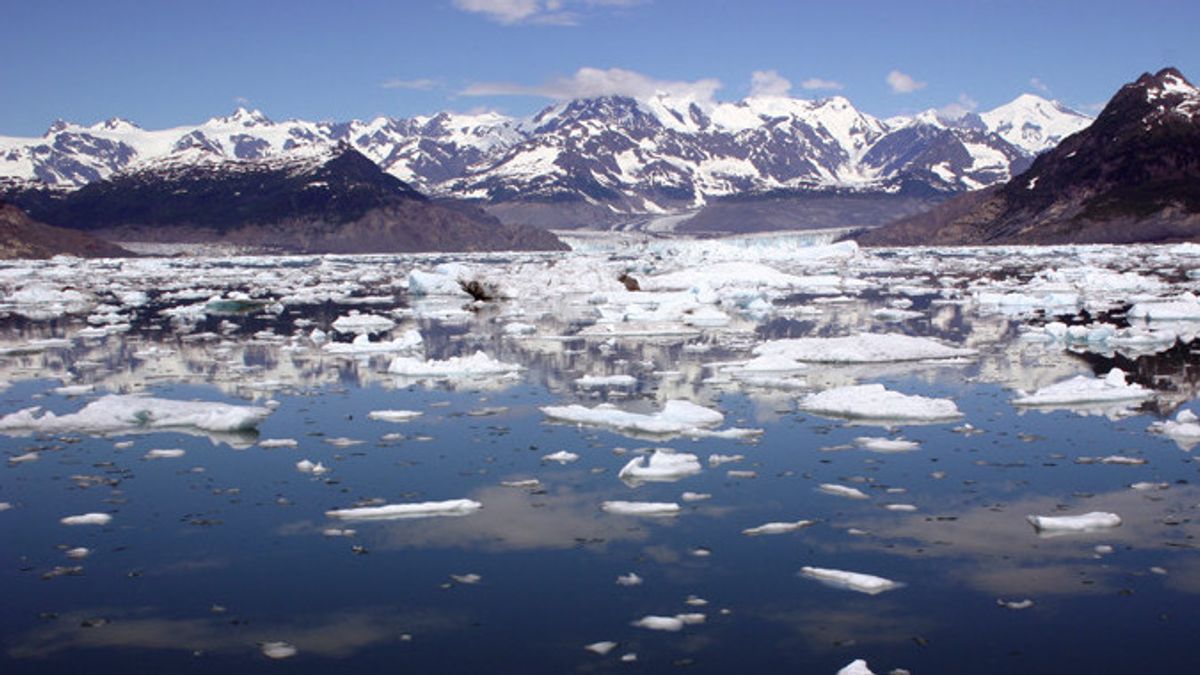


JAKARTA - The Arctic sea ice has shrunk back to the lowest winter level ever recorded, at a time when the Earth is hit by record heat in many regions. Launching NBC News which contains a report from The Associated Press, this condition appears when the ice in the Arctic should still increase, not stop at the lowest point.
The National Snow and Ice Data Center recorded the peak of the Arctic sea ice this season only reached 14.29 million square kilometers. The figure was slightly below last year's 14.31 million square kilometers. However, the agency assessed that the difference between the two was very thin, so it was considered a draw as the lowest winter level.
This year's sea ice extent is also about 1.36 million square kilometers below the average winter peak of 1981-2010. That's roughly twice the size of Texas.
This record was announced when March temperatures broke in a number of US states, almost all of Mexico, Australia, North Africa, and parts of Northern Europe. Climatologist Maximiliano Herrera, as reported on Thursday, April 2 from NBC News which contains a report from The Associated Press, called the extreme heat of March this time as the most extreme heat event in the world's climate history so far.
In the United States, 16 states broke March temperature records in the past week or so. A total of 27 locations recorded temperatures equal to or exceeding the hottest April day ever recorded. In Mexico, thousands of temperature records were broken. According to Herrera, Asia is even more extreme, with tens of thousands of monthly records broken by a difference of about 17 to 19 degrees Celsius.
However, at the beginning of the same week, Antarctica recorded the coldest March day on Earth, namely minus 76.4 degrees Celsius.
From the same reference, the center's senior scientist, Walt Meier, said the ongoing warming, especially in the polar regions, made the chances of ice formation smaller. According to him, this is not a sudden change, but a continuous decrease in winter and at its maximum point.
The condition of the Arctic sea ice is very important for the Earth's climate, especially during the summer. Without an ice layer that reflects sunlight, the ocean will absorb more heat. Meier assessed that the melting season in the summer would be the most decisive phase because as the white ice layer becomes less, the heat absorbed by the ocean will be greater.
Even so, the low winter peak in March does not automatically mean that the summer will set a new minimum record. According to Meier, the growth of ice in winter is indeed more easily changed due to weather factors.
In the southern hemisphere, Antarctic sea ice reached its annual low point in February. Although still below the 30-year average, the condition is not as close as the last three years which recorded the lowest record.
The English, Chinese, Japanese, Arabic, and French versions are automatically generated by the AI. So there may still be inaccuracies in translating, please always see Indonesian as our main language. (system supported by DigitalSiber.id)
Popular


