

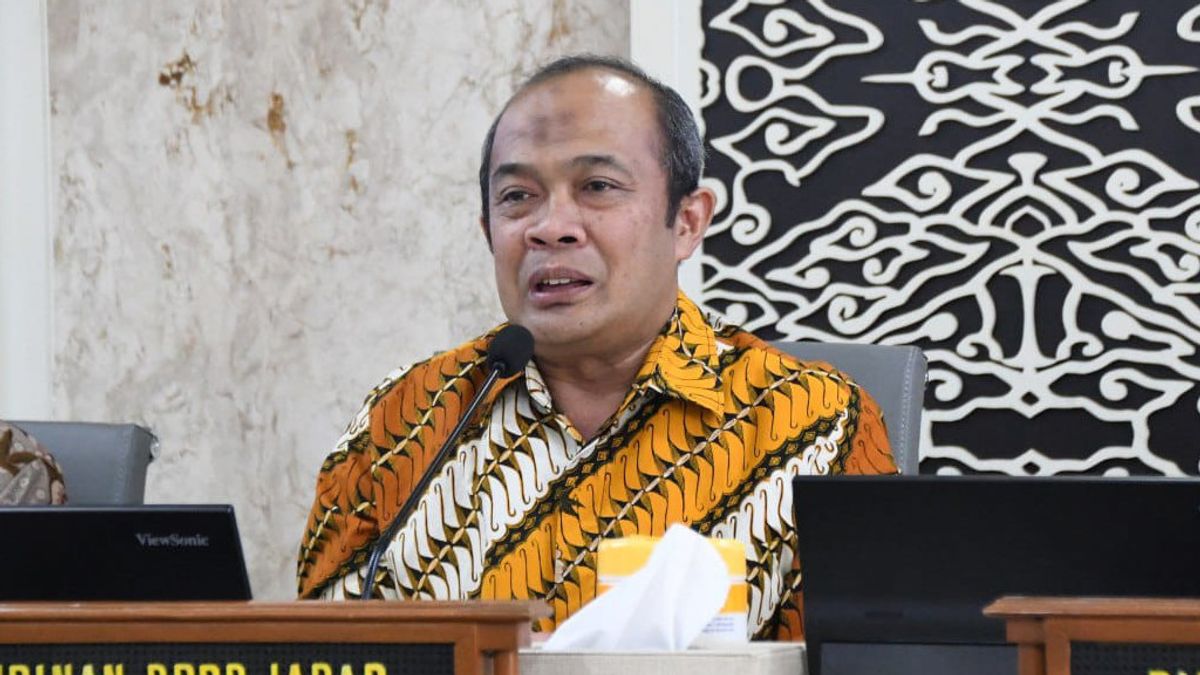


BANDUNG - Deputy Chairman of the West Java Provincial DPRD, Iwan Suryawan, expressed his support for the central government's strategic steps in carrying out national efficiency in the midst of global dynamics. However, he made a special note that the education sector must be maintained face to face by optimizing the use of renewable energy in the school environment.
Iwan assessed that the spirit of efficiency carried by the government was a wise move. Even so, he hopes that the education sector will be exempted from the Distance Learning (PJJ) scenario that was discussed as an option for reducing mobility to reduce national energy consumption by April 2026.
"We fully understand and support the central government's efforts to save energy and budget. This is a visionary step to maintain the stability of our national economy," said Iwan Suryawan in Bandung, Wednesday, April 1.
This senior politician underlined that efficiency in the education sector does not have to be done by sending students home. According to him, schools in West Java can actually be pioneers in energy savings through the implementation of environmentally friendly technologies that are independent, such as accelerating the installation of Rooftop Solar Power Plants (PLTS) in all SMA and SMK buildings.
This step is considered much more effective in reducing the country's electricity operating costs than imposing PJJ, which risks lowering the quality of students' social interactions. Iwan said that installing solar panels on school roofs was technically able to cut the operational electricity load by more than 30 percent.
"Direct interaction between teachers and students is an irreplaceable element. The essence of education is a human touch. We are concerned that if efficiency is carried out through PJJ, the results obtained materially are not commensurate with the risk of reducing the quality of our children's characters," he explained.
Apart from solar energy, Iwan also touched on the potential of Micro Hydro Power Plant (PLTMH) for schools in remote areas of West Java. The utilization of local river flows is believed to ensure the availability of electricity without relying entirely on the conventional network.
Based on data from the West Java Education Office, there are around 27,600 educational units throughout the province. Iwan assessed that this large number is an asset that, if managed with the concept of green building, will have a massive efficiency impact nationally without having to close classrooms.
Responding to the study of the central government through the Coordinating Minister for Maritime Affairs and Fisheries Pratikno regarding the flexible PJJ option, Iwan appreciated the government's openness in listening to regional aspirations. He proposed that the efficiency budget be transferred to the procurement of Renewable Energy Laboratories which also serve as a source of electricity for schools.
The West Java DPRD is committed to continuing to monitor this policy so that the central government continues to allow in-person learning. Iwan emphasized that transforming schools into energy-efficient institutions is a smarter long-term solution.
"We want this efficiency to run successfully without creating new inequalities. Schools remain open, but with much smarter and more independent energy management," concluded Iwan.
The English, Chinese, Japanese, Arabic, and French versions are automatically generated by the AI. So there may still be inaccuracies in translating, please always see Indonesian as our main language. (system supported by DigitalSiber.id)
Most Popular Tags
#Prabowo Subianto #donald trump #firearm #8791 #giias 2026Popular


