
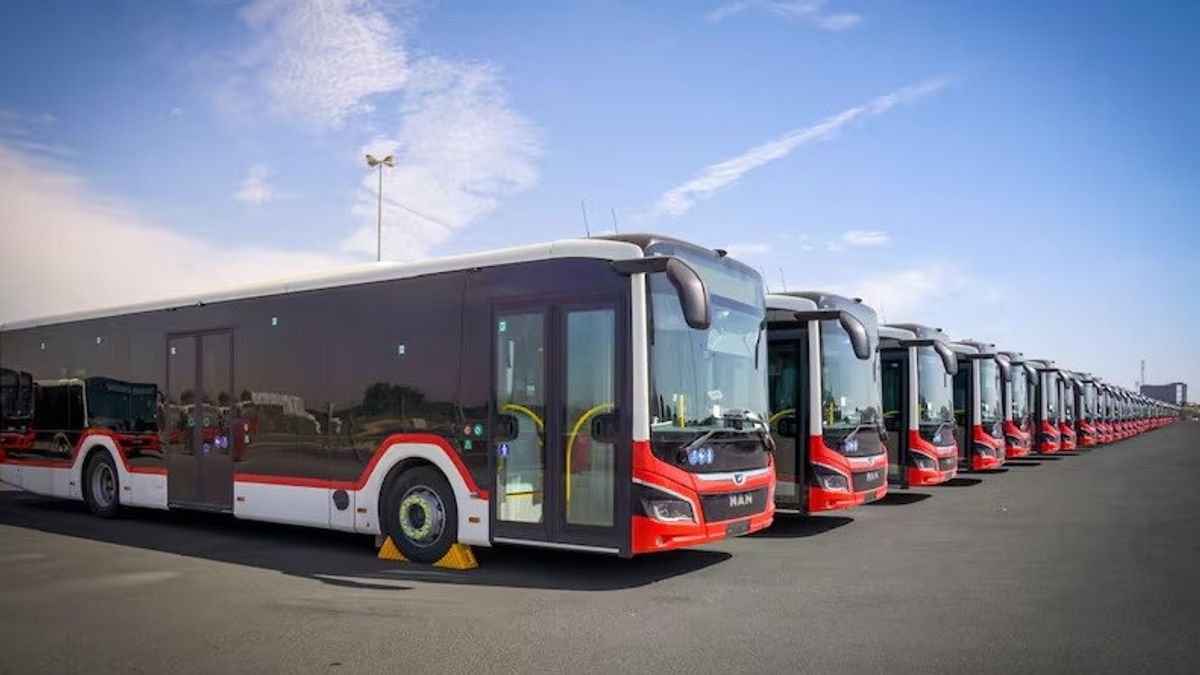


Dubai - The Roads and Transport Authority (RTA) of Dubai, United Arab Emirates (UAE) in January announced the arrival of the first wave of their new buses, including 40 electric vehicles.
RTA Director General Mattar Al Tayer said the goal is to achieve climate neutrality in the emirate by 2050.
The authority announced the arrival of 250 buses, based on a contract for the procurement of 735 multi-sized buses that comply with European low-carbon emission standards.
"In the near future, there will be a gradual increase in the number of electric buses, in line with national directives to reduce carbon footprints," Al Tayer explained, as reported by The National (15/3).
"Our goal is to convert all buses, taxis, and limousine vehicles to emission-free operations," he continued.
"Under the public transport emissions-free strategy, the authority is seeking to achieve a 100 percent transition of public transport buses to electricity and hydrogen by 2050 to support Dubai's D33 Economic Agenda, which aims to strengthen Dubai's position as one of the largest urban economies in the world," he said.
Al Tayer inspected a Zhongtong electric bus, the first of its kind operating on a Dubai urban route.
The bus is designed specifically for Dubai's operational conditions, with a range of up to 280 km on a single charge, allowing the bus to complete daily services without having to return to the depot for recharging.
The 434 kilowatt-hour battery capacity is supported by an ABB charger with 360 kilowatt power.
The 12-meter-long bus can accommodate 70 passengers and is equipped with a 360-degree camera system.
The vehicle was tested in Dubai for more than three months, where the inspection and operational test phases provided positive results in the stability of the electric drive system and energy consumption efficiency, as well as the safety of key systems such as batteries, cooling, and braking.
These buses are equipped with driver behavior monitors that track and improve driver performance through innovative technology designed to raise safety standards.
These buses are also equipped with an automatic passenger counting system, which records the actual number of passengers compared to the existing data.
An automatic tariff collection system to help reduce tariff evasion, as well as a driver identity authentication system integrated with the operating platform.
In addition, these buses have comfortable seats, high safety standards, and adjustable seat belts in a family-specific area to accommodate all age groups.
The design features a low-floor entrance to provide access for people with disabilities, special seating for children, space for bicycles, Wi-Fi service and mobile phone charging stations.
The English, Chinese, Japanese, Arabic, and French versions are automatically generated by the AI. So there may still be inaccuracies in translating, please always see Indonesian as our main language. (system supported by DigitalSiber.id)
Most Popular Tags
#Prabowo Subianto #donald trump #firearm #8791 #giias 2026Popular


