

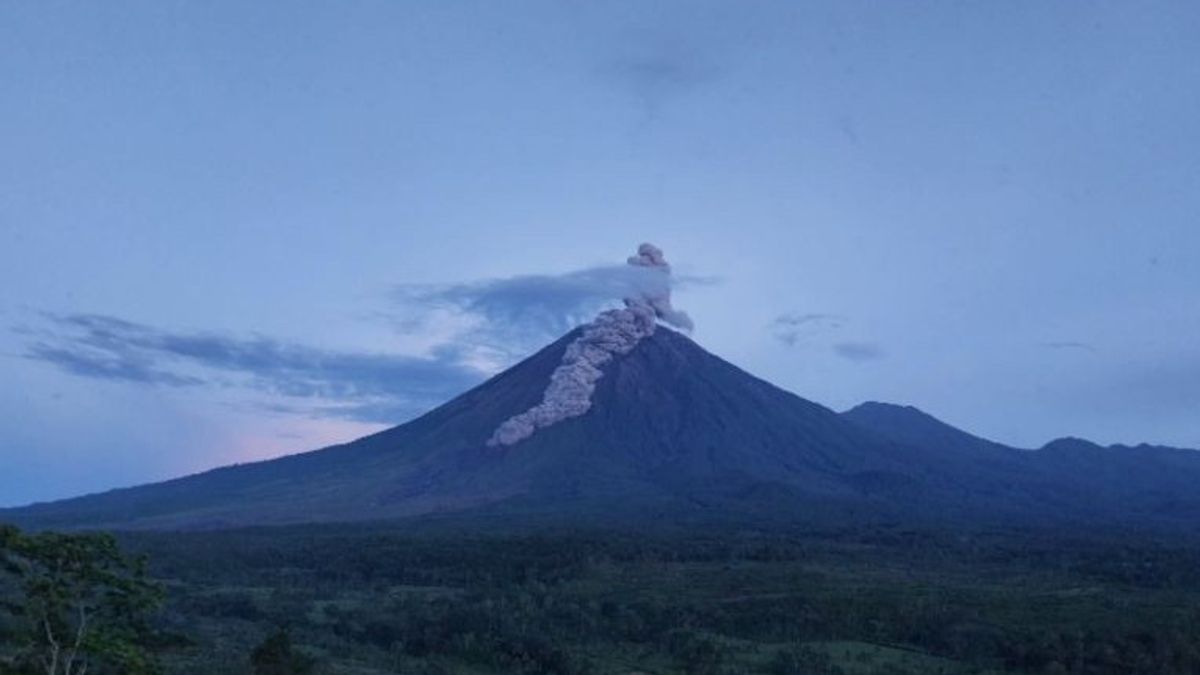


JAKARTA - Mount Semeru, which is on the border of Lumajang and Malang Regencies, East Java, has erupted twice with an eruption height of up to 1,000 meters above the peak.
"Mount Semeru erupted at 05.26 WIB with an observed eruption column height of about 1,000 meters above the peak or 4,676 meters above sea level (msl)," said the Mount Semeru Observation Post Officer, Mukijo, as reported by ANTARA, Friday, March 20.
According to him, the observed ash column was gray with a thick intensity towards the northeast. When the report was made, the eruption was still ongoing.
Then, the highest mountain on Java Island erupted again at 06.40 WIB with an observed eruption column height of about 500 meters above the peak or 4,176 meters above sea level.
"The observed ash column is white to gray with a thick intensity towards the north. The eruption was recorded on the seismograph with a maximum amplitude of 22 mm and a duration of 129 seconds," he said.
Mount Semeru is in Level III (Alert) volcanic activity status, so the Center for Volcanology and Geological Hazard Mitigation (PVMBG) has provided a number of recommendations, namely that the public should not carry out any activities in the southeast sector along Besuk Kobokan, as far as 13 kilometers from the peak (center of the eruption).
Outside this distance, he said, people should not carry out activities at a distance of 500 meters from the river bank (river border) along Besuk Kobokan, because they have the potential to be hit by the expansion of the hot cloud and lava flow up to a distance of 17 kilometers from the peak.
"The public is also prohibited from carrying out activities within a radius of five kilometers from the crater/peak of Mount Semeru, because they are prone to the danger of stone throwing (pijar)," he said.
The public needs to be aware of the potential for hot clouds, lava ejection, and lahar along the river/valley streams upstream of the summit of Mount Semeru.
"Especially, along Besuk Kobokan, Besuk Bang, Besuk Kembar, and Besuk Sat, as well as the potential for lahar in small rivers which are tributaries of Besuk Kobokan," he said.
The English, Chinese, Japanese, Arabic, and French versions are automatically generated by the AI. So there may still be inaccuracies in translating, please always see Indonesian as our main language. (system supported by DigitalSiber.id)


