

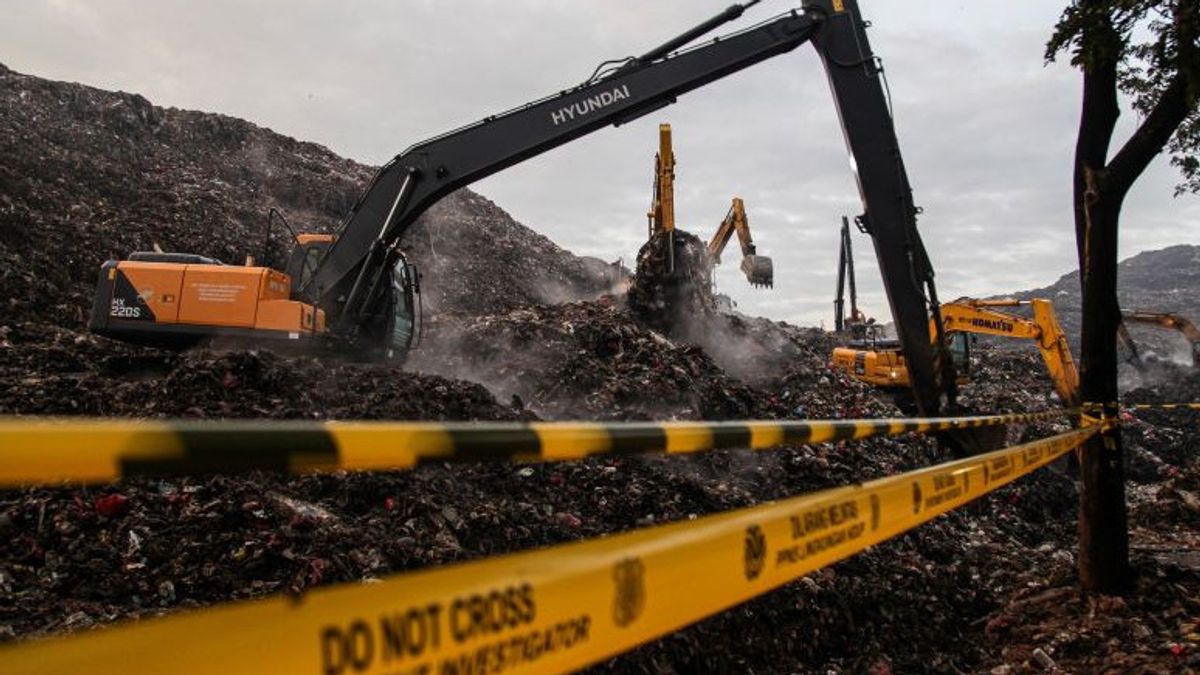


JAKARTA - The DKI Jakarta Provincial Government targets that the waste management operations at the Bantargebang TPST can return to normal within a week after a landslide occurred in the waste pile area.
Head of the DKI Jakarta Environment Service Asep Kuswanto said that currently the team in the field is still focusing on handling the landslide material and rearranging the affected area in Zone 4A.
"We target that waste management in TPST Bantargebang can return to normal within a week. Currently, the team in the field is handling the landslide material in the river flow around the incident location," Asep said in his statement, Tuesday, March 10.
The landslide material in the river will be moved to the storage area in Small Zone 4 and Large Zone 4. The rearrangement of the zone is also carried out to ensure that the area is safer and more organized.
The DKI DLH targets that the river flow around the location can return to normal so that it no longer causes water overflow to the road in the area.
In addition, the repair of the kali canal will also be carried out at two points affected by water overflow. This step is taken to ensure that infrastructure around the location remains safe and to prevent further disruption.
On the operational side, maintenance and repair of the waste accumulation zone is still being carried out to minimize the risk of landslides. This work is focused on the Head Bird Zone 3 and the Big Zone 4.
Even though the recovery process is still ongoing, Jakarta's waste disposal services continue to run through three active zones, namely Zone 1, Zone 2, and Zone 5 with a capacity of around 4,000 tons per day.
If the rectification in the 4 Big Zone that had collapsed is completed, the zone will be operated again with an additional service capacity of around 1,500 tons of waste per day.
To maintain the stability of waste management during the recovery period, some of the waste is also diverted to a number of other processing facilities, such as the Bantargebang RDF Plant, the Merah Putih PLTSa, and the Rorotan RDF Plant.
RDF Plant Bantargebang has a processing capacity of around 800 tons of waste per day, while the PLTSa Merah Putih has a capacity of around 100 tons per day.
Asep explained that the RDF Plant Rorotan began to be operated as a quick step to maintain the waste management service.
"Today the RDF Plant Rorotan has started to operate with an initial capacity of around 300 tons per day. This capacity will be gradually increased to reach 750 tons per day this week, then increased again to 1,000 tons per day," explained Asep.
With the diversion scheme, the total waste that can be handled is estimated to reach around 6,700 to 7,150 tons per day until the end of this week.
"With various handling steps that are being carried out, we hope that the waste management operations at TPST Bantargebang can return to normal within a week," said Asep.
The English, Chinese, Japanese, Arabic, and French versions are automatically generated by the AI. So there may still be inaccuracies in translating, please always see Indonesian as our main language. (system supported by DigitalSiber.id)
Most Popular Tags
#Prabowo Subianto #donald trump #2026 World Cup #venezuela #konflik timur tengahPopular


