

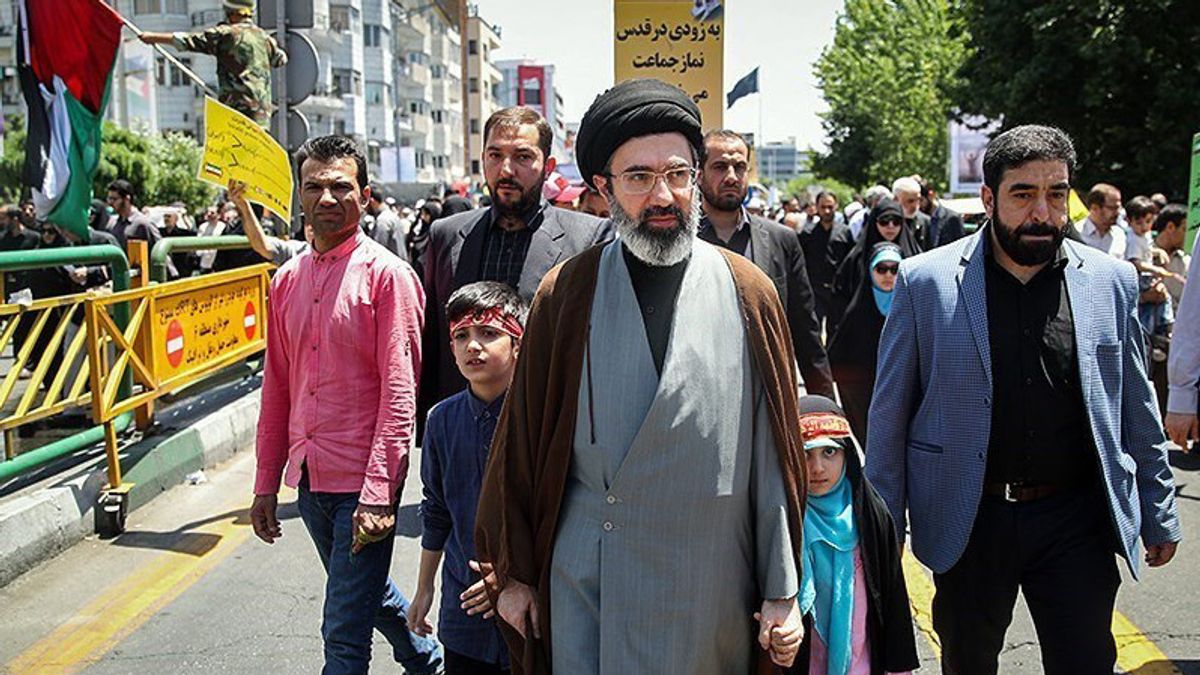


JAKARTA - Mojtaba Khamenei, a cleric who has long been seen as the most influential figure but rarely seen in Iran's political structure, was appointed as Iran's new supreme leader after his father was killed in a recent US and Israeli airstrike.
The 56-year-old cleric was chosen by the Iranian Assembly of Experts, an 88-member body that according to the Constitution is responsible for appointing the country's highest political and religious authorities.
His election followed a prescribed constitutional procedure, not through a hereditary succession, although his family background and his closeness to the late Ayatollah Ali Khamenei have long placed him at the center of speculation about the leadership succession.
With the appointment, Mojtaba becomes Iran's third highest leader since the 1979 Revolution and takes over leadership at a time when regional conflicts are heating up and domestic uncertainty is increasing.
Early life and family background
Mojtaba was born on September 8, 1969 in the city of Mashhad, northeast Iran, which is one of the main religious centers in the country.
He is the second son of the late Ayatollah Ali Khamenei, who has led Iran as supreme leader since 1989 until his death in a US and Israeli air raid more than a week ago.
Mojtaba is also the grandson of the cleric Sayyed Javad Khamenei.
Growing up in a politically dynamic environment, Mojtaba witnessed his father's rise to prominence in the Iranian Revolution and later as the country's president before serving as supreme leader.
Mojtaba is married to Zahra Haddad-Adel, daughter of Gholam-Ali Haddad-Adel, a prominent conservative politician and former speaker of parliament who currently heads one of Iran's main cultural institutions.
Zahra was among those killed in the US and Israeli attacks targeting Khamenei's family residence in the capital Tehran.
Mojtaba survived the attack, but also lost his mother, sister, brother-in-law, and nephews.
Education and training of clergy
Like many figures in the Iranian clerical establishment, Mojtaba received his religious education in the city of Qom, the main center of Shiite theological learning in the country and the site of various schools for Iranian clerics.
He studied Islamic jurisprudence and theology under the guidance of a number of prominent conservative scholars, including Ayatollah Mahmoud Hashemi Shahroudi, Ayatollah Lotfollah Safi Golpaygani, and Mohammad-Taqi Mesbah-Yazdi, an influential ideologue who guided many conservative political figures in Iran.
According to Iranian analysts, Mojtaba spent most of his career teaching at Qom's seminary for would-be clerics, including teaching advanced fiqh classes known as dars-e kharej, which are considered the highest level of education in similar educational institutions.
A number of recent reports say Mojtaba had suspended some of his classes for personal reasons, although this could not be independently confirmed.
Although he has been in the environment of ulama for a long time, Mojtaba has never held an official position in the government or served in an executive position or a position elected through general elections.
Role and influence
International media often portray Khamenei as a closed figure with possible behind-the-scenes influence.
The lack of public appearances reinforces this image, as there are almost no long public speeches, interviews, or political manifestos that explain in detail his views.
Mojtaba's name periodically appears in political discussions in Iran, usually related to presidential elections or speculation about which candidate he might support.
However, Mojtaba himself rarely gets directly involved in political debates in the public sphere. His appearances are mostly limited to official ceremonies, national commemorations, and religious gatherings covered by Iranian state media.
The last time he was seen in public was at a pro-government rally after a wave of widespread protests earlier this year.
According to reports in Iran, he also took part in the Iran-Iraq War in the late 1980s when his father was president.
Mojtaba reportedly joined a volunteer unit when he was young, which was his first experience in military affairs.
A number of Western media also linked him to the Islamic Revolutionary Guard Corps, one of the most influential institutions in Iran, although he does not hold an official role in the organization.
Succession amid threats
Mojtaba Khamenei took over Iran's leadership at one of the most turbulent moments in Iran's modern history.
This transition process is also carried out in the midst of direct threats from Israel, whose leaders have vowed to kill any Iranian leader chosen to replace Khamenei.
"Any leader chosen by the Iranian regime to continue the plan to destroy Israel, threaten the United States, the free world and countries in the region, and oppress the Iranian people will be a definite target to be killed, whatever his name is and wherever he is hiding," said Israeli Defense Chief Israel Katz via the X social media platform.
The threat underscores the immense pressure enveloping Iran's leadership succession process and places Mojtaba at the center of a geopolitical confrontation that extends beyond the country's borders.
Source: Anadolu
The English, Chinese, Japanese, Arabic, and French versions are automatically generated by the AI. So there may still be inaccuracies in translating, please always see Indonesian as our main language. (system supported by DigitalSiber.id)
Most Popular Tags
#Prabowo Subianto #donald trump #Febrie Adriansyah #8791 #giias 2026Popular


