

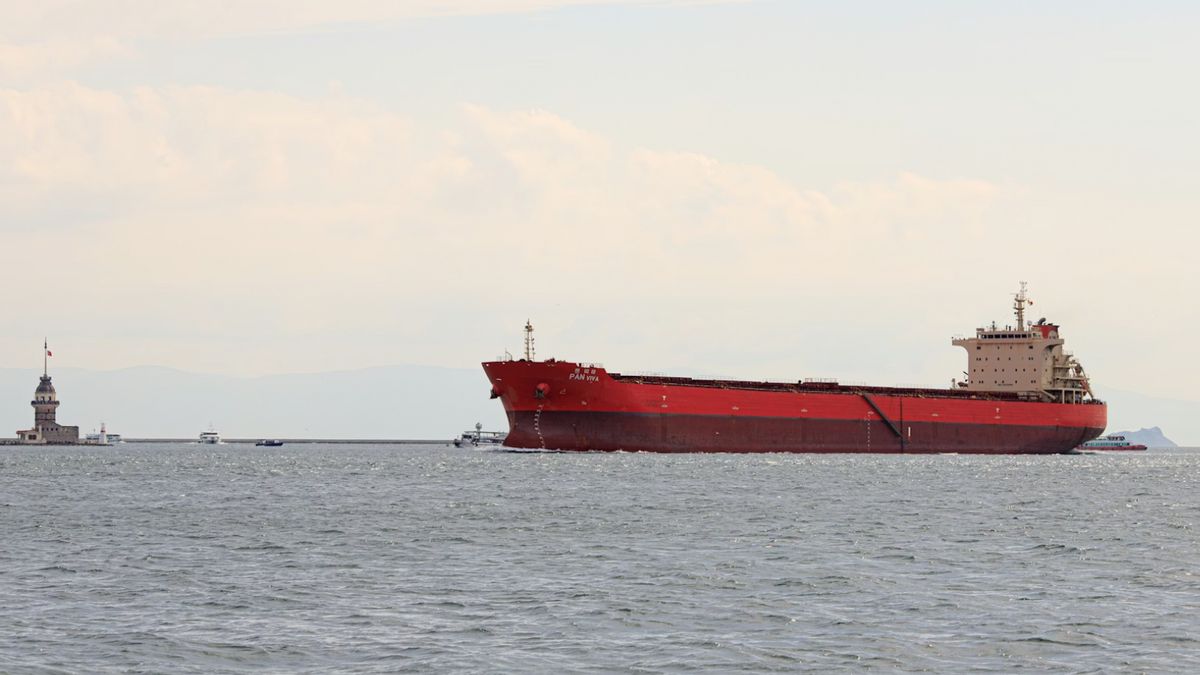


JAKARTA - Oil tanker traffic through the Strait of Hormuz has sharply declined as security risks have increased, leaving shipping activities almost halted, with more than 700 ships gathered on both sides of the strategic route.
Located at the mouth of the Persian Gulf, the Strait of Hormuz connects the Middle East's oil and liquefied natural gas production to global markets through the Gulf of Oman and the Indian Ocean. About 20 percent of the world's daily oil consumption, or about 20 million barrels, pass through this strategic corridor.
Following the joint attack by the United States (US) and Israel on Iran at the weekend, ship operators halted crossings amid soaring insurance costs.
Based on the analysis of the instant data company, Kpler, as many as 21 million barrels of oil were transported by 15 tankers on February 27, increasing to 21.6 million barrels by 18 ships on Saturday. However, on March 1, only three tankers carrying 2.8 million barrels crossed the strait.
With an average daily flow throughout the year reaching 19.8 million barrels, shipments on March 1 recorded a 86 percent decline compared to the average in 2026.
The sharp decline shows that cargo had been accelerated before the risk increased, then followed by almost stopping the crossing when the situation worsened.
To date, 706 non-Iranian tankers are recorded waiting on both sides of the strait. Of these, 334 crude oil tankers, 109 carriers of dirty oil products, and 263 carriers of clean oil products are at various points in the Persian Gulf to the west of the strait, the Gulf of Oman to the east, and the Arabian Sea.
Although loading activities of crude oil in the Gulf are still ongoing, the reduced departure to the east through the strait and longer waiting times to pass through the narrow point are expected to delay the arrival of cargo and drive up transportation costs.
The slowdown in the outflow to the east, coupled with the long queue of ships that want to cross the line, has the potential to further disrupt the supply chain and increase transportation costs.
Developments in the Strait of Hormuz
After the joint US-Israeli attack on Iran that began at the weekend, reports emerged that the Islamic Revolutionary Guard Corps (IRGC) sent a message to ships that were about to use the Strait of Hormuz stating that no ships would be allowed to pass.
Although there were claims that the warning was broadcast to the crew operating in the Persian Gulf through international VHF Channel 16 call and emergency frequencies, there has been no official statement confirming the formal closure of the strait.
Iranian media, however, claimed the Strait of Hormuz had effectively been closed.
A number of container ships were seen turning around to avoid the waters, while some of the world's leading container shipping companies have stopped sailing through the strait due to increased security risks.
The UK Maritime Trade Operations (UKMTO) in its statement, Sunday (1/3) stated that the maritime security level in the Strait of Hormuz had been raised to a critical level, the highest risk category, after several attacks on commercial vessels were confirmed at the weekend in the Gulf of Oman, near Musandam, as well as in the coastal waters of the United Arab Emirates (UAE).
The English, Chinese, Japanese, Arabic, and French versions are automatically generated by the AI. So there may still be inaccuracies in translating, please always see Indonesian as our main language. (system supported by DigitalSiber.id)


