
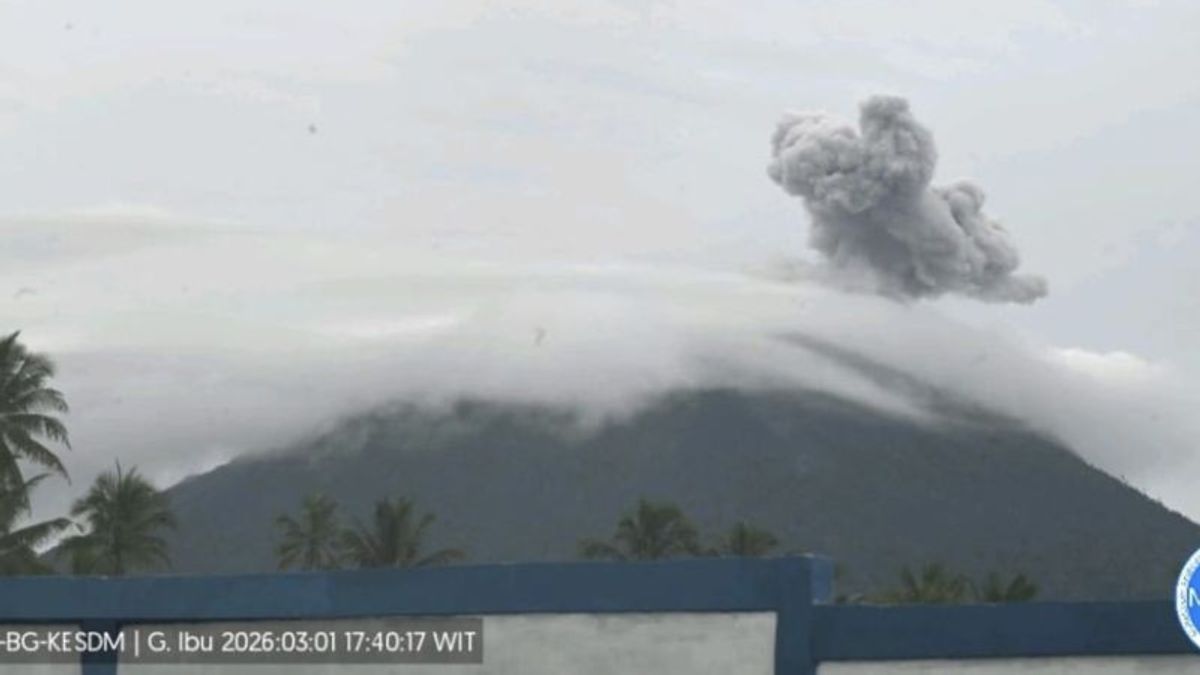


JAKARTA - The Center for Volcanology and Geological Hazard Mitigation (PVMBG) recommends that people around Mount Ibu in West Halmahera Regency, North Maluku not to be active within a radius of 2 kilometers from the active crater.
The recommendation was issued by PVMBG in Jakarta, Sunday, following the Ibu Mountain which erupted again today at 17.37 WIT.
"Based on official reports, the ash column was observed as high as approximately 300 meters above the peak or about 1,625 meters above sea level," said a statement from PVMBG in Jakarta.
In the statement it was informed that the column of gray ash with thick intensity and observed to lean towards the south.
The eruption was recorded on the seismogram with a maximum amplitude of 28 millimeters and a duration of about 49 seconds.
Currently, Mount Ibu is at Level II Status (Alert). There is a sectoral expansion of 3.5 kilometers towards the crater opening in the north which must also be cleared of citizen activities.
PVMBG also appealed to the public to use nose and mouth protectors such as masks and eye protectors when it rains ash and must be active outside the home.
The public is asked to remain calm, maintain the atmosphere of the area, and not spread false information or be provoked by issues that are unclear about their sources.
"Residents are expected to follow official directions from the local government," said PVMBG's statement.
The West Halmahera Regency Government is asked to continue to coordinate with PVMBG in Bandung and the Ibu Mountain Observation Post in Gam Ici to obtain the latest information regarding the development of volcanic activity.
Indonesia is one of the countries on the Pacific Ring of Fire, an area with the most active tectonic and volcanic activity in the world. This position makes Indonesia surrounded by hundreds of active volcanoes as well as prone to earthquakes and tsunamis.
Geologically, the Indonesian region is located at the meeting of three major world plates, namely the Indo-Australian Plate, Eurasia, and the Pacific Plate. The collision and movement of the plates form a series of volcanoes that stretch from Sumatra, Java, Bali, Nusa Tenggara, to Maluku and Sulawesi.
This condition makes Indonesia have high potential for geological disasters, but on the other hand it also provides benefits in the form of fertile land, geothermal energy sources, and abundant mineral wealth.
The English, Chinese, Japanese, Arabic, and French versions are automatically generated by the AI. So there may still be inaccuracies in translating, please always see Indonesian as our main language. (system supported by DigitalSiber.id)
Most Popular Tags
#Prabowo Subianto #donald trump #2026 World Cup #Febrie Adriansyah #8791Popular


