

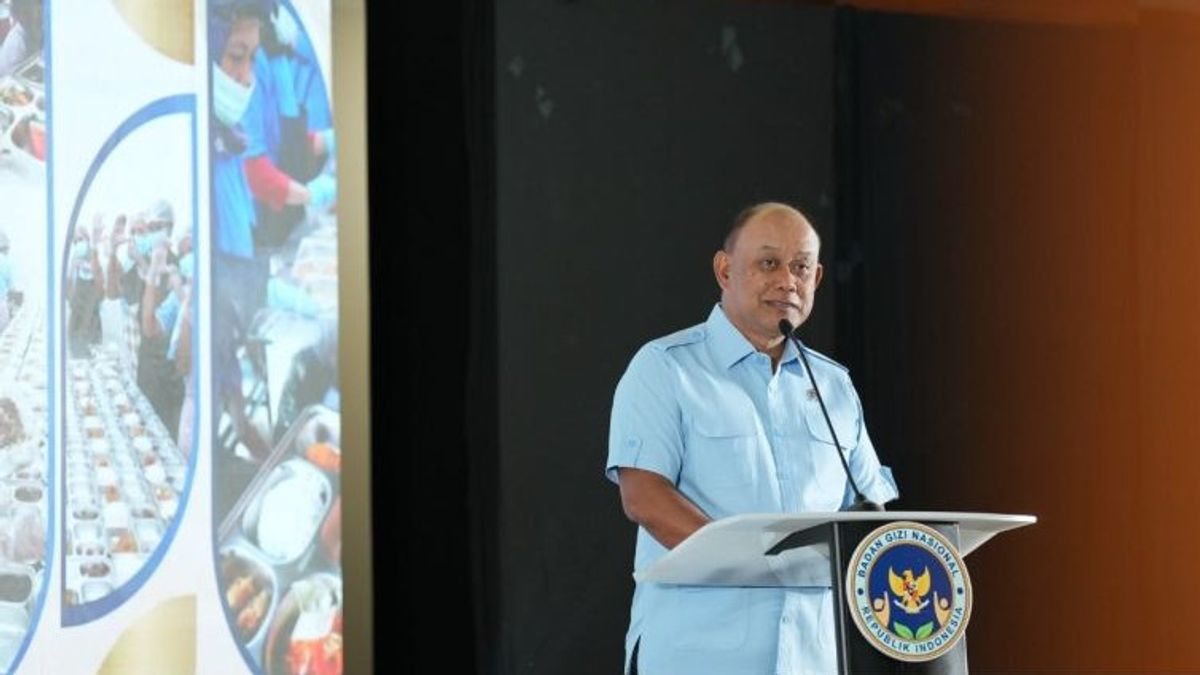


JAKARTA - The Head of the National Nutrition Agency (BGN) Dadan Hindayana said the incentive of Rp6 million per day for the Strategic Nutrition Fulfillment Service Unit (SPPG) to prevent waste of the state budget.
Dadan conveyed this in response to the issue that is circulating that the SPPG facility policy is a policy of waste. According to him, the scheme is actually an efficient and low-risk strategy for the country.
"There are a number of fundamental principles in the partnership scheme. First, Rp6 million per day is not a development fund from the state budget, but rather part of the payment mechanism for services on the SPPG that has been running. The entire physical development process is carried out with independent investment by the partner," he said in a statement reported by ANTARA, Friday, February 27.
He said that all risks were borne entirely by the partners, ranging from development risks, operational implementation, evaluation, to natural disasters. For example, when one of the SPPGs in Aceh was affected by flooding and suffered damage, the losses were entirely the responsibility of the partner and not BGN. The partner is obliged to rebuild without additional burden on the state budget.
"Like in Aceh when SPPG was swept away by floods, then the losers are the partners, not BGN, they have to build again. So, we transfer the total risk to the partners, therefore I say Rp6 million is very efficient because BGN does not spend a single rupiah for maintenance, repairs and others," he said.
Dadan also said that the construction by the partner was ensured to be more efficient because it was impossible to mark up (increase the price) for himself. Partners will build facilities as optimally as possible according to service needs. One example is the construction of SPPG by the Islamic Union (Persis) which is considered very good with an investment value of around Rp. 3 billion.
"I saw yesterday that the SPPG built by Pondok Pesantren Persis was very good, built with a budget of Rp. 3 billion. I believe that if it is built by the state budget, it is worth Rp. 6 billion, so we are 50 percent more efficient," he explained.
In addition, the aspect that is considered the most strategic is the advantage in time speed. Through the partnership scheme, a representative building can be completed in about two months.
"Buildings as luxurious as the Presidential Palace, the National Police, or other places can be built in two months, finished. What about the state budget? First, you have to appoint a consultant. How many months does the planning consultant take? Two months. Then, send a letter to the local government to borrow it, how many months? One month. Then you get the land, once it is surveyed it turns out it is not suitable, what do you do? You have to shift," said Dadan.
"When you shift, what do you do? Ask permission from the Ministry of Finance (Kemenkeu) to shift positions, one month later. It's done. Everything is done, what do you do? Tender. How much tender? 45 days. While the partner who built it, 45 days is done," he added.
Currently, BGN has recorded 24,122 SPPGs, all of which were built through a partnership scheme and have been operational. The average construction reaches 50 SPPG per day. This achievement is claimed to be proof of the partnership approach that can bring significant acceleration while maintaining budget efficiency and accountability.
For this reason, BGN emphasized that the incentive policy for the SPPG facility of Rp. 6 million per day is not a waste, but a strategy to ensure that nutritional fulfillment services run quickly, efficiently, and minimize the fiscal risks of the state, while upholding the principles of good governance.
The English, Chinese, Japanese, Arabic, and French versions are automatically generated by the AI. So there may still be inaccuracies in translating, please always see Indonesian as our main language. (system supported by DigitalSiber.id)
Most Popular Tags
#Prabowo Subianto #donald trump #2026 World Cup #venezuela #Bhayangkara hut #konflik timur tengahPopular


