

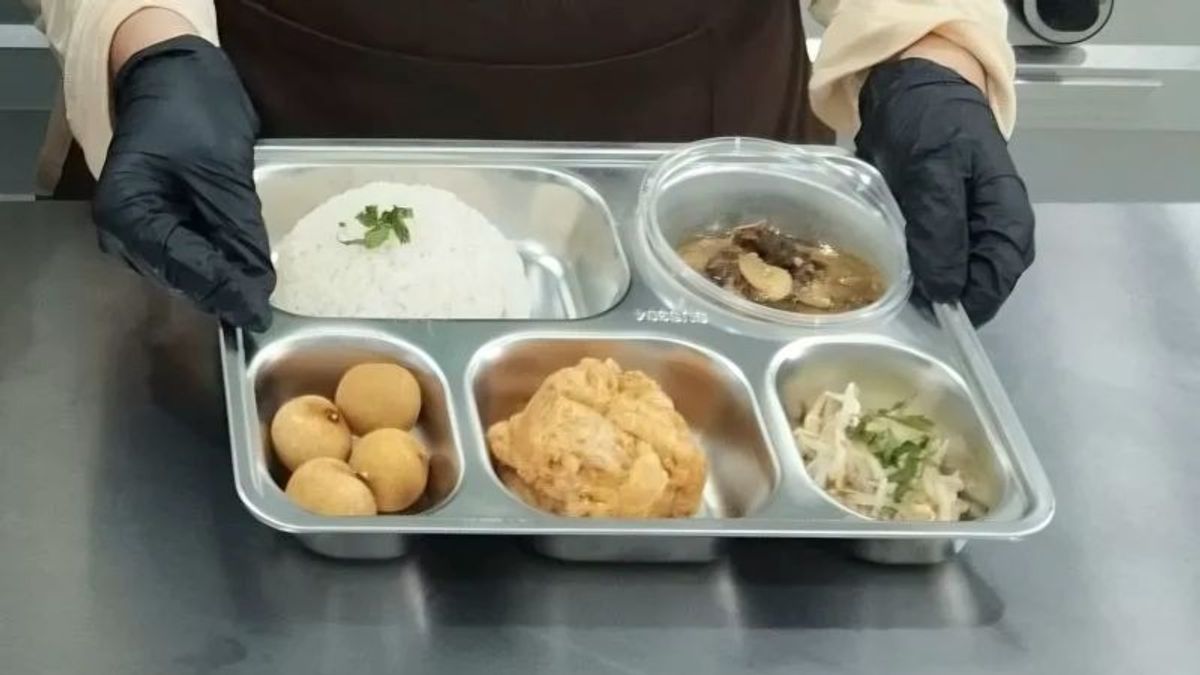


JAKARTA - The National Nutrition Agency (BGN) ensures that there is no reduction in food portions by partners in the Free Nutritious Meal (MBG) Program. BGN emphasized that the financial management of the program had been designed according to the applicable mechanism so as not to provide room for profit-taking from food portions.
Deputy Head of BGN, Sony Sanjaya, said the issue of cutting the portion arose due to a lack of understanding of the MBG financial management system. Therefore, his party is committed to carrying out continuous socialization so that there is no misunderstanding in the community.
"BGN explicitly separates the facility or building incentive of Rp. 6 million per day and the budget for raw materials or food. Through the at-cost principle and the use of virtual accounts (VA), the raw material spending does not go into the partners' personal accounts, but is in the operational VA, whose disbursement is closely monitored and paid according to the evidence of real spending," said Sony in Jakarta, Antara, Monday, February 23.
There is no food margin in the MBG program. If there is a difference in the price of ingredients, the funds cannot be withdrawn as a partner's profit and are still recorded in the financial system according to the provisions.
"This provision," he continued, "has been regulated in Technical Instructions (juknis) 401.1 which states that the only right of the partner is the facility incentive, not the profit from the sale of fish or food portions.
According to Sony, the incentive policy for facilities is a strategy for budget efficiency as well as a risk transfer mechanism. This scheme avoids the need for large capital expenditures from the state in the initial phase which has the potential to burden the state budget.
He explained that if the developing country builds 30 thousand Nutrition Fulfillment Service Units (SPPG) independently with an estimated Rp3 billion per unit, it will require around Rp90 trillion, not including land and maintenance costs.
"With the partnership scheme, the state does not spend a large capital expenditure at the beginning. The state budget is not burdened with giant capital that has the potential to be stalled because the state only pays daily incentives according to the availability of services," he said.
The scheme, he said, allows the acceleration of the development of nutritional infrastructure in a matter of months. The state essentially "buys time" for construction, while the risks of construction, maintenance, and operation become the responsibility of the partner.
In practice, if damage occurs such as CCTV damage, AC is off, or the roof leaks, the repair costs are borne by the partner. If SPPG violates the standard operating procedures or food safety standards, the operational status can be temporarily suspended and incentives are not paid.
In fact, if an extraordinary event occurs such as poisoning, the SPPG can be stopped until it is permanently closed, with the risk of investment losses being borne entirely by the partner.
The English, Chinese, Japanese, Arabic, and French versions are automatically generated by the AI. So there may still be inaccuracies in translating, please always see Indonesian as our main language. (system supported by DigitalSiber.id)


