



Bogor Agricultural Institute (IPB) University has developed an indigenous-based sea farming concept in Wakatobi Regency, Southeast Sulawesi, to strengthen the economy and sustainability of marine resources of coastal communities.
Head of the Science Techno Park PKSPL IPB University Muhammad Qustam Sahibuddin in his statement in Bogor Regency, West Java, Saturday, said the involvement of customary law communities was the key to the success of the program because it was in line with the principles of social and ecological sustainability.
The program was carried out in collaboration with PT PELNI (Persero) and the Kadie Kapota customary law community (MHA) in the South Wangi-Wangi District.
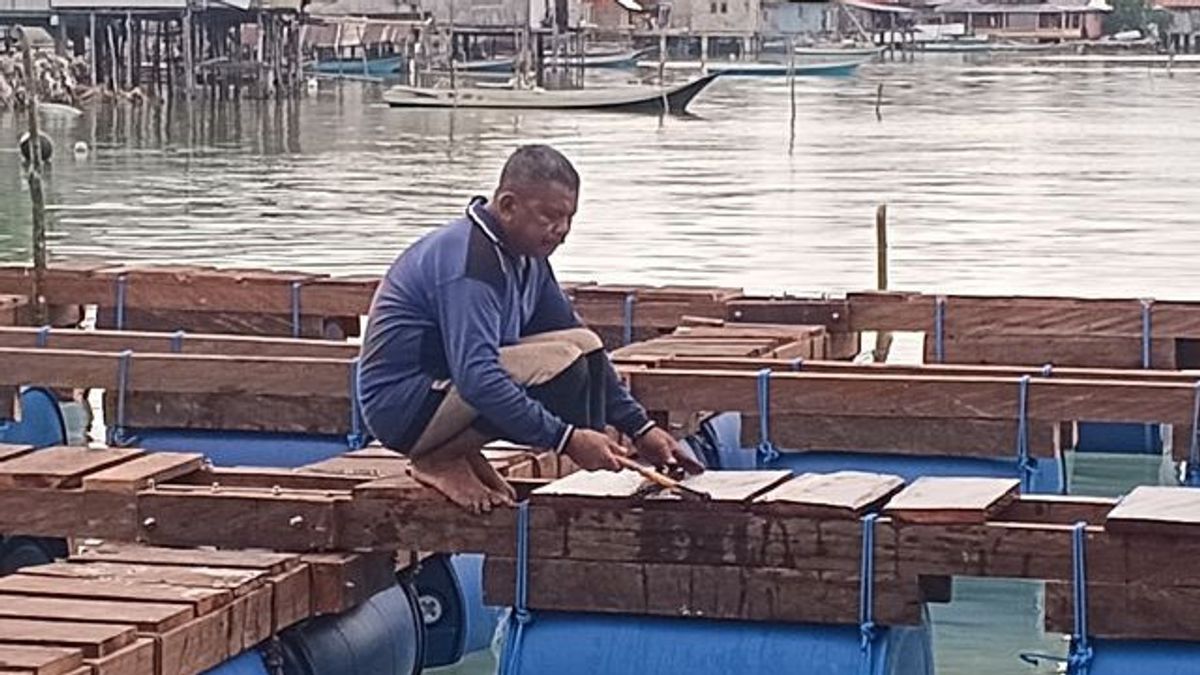
The initial implementation was marked by the construction of one unit of floating net karamba (KJA) containing six boxes which was carried out by the people of Kapota Village on Thursday (12/2). The KJA will be used for the cultivation of grouper as the core of sea farming activities based on mariculture.
Technical assistance was carried out by the Agromaritim Development and Acceleration of Innopreneurship (LPA2I) together with the Coastal and Marine Resources Study Center of IPB University (PKSPL).
"The involvement of customary law communities in the implementation of the sea farming concept is very relevant, because the concept is in line with the spirit of building customary law communities in the midst of uncertain changes," said Qustam.
He explained that sea farming is a system of shallow marine ecosystem utilization based on cultivation which aims to increase fish resource stocks while supporting marine conservation and tourism.
MHA Kadie Kapota includes Kapota, Kapota Utara, Kabita, and Kabita Togo villages. The indigenous community has been maintaining the sustainability of the sea through the practice of Parimparim, a mechanism for periodically opening and closing water areas to prevent excessive fishing, especially octopus.
IPB assesses that local wisdom is an important foundation in the integration of modern science and customary systems in the management of marine resources.
The program, which was initiated at the end of 2025, aims to increase human resource capacity, strengthen customary institutions, develop alternative livelihoods, and increase the economic value of community fisheries.
The series of activities includes mapping the potential for sustainable fisheries, mapping the socio-economic and institutional aspects, diversifying the economy through marine cultivation, to human resource development.
IPB hopes that the development of indigenous-based sea farming in Wakatobi can become a model for the development of coastal villages that are prosperous and sustainable without eliminating the cultural identity of the indigenous customary law community.
The English, Chinese, Japanese, Arabic, and French versions are automatically generated by the AI. So there may still be inaccuracies in translating, please always see Indonesian as our main language. (system supported by DigitalSiber.id)


