

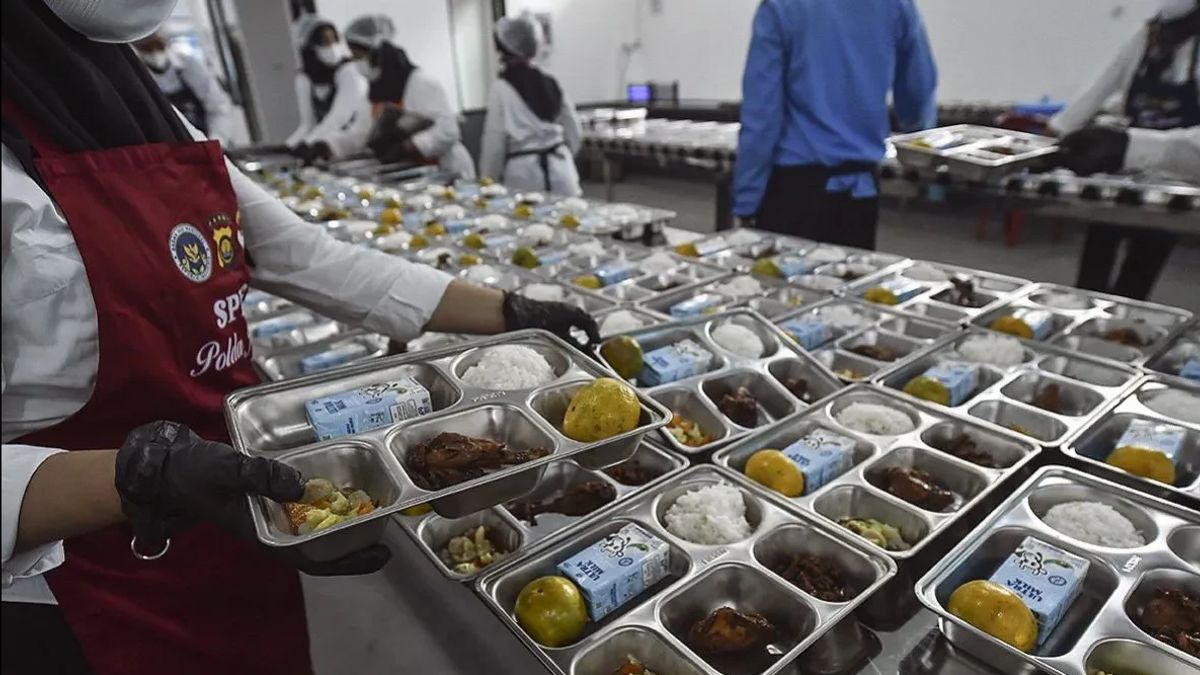


JAKARTA - President Prabowo Subianto responded to criticism that the Free Nutritious Meal (MBG) program was a form of waste of state budget.
The Head of State, in the agenda of the Groundbreaking 1,179 Nutrition Fulfillment Service Units (SPPG) in Palmerah, Jakarta, said that the funding for the program actually came from savings and efficiency in government spending.
"They predicted this project (MBG, ed), it must fail. This program wastes money," he said in a speech reported by ANTARA, Friday, February 13.
In his statement, President Prabowo revealed that since the launch of the MBG program, he had often been accused of squandering state funds. The criticism even came from a number of educated circles who doubted the effectiveness of the program.
The President rejected the assumption and emphasized that the MBG budget was obtained from cutting activities that were considered unproductive.
"In fact, brothers, this money (MBG, ed) is the result of savings, the result of efficiency from the budget that I and my team believe that if we do not save, this money will be eaten by corruption, will be spent to enrich individuals," he said.
The government, said the President, reduced wasteful practices such as meetings, seminars, and official travel that did not provide direct benefits to the community.
According to the President, budget efficiency is carried out to prevent leaks and potential corruption, as well as redirecting state funds to programs that have a real impact on the people, especially the weak economic group.
He also emphasized that criticism of public policies is a natural thing in a democracy. However, he assessed that programs that target the nutritional needs of children and vulnerable groups should be seen as a long-term investment for the future of the nation.
The President explained that malnutrition causes body cells to not be able to develop optimally, including brain, bone, and muscle cells.
According to him, the condition of stunting is also related to the process of poverty experienced by the community. At that time, the stunting rate was recorded at around 25 percent of Indonesian children.
The English, Chinese, Japanese, Arabic, and French versions are automatically generated by the AI. So there may still be inaccuracies in translating, please always see Indonesian as our main language. (system supported by DigitalSiber.id)


