
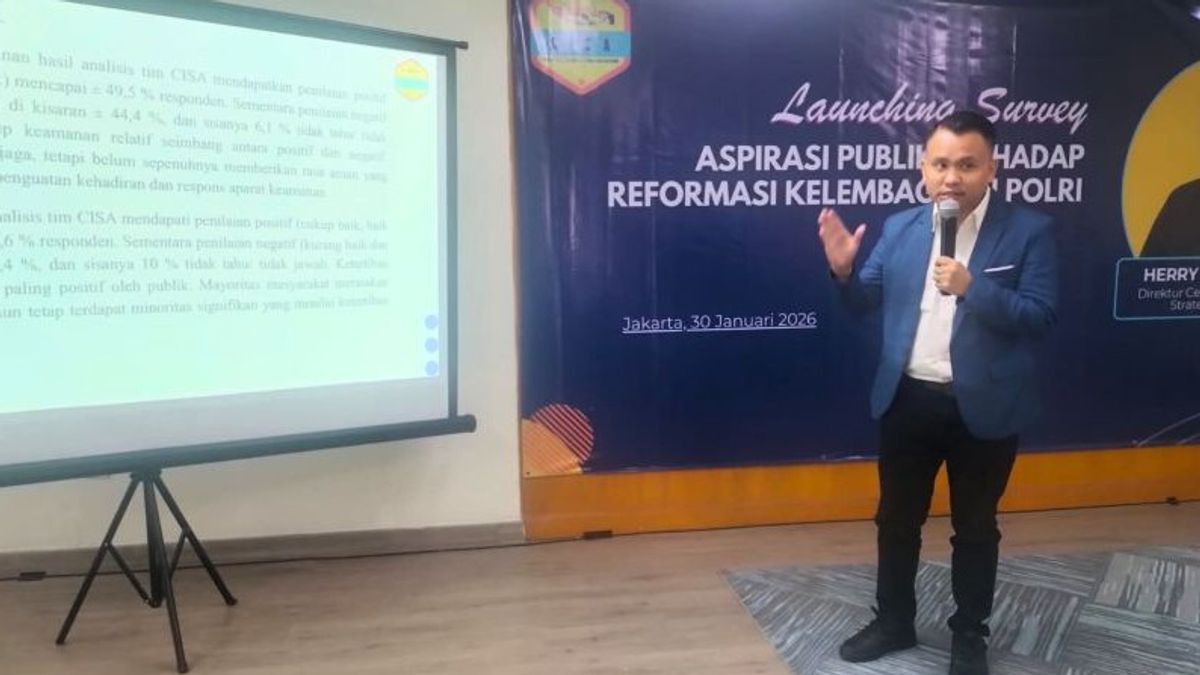


JAKARTA - The discussion on the placement of the National Police of the Republic of Indonesia (Polri) under the ministry has again encountered a difficult road. The latest survey by the Center for Indonesian Strategic Action (CISA) shows a very strong public rejection of the idea. As many as 81.2 percent of respondents said they disagreed to disagree if the National Police were under the ministry.
The results of the survey, which were presented in Jakarta, Friday, January 30, showed that the majority of the public still want the National Police to stand as an independent and professional institution. Of the total respondents, 65.5 percent unequivocally stated that they did not agree, while the other 15.7 percent stated that they were less than satisfied. This figure places public rejection at a dominant and consolidated level.
CISA Executive Director Herry Mendrofa assessed that the findings reflected the attitude of the public which was relatively consistent in viewing the position of the National Police in the constitutional system. According to him, the public considers the placement of the National Police under the ministry to have the potential to interfere with the independence and neutrality of law enforcement institutions.
"This shows real public concern. People do not see structural changes as the main solution, but rather have the potential to open up space for political intervention," said Herry.
This survey also revealed that the approval rate for the discourse is very low. Respondents who expressed their agreement were only 4.2 percent and very much agreed 1.1 percent, or a total of 5.3 percent. Meanwhile, 7.4 percent said they agreed enough and 6.1 percent did not give an answer.
On the other hand, support for the independence of the National Police is considered strong. As many as 61 percent of respondents said they agreed that the National Police would remain an independent institution, while 29 percent disagreed and about 10 percent had not decided. However, this finding also shows that there is still room for improvement in literacy and public communication related to police reform.
Public concerns are becoming more visible when respondents are asked to assess the impact of placing the National Police under the ministry. Around 67 percent of respondents believe that this step has the potential to reduce police independence. In fact, 60.2 percent of respondents believe that there will be a risk of politicization of law enforcement if the National Police is directly under the ministry's structure.
"The public views the independence of the National Police as an important condition for fair law enforcement. Therefore, the majority still supports the National Police being under the President, not the ministry," said Herry.
Interestingly, this survey also confirms that the public does not see a change in the institutional structure as an answer to the problem of Polri performance. As many as 76.7 percent of respondents stated that placing Polri under the ministry was not the main solution to improve performance. Only 2.7 percent disagreed, while the rest chose not to know or not answer.
On the other hand, the approach of internal reform has received strong support. As many as 70.2 percent of respondents believe that improving the internal system of the National Police - from professionalism, transparency, to accountability - is more important than changing the institutional structure. As many as 22.3 percent of respondents said they were not sure, and the rest did not have a definite attitude.
This CISA survey was conducted on January 21-26, 2026, with 1,135 respondents in 29 provinces. The method used was face-to-face interviews and filling out a questionnaire, with a margin of error of 2.7 percent and a 95 percent confidence level. Respondents include residents aged 17 years and above or have the right to vote, both in urban and rural areas.
This finding shows one key message: the public does not reject police reform, but rejects solutions that are considered risky to undermine independence. In the public's view, police reform is more urgent to be carried out from within, not by moving the command line to the ministry. In a democratic climate that is sensitive to power, the independence of law enforcement remains a dead price.
The English, Chinese, Japanese, Arabic, and French versions are automatically generated by the AI. So there may still be inaccuracies in translating, please always see Indonesian as our main language. (system supported by DigitalSiber.id)
Most Popular Tags
#Prabowo Subianto #donald trump #2026 World Cup #Febrie Adriansyah #8791Popular


