

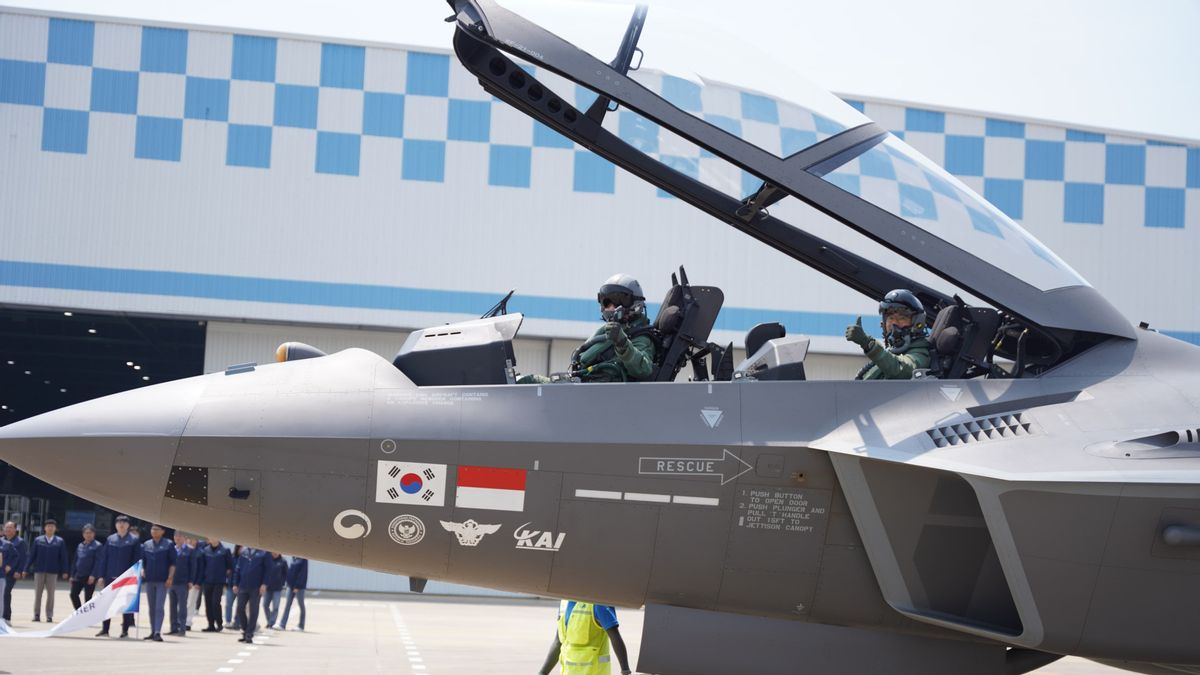


JAKARTA - The cooperation in the development of the KF-21 Boramae fighter aircraft between Indonesia and South Korea is considered not only a military technology project, but a bet on the credibility of the country. The program, which was originally initiated as a major leap in the independence of the defense industry, now reflects the weakness of fiscal consistency and government governance across regimes.
The Founding Secretary of Indonesian Audit Watch (IAW) Iskandar Sitorus said the project was born out of Indonesia's strategic awareness after the early 2000s arms embargo, when dependence on the global arms market was considered a vulnerable point of sovereignty.
"KF-21 is designed as a technological leap. Indonesia not only buys aircraft, but also participates in designing, learning, and becoming a manufacturer," said Iskandar, Tuesday, January 17.
The official cooperation began through the signing of a Letter of Intent on March 6, 2009, which was witnessed by President Susilo Bambang Yudhoyono. The commitment was strengthened through a MoU in 2010 and culminated in a core development contract on October 6, 2014, which was then ratified through Presidential Decree Number 136 of 2014.
In the initial scheme, Indonesia bears 20 percent of the development costs or around 1.6-1.7 trillion won. In return, Indonesia gets the status of risk sharing partner, one prototype unit, technology transfer, and production opportunities for up to 50 aircraft units.
However, according to Iskandar, the institutional foundation and funding of the project from the beginning were fragile.
"That long-term commitment is not accompanied by a multi-year fiscal locking mechanism. There is not a single national institution that really binds the Ministry of Defense, the Ministry of Finance, the Ministry of Foreign Affairs, and the defense industry SOEs under one command," he said.
Problems began to be seen in the implementation phase around 2018 when Indonesia's contribution payments stalled. Meanwhile, South Korea continued to progress until it was able to carry out a prototype roll-out in 2021 and the first flight test in July 2022.
IAW noted that Indonesia's arrears until 2023 approached 1 trillion won. Various renegotiation schemes had been offered, including payment in the form of cooperation on other projects, but South Korea demanded that the basic obligations be settled first.
"At this point, the project is stuck. It is admitted to be strategically important, but it has never been treated as a fiscal obligation that cannot be negotiated," said Iskandar.
The situation became more complicated after the incident of alleged data protocol violations by two Indonesian engineers in 2024 which worsened the trust of partners. Indonesia's position as a developer is also considered to have been eroded.
When the government changed, Indonesia finally renegotiated in 2024-2025. As a result, the funding commitment was drastically cut to around 600 billion won.
As a consequence, Indonesia's ownership share fell sharply from 20 percent to around 7.5 percent. The right to additional prototypes was canceled and Indonesia's status shifted from co-developer to a limited partner that more resembles a potential buyer.
"De facto we are downgraded. From joint developers to limited partners," he said.
On the other hand, South Korea has started mass production since 2024 with a target of delivering aircraft to its air force in 2026.
For IAW, this condition is a hard lesson about the importance of state discipline in fulfilling international contracts.
"The international community does not judge us by independence speeches, but by consistency in fulfilling our own legal signatures," said Iskandar.
IAW also recommends structural improvements, ranging from a legally locked multi-year funding scheme, pre-contract audits by the BPK, to cross-commission supervision by the DPR. Contracts are also considered to be based on technological achievements, not just payment schedules.
"KF-21 Boramae is not just about fighter planes. This is a test of the country's self-esteem. If the defense commitment alone is not consistent, how can strategic partners trust Indonesia?" he said.
The English, Chinese, Japanese, Arabic, and French versions are automatically generated by the AI. So there may still be inaccuracies in translating, please always see Indonesian as our main language. (system supported by DigitalSiber.id)
Popular


