

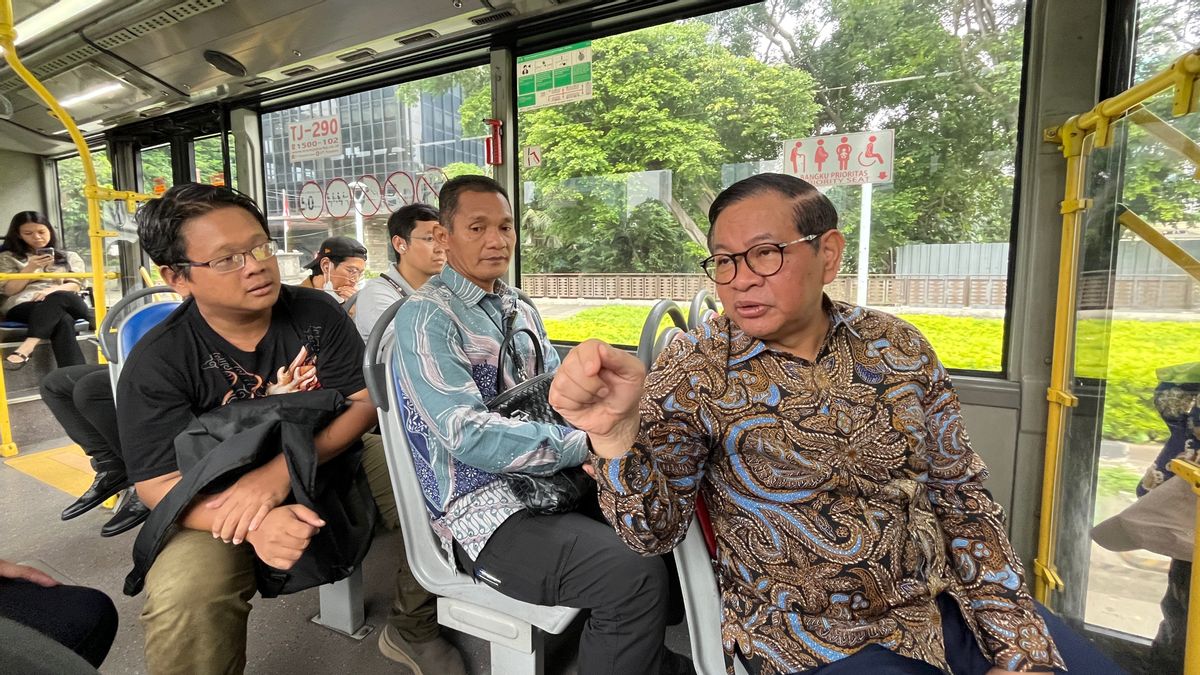


JAKARTA - Jakarta Governor Pramono Anung explained the rationale for the planned launch of the TransJabodetabek service on the Blok M–Soekarno-Hatta Airport route, despite existing airport transportation options already operating, such as Damri buses and the Airport Train (Railink).
Pramono emphasized that the opening of the new route is not intended to replace or reduce existing airport transportation services.
The Jakarta Provincial Government, he said, will continue to coordinate with relevant transportation operators to ensure services run smoothly.
"Of course, there will be coordination, but this is a choice. We will not reduce or close existing routes," Pramono said in West Jakarta on Thursday, January 22.
According to Pramono, the presence of the TransJabodetabek bus service to the airport is intended to expand public mobility options. With more public transportation options, it is hoped that residents will no longer rely on private vehicles to get to Soekarno-Hatta Airport.
"Because it's a choice and makes it easier for the public to choose, so there are more transportation options, with more options, people will no longer rely on private vehicles. Ultimately, this will reduce the use of private vehicles," he said.
Previously, Pramono revealed plans to open several new TransJabodetabek routes to meet the growing need for cross-regional mobility. The two prioritized routes are Blok M–Soekarno-Hatta Airport and Cawang–Jababeka.
According to Pramono, the Blok M-Airport route is an urgent need based on a report from the Transportation Agency. The high level of public activity to and from the airport is deemed to require more integrated public transportation support.
"Regarding TransJabodetabek, we will indeed open new routes, the first of which is from Blok M to the airport. Based on the Transportation Agency's report, the current demand is very high," Pramono said in Central Jakarta on Tuesday, January 20.
Furthermore, the Cawang-Jababeka route, which the Jakarta Provincial Government will prepare, targets industrial areas with a large number of workers, particularly in the Jababeka area of Bekasi Regency.
"Then from Cawang to Jababeka. Why is that being done? Because we have quite a lot of workers in Jababeka, and the demand is also high," Pramono said.
Currently, the DKI Provincial Government only operates six Transjabodetabek routes, namely Alam Sutera-Blok M, PIK2-Blok M, Bogor-Blok M, Sawangan-Lebak Bulus, Vida Bekasi-Cawang, and Bekasi-Dukuh Atas.
The English, Chinese, Japanese, Arabic, and French versions are automatically generated by the AI. So there may still be inaccuracies in translating, please always see Indonesian as our main language. (system supported by DigitalSiber.id)
Most Popular Tags
#Prabowo Subianto #donald trump #Febrie Adriansyah #8791 #giias 2026Popular


