

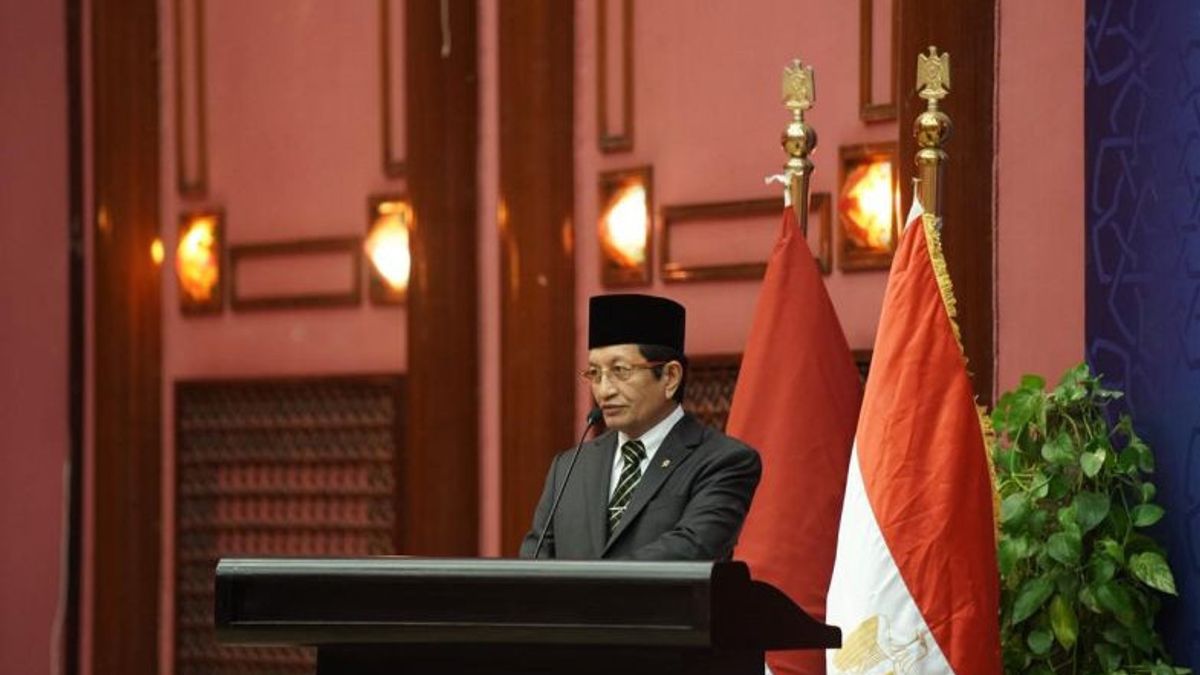


JAKARTA - Minister of Religion (Menag) Nasaruddin Umar emphasized that environmental issues cannot be separated from religious responsibility.
He said this at the International Seminar on Environmental Fiqh (Ecotheology) at the Al-Azhar University Conference Center, Cairo, Egypt, not long ago.
"In the Islamic perspective, the earth is not the absolute property of humans, but a divine trust that must maintain its balance. Therefore, every activity that damages the environment is actually deviating from the purpose of worship and the essence of civilization development," said the Minister of Religion in his statement Wednesday, quoted by Antara.
According to the Minister of Religion, the concept of ecotheology is an important foundation in building the collective awareness of Muslims regarding the trust to protect nature. Ecotheology teaches that human-environment relations must be built on the principles of trust, moral responsibility, and balance.
According to him, the approach of ecotheology places conscience and ethics as important elements in managing progress and maintaining environmental balance.
"Today's world not only needs intelligence, but also conscience and ethics in managing progress," he said.
The international seminar entitled "Challenges of Interacting with the Environment in Tafsir and Sunnah" is the result of synergy between the Indonesian Ministry of Religion with Al-Azhar Al-Sharif, the Indonesian Embassy in Cairo, and the Indonesian Students and Students Association (PPMI) in Egypt.
This activity was attended by hundreds of participants from ulama, lecturers, researchers, students, and observers of environmental issues as an effort to strengthen the contribution of Islamic thought in responding to the global environmental crisis through theological, legal, and ethical approaches.
On the sidelines of the activity, the Minister of Religion also symbolically handed over the braille Al Quran mushaf published by the Ministry of Religion to the Rector of Al-Azhar University Salama Gomaa Dawud.
In his speech, Al-Azhar Rector Salama Gomaa Dawud emphasized that Islam has great concern for environmental preservation efforts.
"Maintaining the environment is not only the responsibility of institutions, but also the obligation of every individual, because the impact of environmental damage will be felt by all mankind," he said.
The Acting Head of the Indonesian Embassy in Cairo, Zaim Al Khalis Nasution, said that the holding of this seminar confirmed the strong historical and intellectual relationship between Indonesia, Egypt, and Al-Azhar.
"This cooperation is an important momentum to strengthen the collaboration of Islamic thought in facing global challenges, especially environmental issues," he said.
The English, Chinese, Japanese, Arabic, and French versions are automatically generated by the AI. So there may still be inaccuracies in translating, please always see Indonesian as our main language. (system supported by DigitalSiber.id)


