

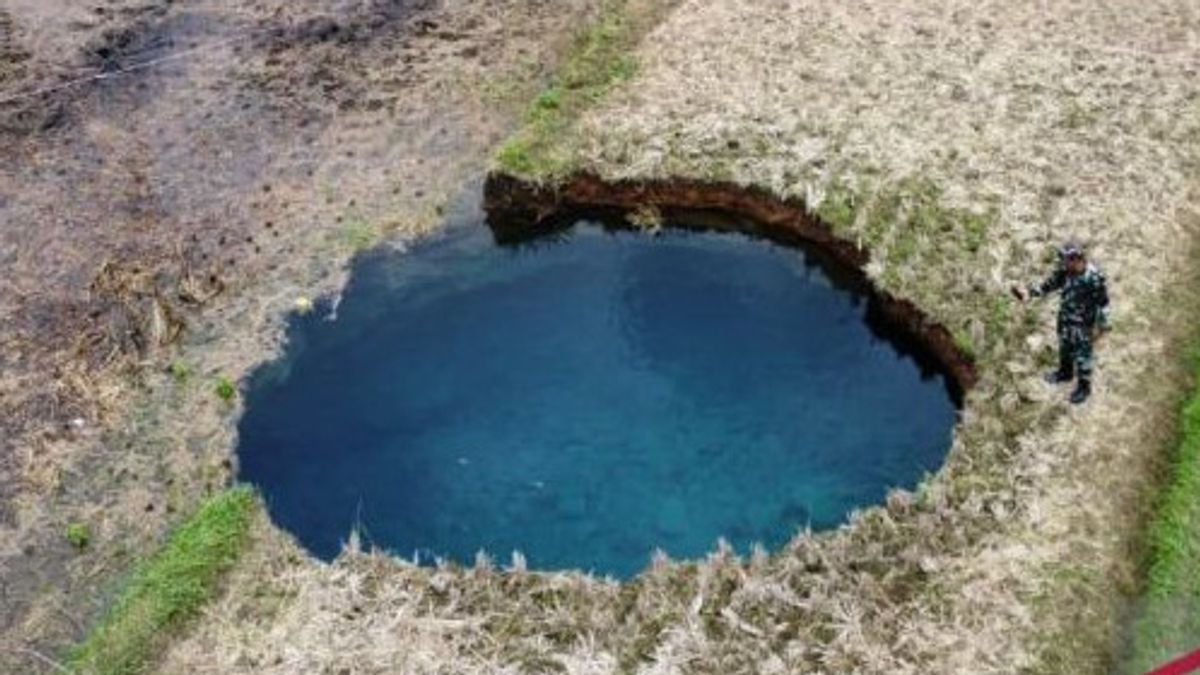


BOGOR - Professor of Soil Science at IPB University, Prof. Widiatmaka, emphasized that the sinkhole or land collapse hole phenomenon that occurred in West Sumatra (Sumbar) can no longer be seen as a natural event.
According to him, the sudden appearance of sinkholes in residential and agricultural areas is a strong signal of a long-term land and groundwater governance crisis.
Scientifically, Widiatmaka explained that sinkholes are formed due to the loss of stability of the soil structure through the process of leaching and subsurface erosion or piping. This process generally occurs in fine to medium textured soils that are above soluble rocks or hollow layers.
"High rainfall does play a role as a trigger, but the main cause is the weakening of the soil structure due to the loss of fine particles from the lower layer. The cavity is formed slowly, but the collapse can be very sudden," Widiatmaka said in his statement, Tuesday, January 20.
He added, in many cases, this condition is exacerbated by human activities that drastically change the groundwater system. Excessive groundwater extraction, construction of drainage without hydrogeological studies, and land loading without soil bearing capacity calculations accelerate the failure of soil structures.
According to Widiatmaka, land use changes are a key factor that is often overlooked. The conversion of forested and vegetated land into developed areas or intensive agriculture eliminates the ecological function of the soil as a water buffer and structure.
"The loss of vegetation cover and soil organic matter reduces soil aggregation. As a result, the soil loses cohesion and becomes very vulnerable to internal erosion through piping," he explained.
In this condition, rainwater is no longer distributed evenly, but is concentrated on certain paths below the ground surface. This focused flow of water, he said, accelerates the formation of cavities while weakening the soil cover layer.
Widiatmaka assessed that excessive groundwater exploitation is the most dangerous factor because it works like a "time bomb" below the surface. Rapid groundwater drawdown removes natural buffering pressure on underground cavities, while repeated wet and dry fluctuations weaken soil cohesion.
"Without strict control, groundwater extraction not only threatens water availability, but also sacrifices land stability and human safety," he said.
He explained that in Indonesia sinkholes have a high potential to occur in fine to medium textured soils in karst areas, such as Mount Sewu in the Special Region of Yogyakarta and Central Java, Maros-Pangkep in South Sulawesi, North and South Kendeng in Central Java and East Java, Citatah-Padalarang in West Java, and Sangkulirang-Mangkalihat in East Kalimantan.
Besides karst areas, areas with old volcanic materials that have undergone intensive weathering, such as the Bandung Basin and its surroundings, the slopes of old volcanoes in central and western Java, and several areas in western Sumatra, also have a high potential for the formation of sinkholes.
"These lands generally have a weak structure, high porosity, and poor organic matter, so they are very vulnerable to subsidence when there is a change in groundwater flow," he explained.
He reminded that the impact of sinkholes not only damages land and infrastructure, but also disrupts the drainage system, reduces agricultural productivity, and increases the risk of groundwater contamination due to changes in subsurface water flow.
As a mitigation step, Widiatmaka emphasized that sinkhole handling should not be reactive. Identification and mapping of land vulnerability needs to be carried out through integrated scientific studies, supported by groundwater monitoring and shallow geophysical surveys.
"Sinkholes are a stark warning that our land and water systems are unhealthy. Without synergy between science and policy, landslides are just a matter of time," he concluded.
The English, Chinese, Japanese, Arabic, and French versions are automatically generated by the AI. So there may still be inaccuracies in translating, please always see Indonesian as our main language. (system supported by DigitalSiber.id)


