

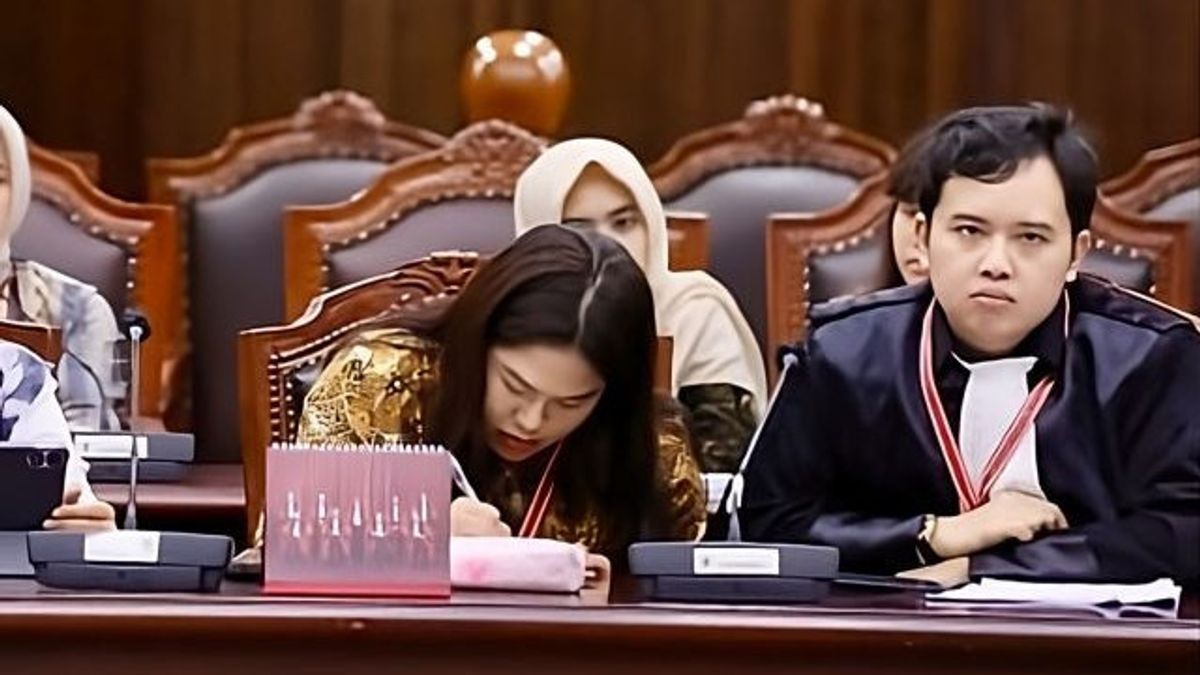


Article 218 of Law Number 1 of 2023 concerning the Criminal Code or the Criminal Code is newly related to the insult of the President and Vice President is tested for constitutionality to the Constitutional Court (MK).
The applicants, consisting of 13 students of the Open University Law Study Program, questioned the article because they felt their rights to express themselves, communicate, and obtain equality before the law were harmed.
"With the enactment of this article, placing applicants in a vulnerable position to criminalization actions that can cause a chilling effect for citizens, including applicants," said the applicant's representative, Suryadi, as reported by the MK website from Jakarta, Wednesday, quoted by Antara.
Article 218 paragraph (1) of the Criminal Code reads: "Anyone who publicly attacks the honor or dignity and dignity of the President and/or Vice President, is sentenced to a maximum of three years imprisonment or a maximum fine of category IV.
Meanwhile, Article 218 paragraph (2) of the Criminal Code stipulates: It is not an attack on honor or dignity as referred to in paragraph (1), if the act is carried out for the public interest or self-defense.
According to the applicants, the norm of the article regulates the prosecution without providing a clear definition and limitation. The phrase "attacking honor or dignity and dignity" is considered to have no concrete reference that can be objectively measured.
The applicants are concerned that this article is not in line with the essence of democracy because it has the potential to criminalize citizens, including when delivering academic material, scientific publications, and public discourse regarding evaluation and criticism of national leadership.
They believe that in a democratic system, the right to freedom of opinion is a fundamental element that cannot be restricted. The communication barriers allegedly arising from the application of Article 218 of the Criminal Code are considered contrary to international human rights standards.
On the other hand, this article is also considered to provide special protection or privileges to the President and Vice President. Because, in Articles 433-442 of the Criminal Code, insults against citizens are regulated in layers and more detailed with variations of criminal threats.
"The difference in treatment reflects normative discrimination based on status or position which is contrary to the principle of equality before the law," said Suryadi.
The applicants reasoned that, if viewed from Latin, praesedere, the word "president" refers to a position within the government of a state. The position is seen as a legal abstraction, not a living and sentient entity.
"The department has no feelings that can be offended and has no personal honor that can be attacked," said another applicant, Tandya Adyaksa.
Therefore, according to the applicants, Article 218 of the Criminal Code as a whole is in conflict with Article 27 paragraph (1), Article 28D paragraph (1), Article 28E paragraph (2) and paragraph (3), as well as Article 28F of the Constitution of the Republic of Indonesia in 1945.
In the petition, the law students asked the Court to declare Article 218 paragraph (1) and paragraph (2) of the Criminal Code unconstitutional.
This application is recorded with case number 275/PUU-XXIII/2025. The applicants, namely Afifah Nabila Fitri, Dimas Fathan Yuda Armansyah, Farhan Dwi Saputra, Feony Gita Safitri, Idham Hakim, Inka Sofia Rahayu, Merry Hana Nathalina, Olivia Jane, Rina Amelia Ika Saputri, Siti Rohmah, Suryadi, and Tjhin Okky Graswi.
The first hearing with the agenda of the preliminary examination was held on Tuesday (13/1) in a panel session chaired by Chief Justice Suhartoyo. The court gave 14 days to the applicants to complete their application.
The English, Chinese, Japanese, Arabic, and French versions are automatically generated by the AI. So there may still be inaccuracies in translating, please always see Indonesian as our main language. (system supported by DigitalSiber.id)


