

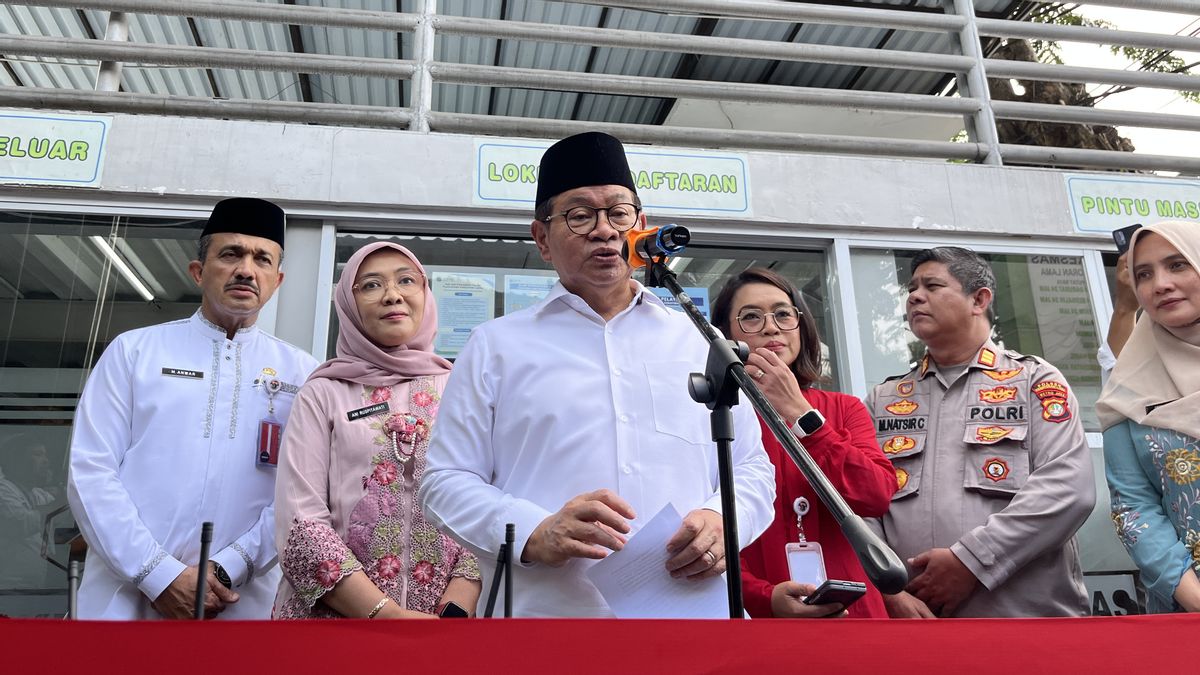


JAKARTA - DKI Jakarta Governor Pramono Anung responded to the demands of a labor group that the DKI Provincial Government provide wage subsidies because they are dissatisfied with the DKI Jakarta provincial minimum wage (UMP) in 2026 which was set at Rp5.73 million.
Pramono gave a signal that he refused to comply with the proposal regarding wage subsidies from the DKI APBD so that the value of the work income obtained by workers was according to their wishes.
"The point is that what we have agreed on in the Wage Council I will carry out. Of course I will not take a policy without what has become an agreement in the Wage Council," said Pramono at the Kebayoran Lama Health Center, South Jakarta, Friday, January 8.
Regarding the workers' rejection of his decision to set the UMP next year at Rp5.7 million, Pramono emphasized that Jakarta is still the highest value compared to other provinces in Indonesia.
He also touched on the amount of the Jakarta UMP increase which was determined using the alpha value of 0.75. This value is the middle ground taken by Pramono from the labor proposal which asked for an alpha of more than 0.9 and the business group which proposed 0.55 in the formulation of the UMP in the DKI Jakarta Wage Council.
Moreover, Pramono assessed that the minimum wage set in Jakarta for this year is still larger than other provinces.
"Actually, if Jakarta is relatively good, it is actually good enough. But yes, once again, if there are still those who object, this is a democratic country, it's okay," said Pramono.
Previously, the Indonesian Workers' Confederation (KSPI) urged the DKI Jakarta Provincial Government to shift the policy of providing various incentives for workers to wage subsidies that are directly received by workers.
KSPI President Said Iqbal emphasized that workers did not need promises or policy narratives, but concrete evidence in the form of wage subsidies that went directly into workers' pockets.
"We don't want just words, we want proof. What? Wage subsidies. For example, if it is still Rp. 5.73 million per minimum wage worker, subsidized by the DKI Jakarta Government, Rp. 200,000," said Said Iqbal in a demonstration on Thursday, January 8.
He explained that workers as a group of workers have a different character from extreme poor people. Therefore, the form of assistance needed is also different and cannot be equated with incentive programs based on facilities.
"We who work have purchasing power. But the poor people, the poor people, can have transportation incentives, food incentives, clean water incentives, that's okay. But if people work, it's not the incentives that are needed, or if you want a wage subsidy incentive," he said.
According to Said Iqbal, incentives such as free transportation, cheap food, or clean water are more appropriate for the poor. Meanwhile, for workers, the assistance does not touch the most basic needs.
"If you really want to help workers, just channel it as a wage subsidy. It goes directly into the workers' pockets, not just an additional facility that not all workers can access," said Said Iqbal.
The English, Chinese, Japanese, Arabic, and French versions are automatically generated by the AI. So there may still be inaccuracies in translating, please always see Indonesian as our main language. (system supported by DigitalSiber.id)
Popular


