

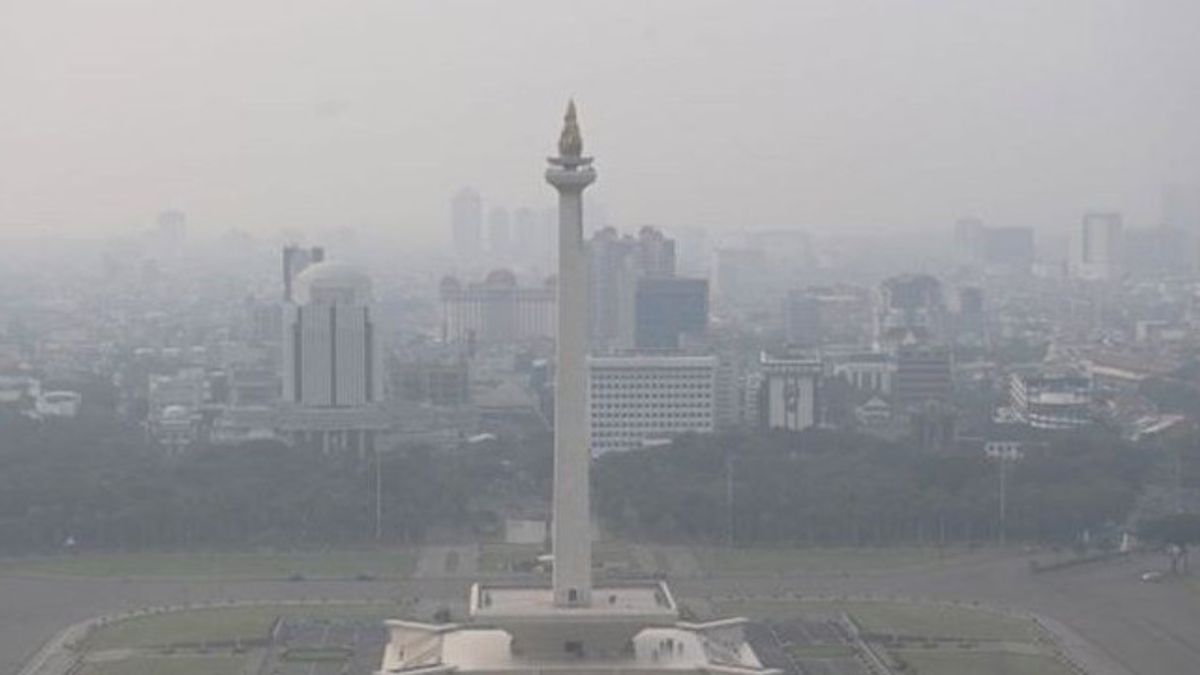


JAKARTA - The air quality in Jakarta on Monday morning, January 5, entered the unhealthy category and ranked sixth as the city with the worst air quality in the world.
Based on data from the air quality monitoring site IQAir at 05.45 WIB, quoted by Antara, the air quality index (AQI) in Jakarta was at 174 or in the unhealthy category with PM2.5 air pollution and a concentration value of 79.5 micrograms per cubic meter.
The figure has an explanation of the air quality level that is unhealthy for sensitive groups because it can harm humans or sensitive animal groups or can cause damage to plants or aesthetic value.
The site also recommends the air conditions in Jakarta, namely for the public to avoid outdoor activities. If you are outdoors, use a mask, then close the windows to avoid dirty outdoor air.
Meanwhile, the good category is the air quality level that does not have an effect on human or animal health and does not affect plants, buildings or aesthetic values with a PM2.5 range of 0-50.
Then, the moderate category is the air quality that does not affect human or animal health but affects sensitive plants and aesthetic values with a PM2.5 range of 51-100.
Then, the very unhealthy category with a PM2.5 range of 200-299 or air quality can be harmful to health in a number of exposed population segments. Finally, dangerous (300-500) or in general the air quality can be seriously harmful to health in the population.
The city with the worst air quality is Karachi, Pakistan at 218, second is Kolkata, India at 189, third is Delhi, India at 187, and fourth is Kinshasa, Democratic Republic of Congo (DR Congo), at 177.
Jakarta is the city with the most integrated and extensive air quality monitoring system in Indonesia, with 111 Air Quality Monitoring Stations (SPKU) active throughout the Capital Region.
Head of the DKI Jakarta Environmental Service (DLH) Asep Kuswanto explained that the monitoring system is a combination of reference stations and low-cost sensors (Low-Cost Sensor or LCS) installed at various strategic points.
"Through this integrated system, we can monitor air conditions in 'real-time' and take faster mitigation steps to protect the health of residents," said Asep in Jakarta.
This monitoring network is the result of collaboration between the DKI Jakarta DLH, the Ministry of Environment (KLH), the Meteorology, Climatology and Geophysics Agency (BMKG), civil society organizations, universities, and partners from the private sector.
Jakarta is also preparing an "Early Warning System" (EWS) for air pollution as a proactive and responsive step against potential pollution increases.
The English, Chinese, Japanese, Arabic, and French versions are automatically generated by the AI. So there may still be inaccuracies in translating, please always see Indonesian as our main language. (system supported by DigitalSiber.id)
Most Popular Tags
#Prabowo Subianto #donald trump #Febrie Adriansyah #8791 #giias 2026Popular


