

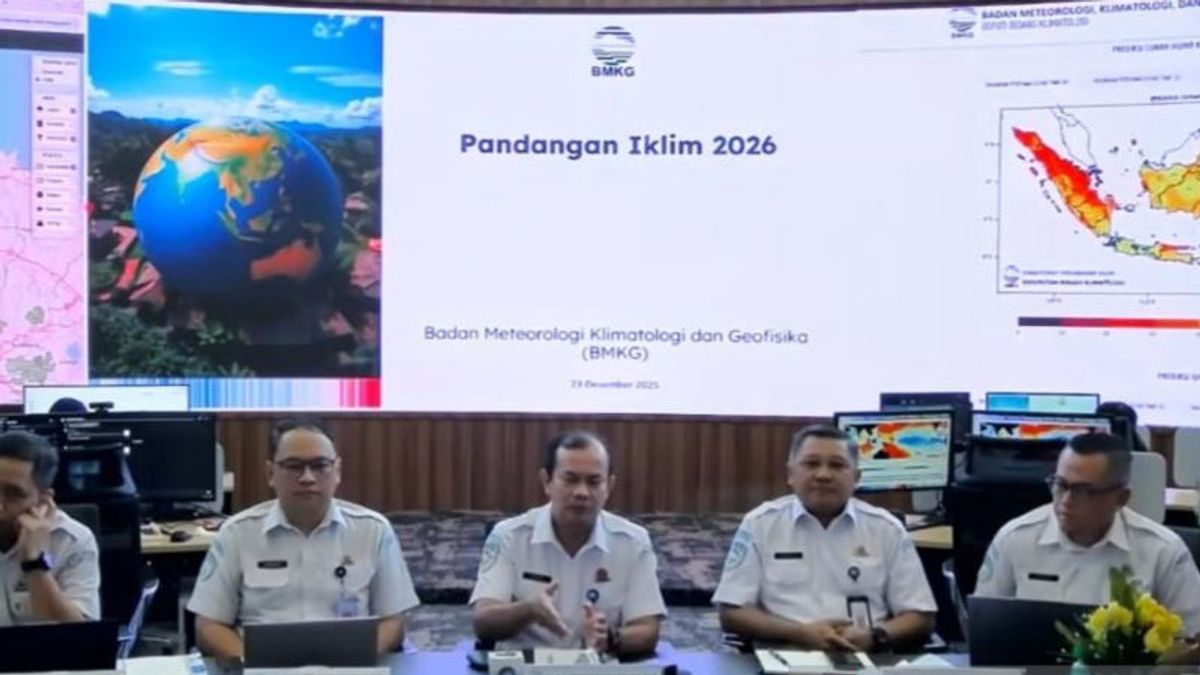


JAKARTA - The Meteorology, Climatology and Geophysics Agency (BMKG) is developing an impact-based early warning system or impact-based forecasting which will be implemented in 2026.
Head of BMKG Teuku Faisal Fathani said this system is an expansion of the learning from various hydrometeorological disaster events in recent years.
BMKG assesses that this system not only conveys weather forecast information, but also projects the potential impacts that can be caused in the affected areas.
"When BMKG says that rain will occur in an area, whether moderate, heavy, or very heavy, the information will be further analyzed to see the potential impact," he said in a press conference "Climate Outlook 2026" in Jakarta, Tuesday, quoted by Antara.
BMKG, he continued, is working together with the National Disaster Management Agency (BNPB), the Ministry of Public Works (PU), and the Geological Agency of the Ministry of Energy and Mineral Resources (ESDM) in developing the system.
The impact analysis is carried out by combining the BMKG weather forecast with the regional vulnerability map, so that potential disasters such as floods and landslides can be identified more specifically.
Teuku Faisal explained that BMKG currently has weather forecasting capabilities with a high level of accuracy for the next three to seven days.
"Our challenge now is to prepare a more detailed map of regional vulnerabilities so that the impact information can be delivered accurately," he said.
"With this system, BMKG targets early warning in 2026 to no longer be general, but accompanied by information on locations that are potentially affected by disasters, so as to support faster and more targeted mitigation steps," he continued.
This is considered important after the BMKG Climatology Directorate explained that the annual rainfall in Indonesia in 2026 is estimated to range between 1,500 to 4,000 millimeters per year, in accordance with the climatological pattern that has often occurred in previous periods.
A number of areas are reported to have high rainfall potential, especially on the west coast of Sumatra Island which is influenced by the relatively warm sea surface temperature of the Indian Ocean and the orographic factor of the Bukit Barisan Mountains.
Heavy rainfall is likely to occur in January-February and November-December 2026, with the western coastal areas of Sumatra such as Aceh, West Sumatra-Bengkulu need to increase vigilance at the peak of the rainy season.
In addition to the west coast of Sumatra, BMKG also predicts the potential for heavy rain in parts of West Java, Central Java, Kalimantan, Central Sulawesi, and Papua.
BMKG assesses that although the nature of the rain is generally normal, the intensity of the rain that occurs locally has the potential to trigger hydrometeorological disasters, such as floods and landslides, especially in vulnerable areas. Meanwhile, the period from May to September 2026 is estimated to be a drought phase.
The English, Chinese, Japanese, Arabic, and French versions are automatically generated by the AI. So there may still be inaccuracies in translating, please always see Indonesian as our main language. (system supported by DigitalSiber.id)


