

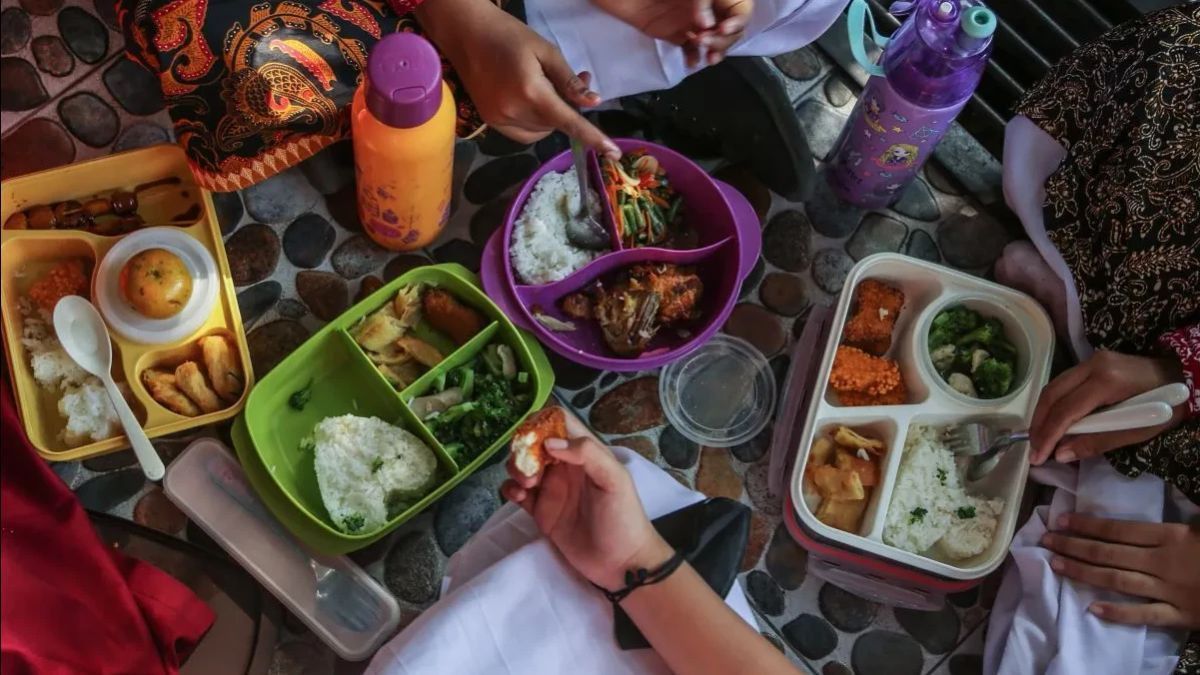


JAKARTA - Deputy Chairman of Commission VIII of the Indonesian House of Representatives, Singgih Januratmoko, supports the Free Nutritious Meal (MBG) Program to continue during the school holidays. According to him, the school holidays are actually a period that is prone to a decrease in nutritional intake, especially for children from economically vulnerable families.
Singgih assessed that the provision of MBG menus in the form of one ready-to-eat package from the SPPG kitchen and two MBG packaged packages that can be taken home containing bread, eggs, milk, and fruit according to the adequacy of nutrition are forms of the presence of the state that should be appreciated. He also assessed that this policy is a strategic step to ensure the sustainability of children's nutrition, especially students under the auspices of the Ministry of Religion, such as madrasahs and religious education units.
"The sustainability of MBG during school holidays is proof that the state must not take a break in protecting children's basic rights, including the right to adequate food and nutrition. This is in line with the mandate of the constitution and the national commitment to prepare superior generations towards Golden Indonesia 2045," Singgih told reporters, Monday, December 22.
The head of the commission for religious, social and community empowerment said that various data showed that nutritional problems were still a serious national challenge. He said, the prevalence of stunting in Indonesian children had indeed shown a downward trend in recent years.
"However, it is still at a number that requires continuous and integrated intervention," said Singgih.
Singgih explained, based on the latest Basic Health Research (Riskesdas) results, through the Indonesian Nutrition Status Survey (SSGI) 2024, showed a national stunting prevalence of 19.8 percent. Therefore, according to him, there is still a need for hard work to achieve the 2025 target (18.8 percent) and overcome other nutritional problems such as severe wasting and chronic malnutrition.
"Especially in provinces with the highest cases such as West Java, Central Java, and East Java," explained the Golkar legislator for Central Java.
In this context, Singgih emphasized the importance of accelerating the implementation of MBG in madrasah and pesantren. Commission VIII of the DPR RI considers pesantren as a strategic ecosystem for the development of the nation's generation.
With the number of students reaching millions and the majority living in boarding schools, according to Sungguh, pesantren has specific and sustainable nutritional needs.
"Pesantren is not only a religious education center, but also a center for character building and human resources. The MBG program must be designed adaptively for pesantren, both in terms of menu, distribution system, and management of healthy kitchens based on pesantren," he said.
According to data from the Ministry of Religion of the Republic of Indonesia 2025, there are more than 42,391 pesantren with a total of 4.3 million students throughout Indonesia. Meanwhile, the pesantren environment, with the characteristics of boarding houses and centralized consumption management, is a very appropriate and strategic locus for the implementation of sustainable nutrition programs.
In order to strengthen the implementation of the MBG program, especially in madrasah and pesantren environments, Singgih suggested that there should be synergy and data integration between the Ministry of Health, BGN and the Ministry of Religion in mapping and integrating MBG recipient data more accurately.
"This data includes the number of students, the condition of the kitchen, the specific nutritional needs so that the distribution of MBG can be more targeted," he said.
Singgih also suggested the need for a more adaptive MBG distribution model in the environment of madrasah and pesantren schools with the culture and capacity of pesantren. In addition to packaging, it is also necessary to consider a pesantren kitchen model with the assistance of nutrition experts, supply chain, local food ingredients, and nutrition education for kitchen managers.
Singgih added that support for MBG in the Ministry of Religion schools and its acceleration in pesantren is not merely a social assistance program, but a manifestation of the state's responsibility in protecting and fulfilling children's rights to quality health and education.
With the collaboration of all parties, said Singgih, this program will contribute greatly to realizing a healthier, smarter, and more virtuous generation of Indonesians.
"We in Commission VIII will continue to monitor so that the budget and implementation of this MBG are targeted. The spirit is one: no child or student should be left behind in accessing quality nutrition," he concluded.
The English, Chinese, Japanese, Arabic, and French versions are automatically generated by the AI. So there may still be inaccuracies in translating, please always see Indonesian as our main language. (system supported by DigitalSiber.id)


