

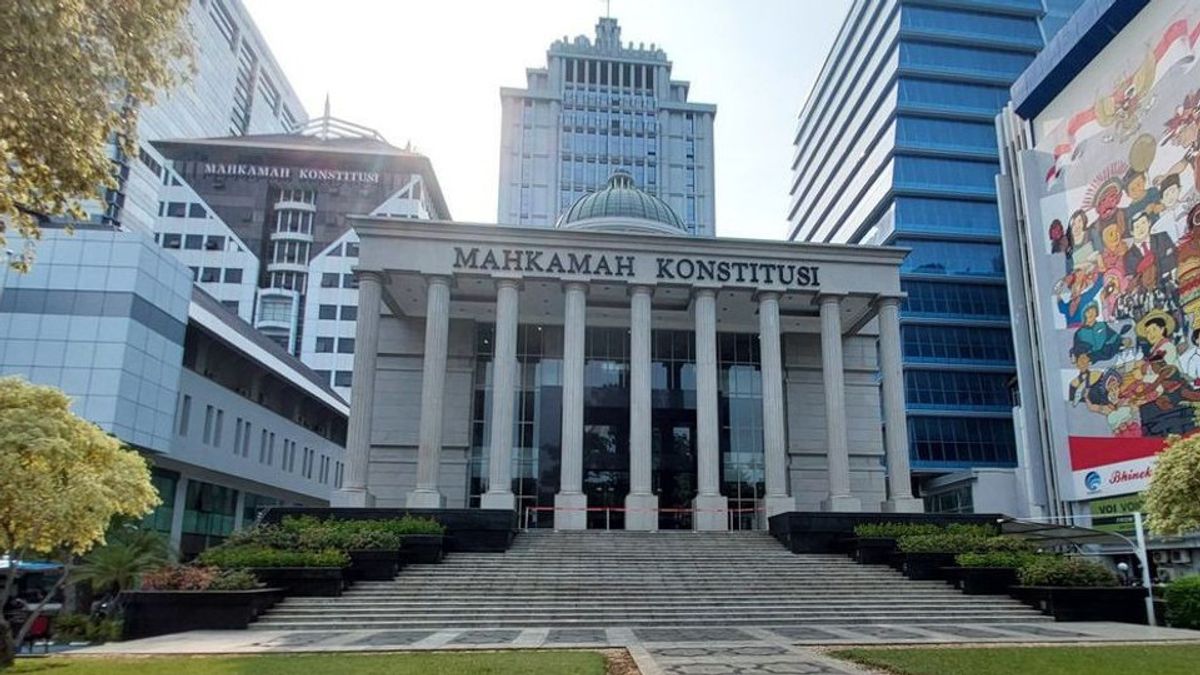


JAKARTA - The Constitutional Court (MK) will read the verdict on two cases testing the substance of Law Number 28 of 2014 concerning Copyright on Wednesday, December 17. The two cases are each listed with Number 28/PUU-XXIII/2025 and Number 37/PUU-XXIII/2025.
Based on the trial schedule published on the MK's official website, as reported by Antara, the pronouncement of the verdict will be held at Building I of the Indonesian Constitutional Court and is scheduled to begin at 13.30 WIB, along with eight other cases of testing laws.
Case No. 28 was filed by musician Tubagus Arman Maulana or Armand Maulana, Nazril Irham or Ariel NOAH, Vina Panduwinata, and 26 other musicians and singers. They tested the constitutionality of a number of articles in the Copyright Law, namely Article 9 paragraph (3), Article 23 paragraph (5), Article 81, Article 87 paragraph (1), and Article 113 paragraph (2).
The applicants assessed that these provisions create legal uncertainty and create a structural threat for performers. According to them, the tested articles have not provided clear, equal, and adequate legal protection, especially for musicians and singers when performing other people's works.
In their application, the applicants highlighted the copyright controversy that performers often experience, one of which was experienced by the vocalist of the Kahitna music group, Hedi Yunus, who was also a petitioner. Hedi is said to have suffered constitutional harm as a result of the obligation to implement direct licensing or direct licensing by the composer of the song Melamarmu, one of the songs he often sings.
The direct licensing system is a direct licensing mechanism between the copyright owner and the work user without going through an intermediary institution, such as the National Collective Management Agency (LMKN) or the Collective Management Agency (LMK). In his application, Hedi stated that this condition made him in an uncertain situation to bring the song to various performances.
Meanwhile, Case No. 37 was filed by the TKOOS Band music group and rock singer Saartje Sylvia. In this case, the applicants questioned the constitutionality of Article 9 paragraph (2) and Article 113 paragraph (2) of the Copyright Law.
TKOOS Band admitted that they were not allowed to perform songs created by Koes Plus due to a ban from the heirs of the legendary music group. As a result, they claim to have experienced a decline in their image in the public eye because they are considered to use the work commercially without respecting the economic rights of the creator.
In fact, according to the applicants, royalties for the songs they performed have been paid through LMKN and LMK. Through this material test application, the applicants asked the Constitutional Court to provide a new interpretation of a number of tested articles or declare that some of the provisions do not have binding legal force.
Both cases have been rolling at the Constitutional Court since the preliminary examination hearing on April 24, 2025. During the trial process, the Constitutional Court has requested information from the DPR, the government, witnesses and experts, as well as related parties, including the LMKN.
The English, Chinese, Japanese, Arabic, and French versions are automatically generated by the AI. So there may still be inaccuracies in translating, please always see Indonesian as our main language. (system supported by DigitalSiber.id)
Popular


