

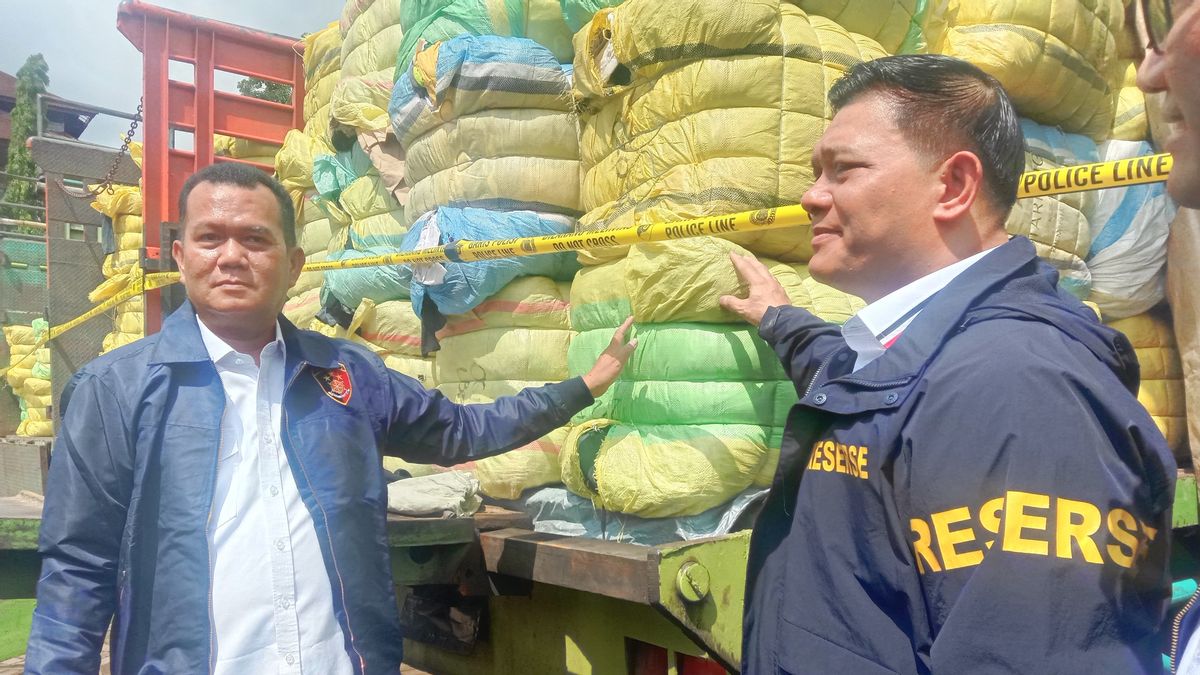


DENPASAR - The Special Economic Crime Directorate (Dittipideksus) of the Criminal Investigation Unit of the National Police found harmful bacteria in used clothes imported illegally by the South Korea-Bali network involving two suspects ZT and SB.
Director of Special Economic Crime (Dirtipideksus) of the Criminal Investigation Unit of the National Police, Brigjen AdeSafri Simanjuntak, said that the bacteria were known based on laboratory test results in Bali.
"The results of the laboratory examination conducted by the investigators, from the sample of used clothes taken and then submitted for laboratory examination to the Bali Provincial Labkesda, found that there were Bacillussp bacteria," he said in Denpasar, Bali, Monday, December 15.
According to him, the bacteria are very vulnerable to causing health problems for users of second-hand clothing.
Apart from being dangerous for health, the practice of importing used clothing also kills the domestic textile industry and MSMEs that are active in the fashion industry.
"These illegal import practices or used clothes can threaten the domestic textile industry and the UMKM sector of garment manufacturers in Indonesia," he said.
Meanwhile, the Director of Law and Regulation of the Financial Transaction Reports and Analysis Center (PPATK) Muhammad Novian revealed that for five years they had been engaged in the illegal business of used clothes from South Korea, ZT and SB disguised the identity of traders to students to deceive officers.
"They use the identity as a clothing trader, a self-employed person, and even use a student profile," he said.
He explained that from 2021, it was seen that there were approximately 1,900 more transactions carried out by the perpetrators to one country, namely South Korea.
Not only South Korea, PPATK also managed to sniff out approximately 6 other countries suspected of being suppliers of used goods that are widely circulated in Indonesia.
"The modus operandi they used was conveyed using transactions using the names of other parties. And there is also the potential to mix the proceeds of crime or the proceeds of criminal acts with legitimate business money, namely the transportation business and also the export-import business," said Novian.
From the transaction side, he said, there was also a strong indication that they were carrying out a scheme of trade-based money laundering.
English:
"It is known internationally that transactions are carried out in such a way that they are engineered to look like legitimate transactions that are the result of normal export-import business as it should be," he said.
In fact, behind this there are several things that must be investigated such as money laundering.
Previously, the Special Economic Crime Task Force (Dittipideksus) of the Criminal Investigation Unit of the National Police revealed the practice of illegal import of used clothes in a warehouse in Tabanan, Bali, with a total transaction of Rp. 669 billion.
English:
The English, Chinese, Japanese, Arabic, and French versions are automatically generated by the AI. So there may still be inaccuracies in translating, please always see Indonesian as our main language. (system supported by DigitalSiber.id)


