

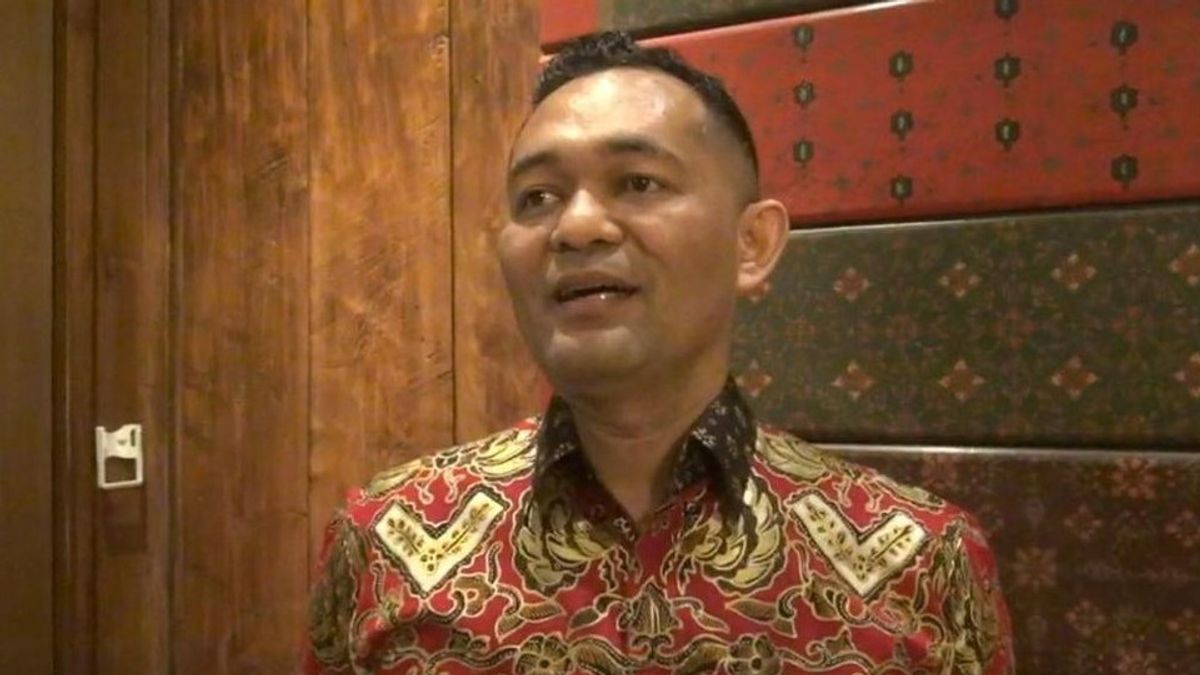


JAKARTA - Senior political analyst Boni Hargens again launched a harsh criticism of the National Police Reform Committee which discussed the direct appointment of the Chief of the Indonesian National Police (Kapolri) by the President. He assessed that the idea was a "misguided thought" or logical fallacy that ignored the basic principles of democracy, especially the representation of the people's voice.
"The proposal of the National Police Reform Committee is a serious thought or logical fallacy because it ignores the fundamental principle of democracy, namely the people's voice. Direct appointment by the executive without involving the legislature has the potential to create a dangerous concentration of power and reduce democratic oversight mechanisms," Boni Hargens said in a statement, Friday, December 12.
According to Boni, the current mechanism for appointing the National Police Chief, which involves the DPR, is an important part of the checks and balances system. The process, he said, ensures accountability while ensuring that decisions regarding the leadership of law enforcement institutions continue to accommodate public interests.
"Democracy always puts the people's voice as the key in considering and making public policies. In this context, the DPR is a people's representative who cannot be bypassed in determining the National Police Chief," he said.
Boni then explained the four fundamental weaknesses of the proposal for the direct appointment of the National Police Chief by the President. First, it violates the principle of checks and balances by removing the legislative oversight role. Second, it ignores the people's representation by eliminating the DPR's role in the selection process for public agency leaders.
"Third, the proposal opens up greater opportunities for politicization. Direct appointments can create dependence on the President and make the National Police an executive political tool without external oversight," explained the Executive Director of the Indonesian Electoral Institute (LPI).
"Fourth, the proposal reduces transparency and accountability. The fit and proper test process in the DPR gives the public space to assess the qualifications, integrity, and vision of the prospective National Police Chief," he added.
Boni also questioned the focus of the Polri Reform Committee which instead rolled out the issue of appointing the National Police Chief, instead of encouraging substantive reforms in the police, such as cultural transformation, integrity, and work systems.
"The mechanism for appointing the National Police Chief is a technical-procedural issue within the framework of the constitution. Changing it requires a broader constitutional debate, not the authority of the Reform Committee," he said. He assessed that the proposal actually diverted attention from issues that were far more urgent, such as eradicating internal corruption and improving the quality of public services.
Boni emphasized that there were six agendas for Polri reform that should be a priority. First, the transformation of the organizational culture so that it is more oriented towards public service. Second, strengthening integrity and eradicating corruption. Third, improving professionalism through competency-based education and modern technology.
English:
"The fourth is improving relations with the community through community policing and openness of information. Fifth, reform of the internal legal system. Finally, the development of an objective performance evaluation system based on public satisfaction," he said.
Boni concluded that the polemics showed the importance of distinguishing between procedural changes and substantive reforms. "The proposal for the direct appointment of the National Police Chief by the President is not only problematic from a democratic perspective, but also diverts the focus from the real reform agenda that is urgent," he concluded.
The English, Chinese, Japanese, Arabic, and French versions are automatically generated by the AI. So there may still be inaccuracies in translating, please always see Indonesian as our main language. (system supported by DigitalSiber.id)
Popular


