

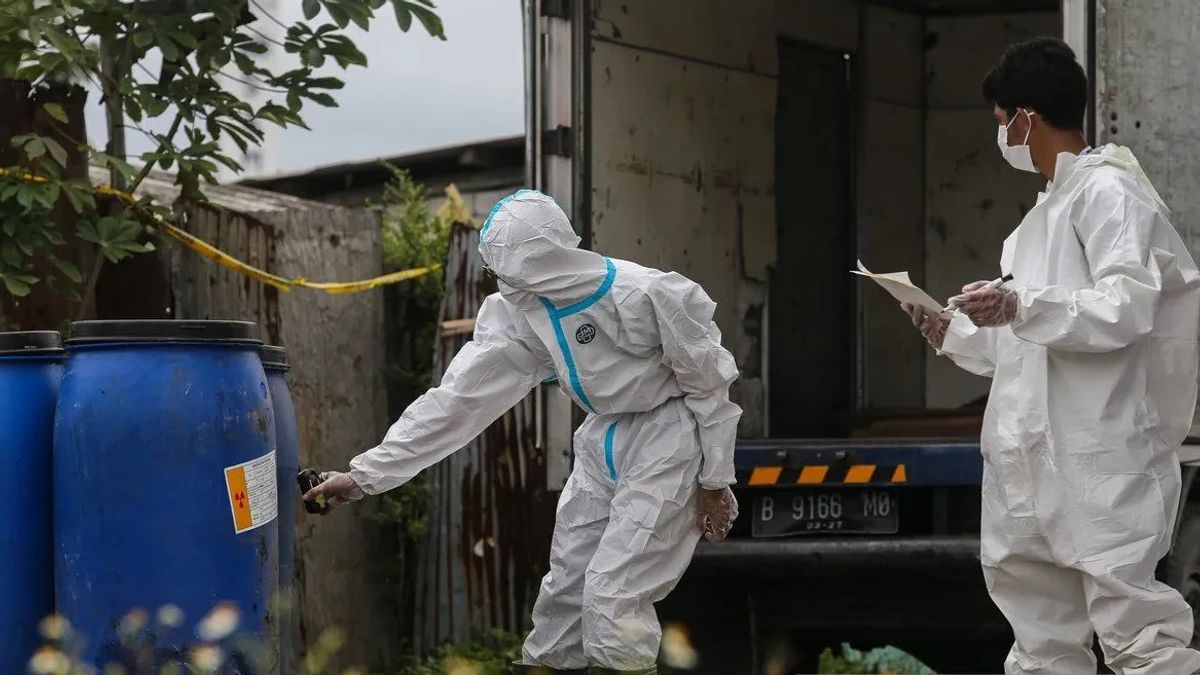


JAKARTA - Member of Commission III of the DPR Abdullah responded to the determination of a Chinese citizen (WN) as a suspect related to the findings of Cesium-137 or Cs-137 radioactive material in the metal screen trading chain in Cikande, Banten.
He asked law enforcement officials to thoroughly investigate this case and investigate other possible violations.
"The determination of the suspect in this case must be the entry point for the possibility of the involvement of other parties, especially since this incident was allegedly due to an element of intent. So we ask law enforcement to thoroughly investigate," Abdullah told reporters, Tuesday, December 9.
"Including whether there are trade activities without a permit, severe negligence, or even intentional elements. This case should not be considered as an ordinary negligence. There is a potential criminal act that must be dismantled to the root," he continued.
Abdullah also encouraged the police to apply maximum sanctions in accordance with the provisions of the laws and regulations for individuals and companies proven to be involved, including the threat of corporal punishment, large fines, revocation of business licenses, and the obligation to restore the environment.
Moreover, the police have also filed a demarcation abroad against the suspect, Lin Jingzhang, to the Directorate General of Immigration, because he was suspected of wanting to escape from Indonesia.
"We are talking about radioactive material that is harmful to public health and safety. The state must be present and act strongly," Abdullah stressed.
Meanwhile, Lin was charged with Article 98 paragraph (1) of Law Number 32 of 2009 concerning Environmental Protection and Management. This article contains sanctions for perpetrators who intentionally cause environmental pollution.
According to Abdullah, this case shows that there are weaknesses in monitoring hazardous materials, as well as opening up allegations of involvement of many parties in the flow of material distribution that should not be circulating freely.
"So law enforcement officers are required to continue their thorough investigation, ranging from importers, brokers, distributors, to metal screen business actors who process the material," said the Central Java electoral district PKB legislator.
The member of the House of Representatives Law Enforcement Commission emphasized that
The investigation must fully reveal the flow of the transfer of radioactive material. Abdullah also highlighted the potential environmental and health threats due to exposure to Cs-137 radiation.
This case concerns not only the legal aspect, but also public safety. Violations of storage standards and management can pose long-term risks. This directly touches the aspects of people's safety. The government and officials must ensure that there is no more negligence like this," he stressed.
Abdullah asked for transparency in the investigation process to maintain public trust. Abdullah considered openness to be important considering that this case involved a long distribution chain and many parties.
"The public has the right to know the progress of handling this case. Transparency is a form of responsibility from the authorities to the public," he said.
Abdullah also encouraged the government to strengthen the surveillance system of national radioactive materials, especially at vulnerable points such as ports, logistics depots, industrial areas, and metal swab processing facilities. He said coordination between the Police, BAPETEN, the Prosecutor's Office, the Ministry of Environment, Customs and Excise, the Ministry of Trade, and local governments needed to be strengthened.
"The state must not be careless. Supervision must work from upstream to downstream, from the point of import until the material is processed. Do not let projects or industries have a health impact on the people, and the economic impact on the country," Abdullah concluded.
SEE ALSO:
-
 | BERITA
Jepang Diguncang Lebih dari 10 Gempa Susulan Pascagempa Magnitudo 7,5
09 Desember 2025, 16:18 -
 | BERITA
Jaksa Agung Perintahkan Penangkapan Eks Presiden Honduras yang Baru Bebas Diampuni Trump
09 Desember 2025, 15:18 -
 | BERITA
Bentrok Lagi, Kamboja-Thailand Didesak Trump Patuhi Gencatan Senjata
09 Desember 2025, 14:51
The Cs-137 Bareskrim Polri Hazard Management Task Force previously appointed the Director of PT Peter Metal Technology (PMT), Lin Jingzhang, as a suspect in a case of environmental pollution due to exposure to radioactive Cs-137 in the Cikande Modern industrial area, Serang, Banten.
This determination is related to cases of alleged serious environmental pollution and exposure to Cs-137 (Cs-137) radiation in the Cikande industrial area. The National Police revealed that the source of the Cs-137 radioactive exposure came from a metal sheet used by PT PMT as a smelting raw material (smelting).
During an examination conducted by the Nuclear Energy Supervisory Agency (BAPETEN) and investigators, the worrying radiation exposure in PT PMT's operations reached 216 microsieverts/hours on the outside furnace and even up to 700 microsieverts/hour on the inside stove.
The contamination allegedly occurred when a metal sheet containing Cesium-137 was melted, resulting in fine particulates scattered by air at a number of points in the area. As a result, contamination also spread to other facilities, including the shrimp producer plant PT Bahari Makmur Sejahtera (BMS).
The main risks of Cs-137 exposure to humans are being able to cause cancer (in the lungs, thyroid, internal organs), blood cell damage, and gene mutations in the next generation. Water-rich body organs or soft tissue become more vulnerable.
In the environment, radioactive material can damage soil microorganisms, affect water quality, and pollute biota in the water ecosystem. Because Cs-137 is easily carried away by water flow, contamination can spread far from the point of origin if not immediately controlled.
The English, Chinese, Japanese, Arabic, and French versions are automatically generated by the AI. So there may still be inaccuracies in translating, please always see Indonesian as our main language. (system supported by DigitalSiber.id)
Popular


