

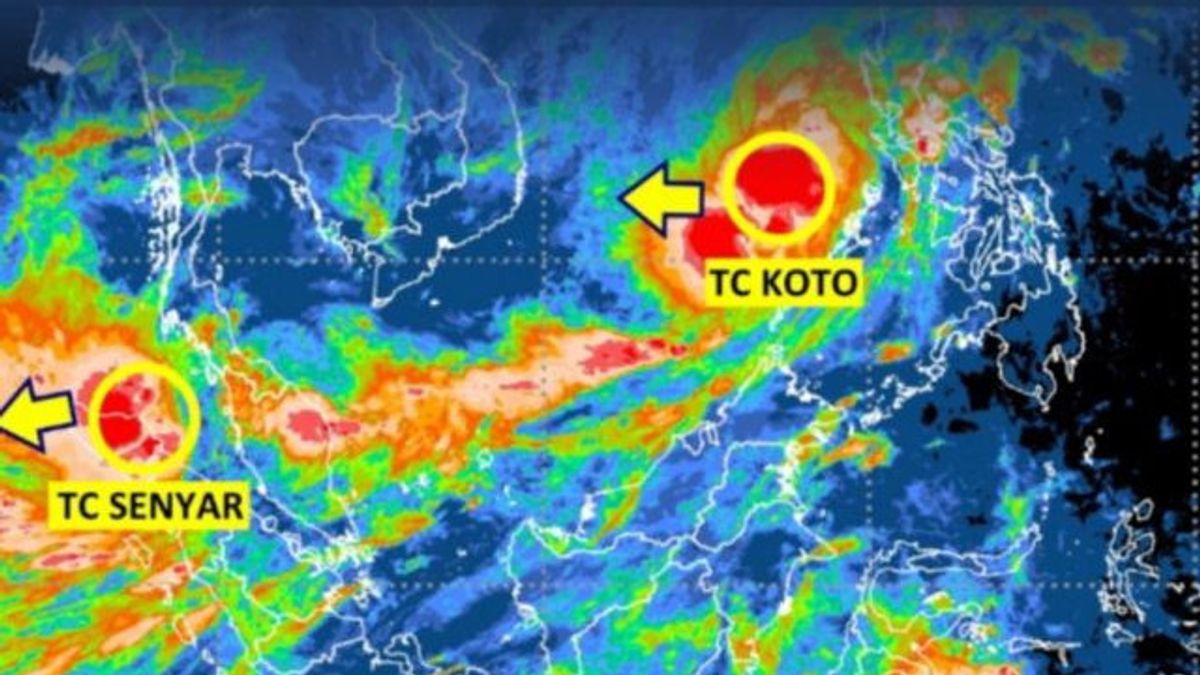


JAKARTA - The Meteorology, Climatology and Geophysics Agency (BMKG) said that the phenomenon of Tropical Cyclone Senyar is relatively unusual in the Malacca Strait region, considering that Indonesia's position is near the equator line which theoretically does not support the formation or trajectory of tropical cyclones.
BMKG Director of Public Meteorology Andri Ramdhani said that although climatologically the territory of Indonesia is not a common route for tropical cyclones, in the last five years quite a lot of cyclone systems have moved closer to Indonesia and had a significant impact, including Tropical Cyclone Senyar.
"Penomenas such as Tropical Cyclone Senyar are not common in the waters of the Malacca Strait, especially if it has an impact on the mainland, therefore the BMKG emphasizes the importance of community preparedness," Andri said, quoted by Antara, Thursday, November 27.
He said that global climate anomalies and regional atmospheric dynamics could increase the chances of forming a low pressure system and cyclone seeds that evolved into tropical cyclones in the region around Indonesia, including those near the equator.
Meteorologists from the BMKG assess that the extreme weather conditions triggered by Senyar not only have an impact on heavy rains and strong winds, but also have the potential to cause floods, coastal floods, landslides, and disruptions to land and sea transportation.
The Meteorology, Climatology and Geophysics Agency (BMKG) said that the extreme weather that occurred in a number of areas in North Sumatra in recent days was the impact of Tropical Cyclone Senyar.
SEE ALSO:
-
 | BERITA
Prabowo Instruksikan Penegakan Aturan Tegas di Bandara IMIP Morowali
27 November 2025, 07:06 -
 | LIFESTYLE
Makanan khas Sulawesi Utara Paling Populer yang Wajib Dicoba Wisatawan, Apa Saja?
27 November 2025, 05:25 -
 | OLAHRAGA
Konsistensi Arsenal Akan Diuji Bayern Munchen, Duel Tim Papan Atas Liga Champions
27 November 2025, 00:15
Tropical Senyar Cyclone is Tropical Cyclone 95B which has grown since November 21, 2025 in the eastern waters of Aceh, precisely in the Malacca Strait. The impact in the past week the region of Aceh, North Sumatra, West Sumatra was hit by rain every day, triggering flash floods accompanied by landslides with significant damage in a number of districts and cities.
For this reason, he emphasized the importance of the active role of local governments in monitoring weather conditions and preparing risk-based mitigation measures, especially in areas prone to these hydrometeorological disasters.
He also reminded fishermen, shipping operators, and coastal communities to pay attention to information on high wave forecasts in order to avoid risky areas and adjust activities at sea.
The BMKG ensures that monitoring takes place intensively and information on updates will continue to be delivered periodically through official channels in an effort to strengthen early warnings to the public.
The English, Chinese, Japanese, Arabic, and French versions are automatically generated by the AI. So there may still be inaccuracies in translating, please always see Indonesian as our main language. (system supported by DigitalSiber.id)


