

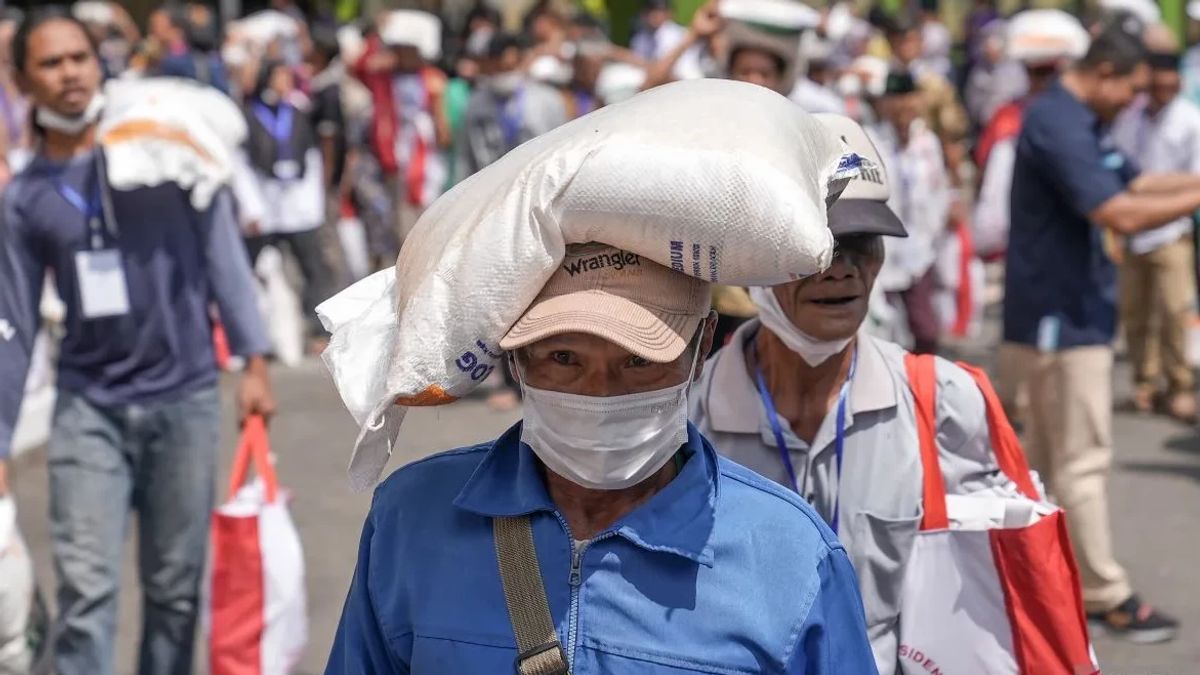


JAKARTA - Deputy Chairman of Commission IV of the House of Representatives Alex Indra Lukman criticized the realization of the distribution of food social assistance (Bansos) in the form of 20 kilograms of medium quality rice and 4 liters of packaged cooking oil for the period October and November, which only reached 4.54 percent as of November 24, 2025.
According to him, the lack of absorption figures shows that the program is not running.
If the distribution report is only 4.54 percent, it means that this program is barely carried out. This also means that the main purpose of this program is initiated to 'preserving people's purchasing power,' so it fails to be realized," Alex told reporters, Tuesday, November 25.
Alex said that this food assistance was intended as an effort to maintain the purchasing power of people registered as recipients of Food Assistance (PBP), which was 18.8 million families.
"This PBP is free of charge. It is different from other social assistance such as PKH (Family Hope Program) or BLT. Because, the focus is on distributing physical food, not cash," he said.
According to the PDIP legislator from the West Sumatra electoral district, the budget allocation for the Food Social Assistance program reached IDR 6.5 trillion with the coverage of all provinces in Indonesia. This budget, said Indra, has quite a significant impact in the framework of maintaining people's purchasing power as intended for this Food Social Assistance.
Alex also warned the institutions assigned by the state to distribute various types of aid in the era of the global economy which continues to be volatile to focus on the goal of the program being initiated.
"The distribution of aid is not only a matter of numbers, but about the psychology of the people who are waiting for assistance that does not come true," said the chairman of the West Sumatra PDIP DPD.
Alex considers that in distributing rice and oil, the government does not experience significant problems. Moreover, he said, rice stocks are very abundant in Bulog warehouses throughout the archipelago. Likewise with cooking oil that is not experiencing scarcity.
Therefore, I question the seriousness of the government in maintaining public trust. When the state decides to provide assistance, it means that the government has read the needs of the community and is obliged to ensure that the distribution of aid is on time," he said.
This Food Social Assistance was first launched in July 2025, in response to the dynamics of the economy and social protection needs for low-income people (MBR).
Although still targeting the MBR group, this Food Social Assistance cannot be accepted by all people. There are strict criteria set by the government based on Integrated Social Welfare Data (DTKS) and National Socio-Economic Single Data (DTSEN).
The main criteria for recipients of economic status are community groups which include the 1 to 4 (LOWest 40 percent of economic groups), poor and vulnerable families, income below the regional poverty line and do not have excess assets.
Then, registered in DTKS/DTSEN, do not receive a fixed salary and the condition of the house and asset with the characteristics, the conditions are simple, do not have a new year's motorized vehicle, do not have a large business and do not have significant savings/investment.
For this Food Social Assistance program, the government provides special priorities for the elderly (above 60 years) family, families with disabilities, pregnant and lactating women, stunting children or malnutrition and families with many dependents (more than 4 children).
The English, Chinese, Japanese, Arabic, and French versions are automatically generated by the AI. So there may still be inaccuracies in translating, please always see Indonesian as our main language. (system supported by DigitalSiber.id)


