
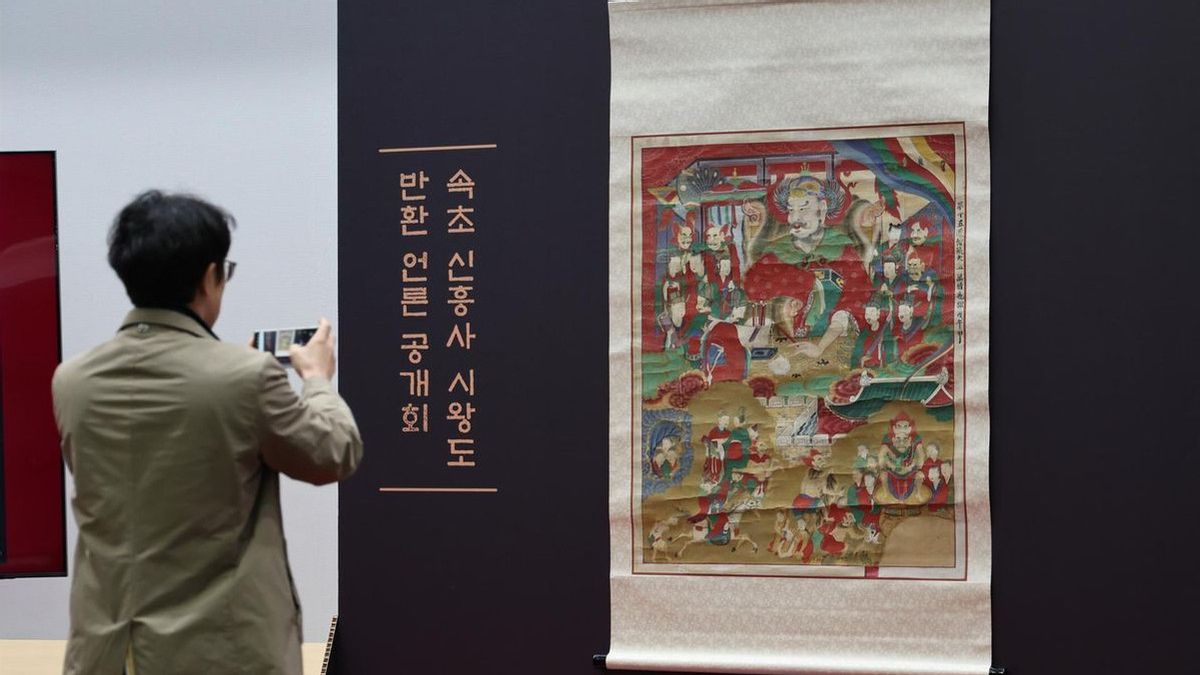


JAKARTA - Buddhist painting from the end of the Joseon Dynasty has been returned to Korea from the United States, about 70 years after it is believed to have been removed from a temple after the 1950 '1953 Korean War.
The Metropolitan Museum of Art (Met) in New York, United States said on Friday it had repatriated "Siwangdo" one of the 10 series of works depicting 10 kings in the afterlife to the Sin regard Temple in the eastern coastal city of Sokcho.
Painting in 1798 during the Joseon Dynasty (1392-1910), the work was allegedly taken illegally from the temple's Myeongbujeon, a hall dedicated to 10 kings, in 1954, when Korea was under US military administration, quoted from The Korea Times November 14.
A 1942 survey by the Japanese government-general in Korea noted the painting's presence at the temple, and its existence was also documented in photos taken by US military officers between 1953 and 1954.
Six panels from the "Siwangdo" set were returned to Korea in 2020 from the Los Angeles County Museum of Art (LACMA), but four panels, including those newly repatriated, are still overseas.
The painting, measuring 116.8 centimeters long and 91.4 cm wide, depicts the 10th and last king that judges the dead according to Buddhist beliefs.
This return is made possible through a collaboration between the Korean Cultural Heritage Foundation Abroad, the Korean Buddhist Jogye Order, the Sinmen's Temple, and the local community group that campaigns for the recovery of cultural assets brought abroad.
Lee Sang-rae, leader of Sokcho-based activist group, said the painting "appears to have been brought to the US around 1954, shortly after the Korean War."
Met obtained the panel in 2007. Temple officials and civil activists identified the work on the museum's website and started formal discussions on its return in 2023 after verifying its origins.
"The 'Siwangdo' art work owned by LACMA and Met appears to have been taken abroad at different times," Lee said.
SEE ALSO:
-
 | BERITA
Indonesia Harapkan Rancangan Resolusi DK PBB Dapat Menjembatani Perdamaian di Palestina
15 November 2025, 16:50 -
 | BERITA
AS Perketat Penerbitan Visa, Pengidap Diabetes hingga Obesitas Terancam Tidak Boleh Masuk
15 November 2025, 12:00 -
 | BERITA
Indonesia Terpilih Sebagai Anggota Dewan Eksekutif IOC dan Komite MOST UNESCO
15 November 2025, 09:00

"We are preparing various materials to prove that the painting came from the Sin hyacinth and to clarify the timing of the transfer," he added.
Regarding how the two museums got their own panels, he added: "Initially we believed the panels were owned by the previous owners who were the same, but they didn't. We plan to continue to look for the three remaining works of art."
Six "Siwangdo" panels that were previously repatriated are still stored at the Sin Maritime Temple. The newly returned work will be placed next to them, and officials will consider options to be exhibited to the public in the future.
The English, Chinese, Japanese, Arabic, and French versions are automatically generated by the AI. So there may still be inaccuracies in translating, please always see Indonesian as our main language. (system supported by DigitalSiber.id)
Popular


