

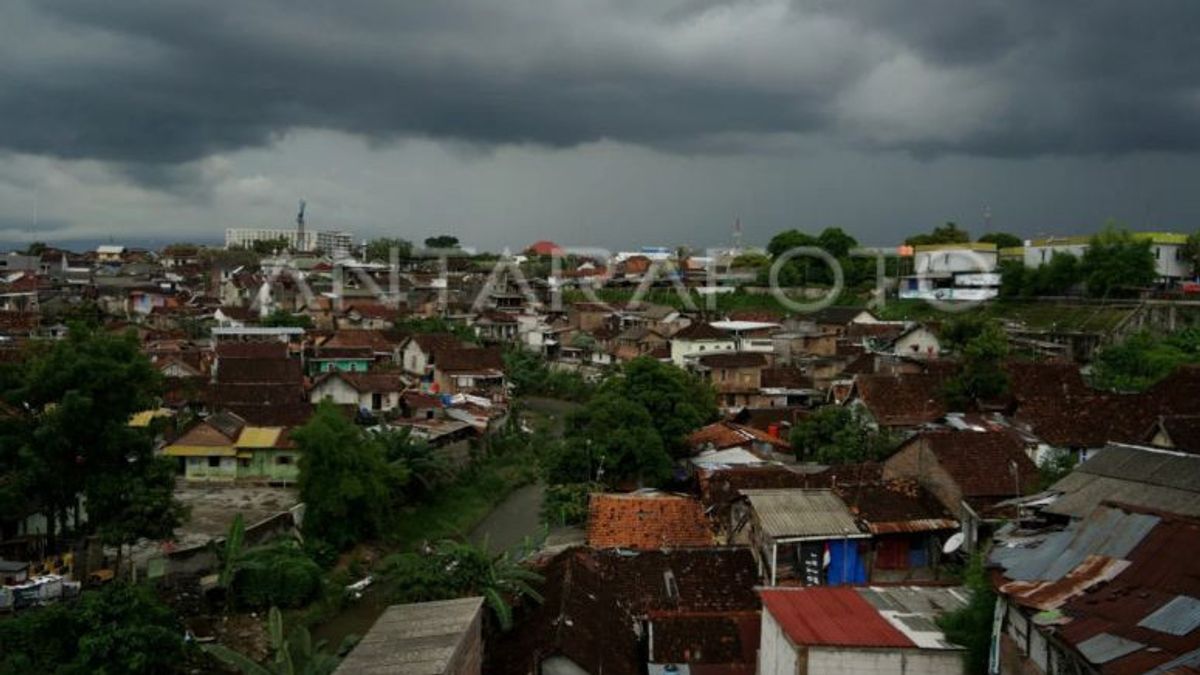


YOGYAKARTA - The Regional Disaster Management Agency (BPBD) of the Special Region of Yogyakarta (DIY) has prepared a weather modification operation (OMC) to move rain into the sea to prevent potential hydrometeorological disasters in this province.
"We have a weather modification operation (OMC), it actually intervenes in weather conditions that have the potential to cause extreme weather, too heavy rain," said DIY BPBD Chief Executive Agustinus Ruruh Haryata as reported by ANTARA, Friday, November 14.
Ruruh Haryata said the weather engineering was prepared considering that DIY is now in the emergency status of a hydrometeorological disaster.
This status is stated in the Decree of the Governor of DIY Number 347/2025 which is valid from October 20 to November 19, 2025 and can be extended according to conditions.
The technical implementation of OMC, he said, would be carried out by the National Disaster Management Agency (BNPB), while the DIY BPBD prepared the basis for regulation through the determination of the status.
"We are only preparing from the regulatory side. The local government has issued it, through the Governor, the Governor's Decree on the hydrometeorological disaster alert, from the decree, it can later become the basis for BNPB to intervene in OMC earlier," he said.
According to Ruruh, the implementation of OMC in DIY is the first time this has been done. This technology is used to direct the potential for heavy rain on land to the sea so as not to pose a disaster risk.
"The point is that the rain will be directed, shifted to the sea. So if the potential for rain is in the mainland position, it will be shifted, through technological intervention, to the sea," he said.
Regarding the timing of the OMC implementation, according to Ruruh, it depends on weather predictions, especially if extreme weather indications appear.
"It depends on what the weather is like, if there are extreme weather predictions, maybe BNPB will make that effort," he said.
Ruruh ensured that there would be no negative impact when the technology was implemented.
"Of course 'no' (there is a negative impact). The impact is positive because we control it so that there is no potential for disasters," he said.
In addition to the provincial level, according to him, districts/cities in the region have prepared a similar status determination to support anticipatory steps to face the peak of the rainy season.
Head of DIY Climatology Station Reni Kraningtyas said the rainfall in DIY in November 2025 is predicted to be in the range of 201 - 500 mm per month with the above normal rainfall properties.
As for December 2025, rainfall is estimated to be 151 - 500 mm per month with normal properties, and in January 2026 it ranges from 201 - 500 mm per month with normal properties.
Reni appealed to the community and local governments in flood-prone areas, landslides, and strong winds to increase their vigilance against the peak of the rainy season.
"Taking disaster mitigation includes cleaning waterways, cutting tree branches, ensuring the strength of billboards on roads and other disaster mitigation measures," said Reni.
The English, Chinese, Japanese, Arabic, and French versions are automatically generated by the AI. So there may still be inaccuracies in translating, please always see Indonesian as our main language. (system supported by DigitalSiber.id)
Popular


