

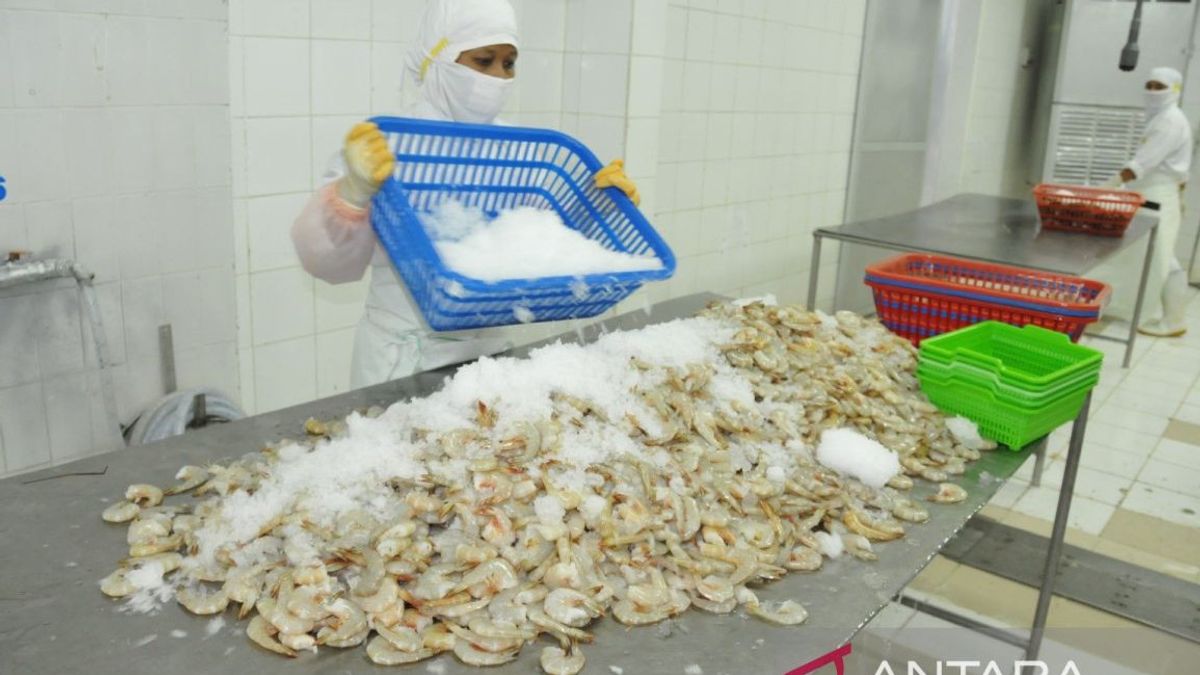


JAKARTA - Member of Commission IV DPR RI, Daniel Johan asked the Government to seriously evaluate the return of hundreds of tons of shrimp from Indonesia by the United States (US) amid the findings of Indonesian frozen shrimp containing Cesium-137 (Cs-137) radioactive contamination.
According to him, the case is not only a matter of export losses or pollution of fishery products, but concerns the reputation, credibility, and international trust in Indonesia's food security.
"The case of returning shrimp from the United States is not just a technical problem for exports, but touches on the credibility of the fisheries industry and global market confidence in Indonesian products. If this continues, the nation's trade face and the country's credibility in ensuring sea food security can be tarnished in the eyes of the international community," Daniel told reporters, Saturday, November 8.
Daniel assessed that the KKP together with the Ministry of Trade (Kemendag), BPOM, and the National Research and Innovation Agency (BRIN) needed to immediately conduct a thorough audit of the national shrimp production and export chain. According to him, audits must trace the origin of the source of the raw materials, processing process, and the security certification system used by exporters.
"Audits must be carried out from upstream to downstream, starting from pond locations, sea water sources, feed, to processing and export chains," said Daniel.
So far, our export supervision is still too fragmented between institutions. There are quality certifications at the KKP, food inspections at BPOM, and export clearance at the Ministry of Trade. But when there is a problem, coordination is slow. This must be integrated," he continued.
The member of the Commission in the DPR in charge of food and fisheries affairs also emphasized the importance of cross-institutional cooperation, including with the Ministry of Environment. This, said Daniel, is to ensure that there is no leakage of radioactive substances from industrial or waste activities that pollute the coastal environment.
"It is also necessary to pay attention to the weak export control system of Indonesian marine products," he said.
Although shrimp is one of the leading export commodities, according to Daniel, this case proves that the pre-export mechanism (pre-ship inspection) has not been implemented strictly and integrated between institutions.
Therefore, Daniel assessed that the KKP needs to strengthen national marine food quality and safety standards (National Fish Quality Assurance System) which not only meet domestic standards, but also precede export destination countries such as the US, European Union, and Japan.
SEE ALSO:
-
 | OLAHRAGA
Indonesia Masih Belum Punya Lawan 5 Hari Jelang FIFA Matchday November
05 November 2025, 21:15 -
 | OLAHRAGA
Bintang Veteran, Ronaldo dan Messi, Masih Saja Berseteru soal Klaim Terbaik di Dunia
05 November 2025, 18:45

Daniel also asked the government to build an early detection system (early warning system) to ensure the safety of marine products from the risk of chemical, microbial, or radioactive contamination.
In addition, the government is also asked to periodically publish the results of national laboratory tests on marine food exports, so that the public and international partners have confidence in the transparency of Indonesia's data.
"The public has the right to know the extent to which our fishery products are safe. The government must open test data regularly. Transparency is the key to restoring market confidence," concluded Daniel.
The English, Chinese, Japanese, Arabic, and French versions are automatically generated by the AI. So there may still be inaccuracies in translating, please always see Indonesian as our main language. (system supported by DigitalSiber.id)
Most Popular Tags
#Prabowo Subianto #donald trump #Febrie Adriansyah #8791 #giias 2026Popular


