
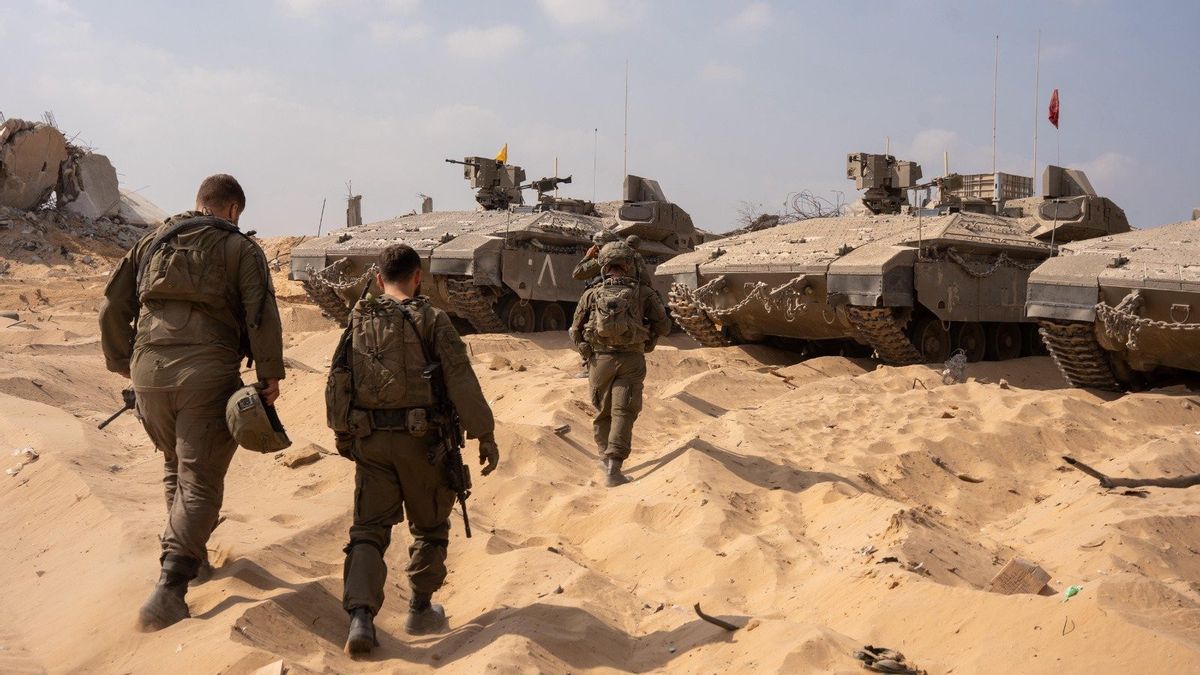


JAKARTA - A proposal proposing the handover of weapons for Hamas members in the Rafah region, the Israeli-controlled Gaza Strip will hand over their weapons in exchange for access out of Israeli-controlled territory.
This was done as part of a proposal to resolve issues deemed risky to the ceasefire that had been going on for a month, according to two sources familiar with the negotiations.
United States Special Envoy Steve Witkoff said the proposed deal for about 200 fighters would be a test for a broader process to strip the weapons of Hamas troops across Gaza.
"We'll probably see an example of what we're trying to do (in all of Gaza) with 200 fighters trapped in Rafah, and whether they're going to be able to raise their hands, come out and hand over their weapons," Witkoff said at a business conference in Florida. November 7th.
"So this will be one of the tests," he said.
Since the US-brokered ceasefire took effect in Gaza on October 10, the Rafah region has been the site of at least two attacks on Israeli forces allegedly carried out by Hamas; the militant group has denied responsibility.
Egyptian mediators have proposed that, in exchange for safe access, the fighters who are still in Rafah hand over their weapons to Egypt and provide details of the tunnels there so that the tunnel can be destroyed, said one of the sources, an Egyptian security official.
Israel and Hamas have not publicly accepted the mediator's proposal, the two sources said. Meanwhile, a third source confirmed negotiations on the matter were ongoing.
The Israeli Prime Minister's office did not immediately respond to a request for comment on the report; Hazem Qassem, a spokesman for Hamas in Gaza, declined to comment.
The attack on Rafah turned out to be one of the worst violence since the ceasefire came into force, with three Israeli soldiers killed, sparking Israeli retaliation that killed dozens of Palestinians.
Two sources said Hamas fighters in Rafah, who the group's armed wing had lost contact since March, may not have been aware of a ceasefire.
One source added that expelling the fighters was an important step to maintain the ceasefire.
The sources did not specify how many Hamas fighters might be hiding in the Rafah region.
This ceasefire is the first phase of US President Donald Trump's plan to end Gaza's war.
The militant group has released the last 20 living hostages to be carried out in a Hamas-led attack on Israel on October 7, 2023 in exchange for nearly 2,000 Palestinian prisoners; Israeli forces have been withdrawn from the western region of Gaza, where Hamas is still in control.
SEE ALSO:
-
 | BERITA
Presiden Meksiko Sheinbaum Bawa Kasus Pelecehan Terhadapnya ke Ranah Hukum
07 November 2025, 05:00 -
 | BERITA
Israel Lakukan Kampanye Teror Terorganisir Terhadap Keluarga Tahanan Palestina
07 November 2025, 04:00 -
 | BERITA
Presiden Abbas Berterima Kasih kepada Paus Leo XIV Atas Dukungan untuk Mencapai Perdamaian
06 November 2025, 21:30


Details of the next phase of Trump's plan, requiring Hamas to lay off arms and give up control of Gaza, have not been agreed upon.
The plan expects Gaza to be ruled by a technocratic Palestinian committee with international surveillance and deployment of international troops.
Witkoff, one of the US negotiators in the plan, said efforts to form international security forces would be completed in the next three weeks and it would be a moment for Hamas to deactivate its fighters and demilitarize the Gaza Strip.
The English, Chinese, Japanese, Arabic, and French versions are automatically generated by the AI. So there may still be inaccuracies in translating, please always see Indonesian as our main language. (system supported by DigitalSiber.id)
Most Popular Tags
#Prabowo Subianto #donald trump #Febrie Adriansyah #8791 #giias 2026Popular


