

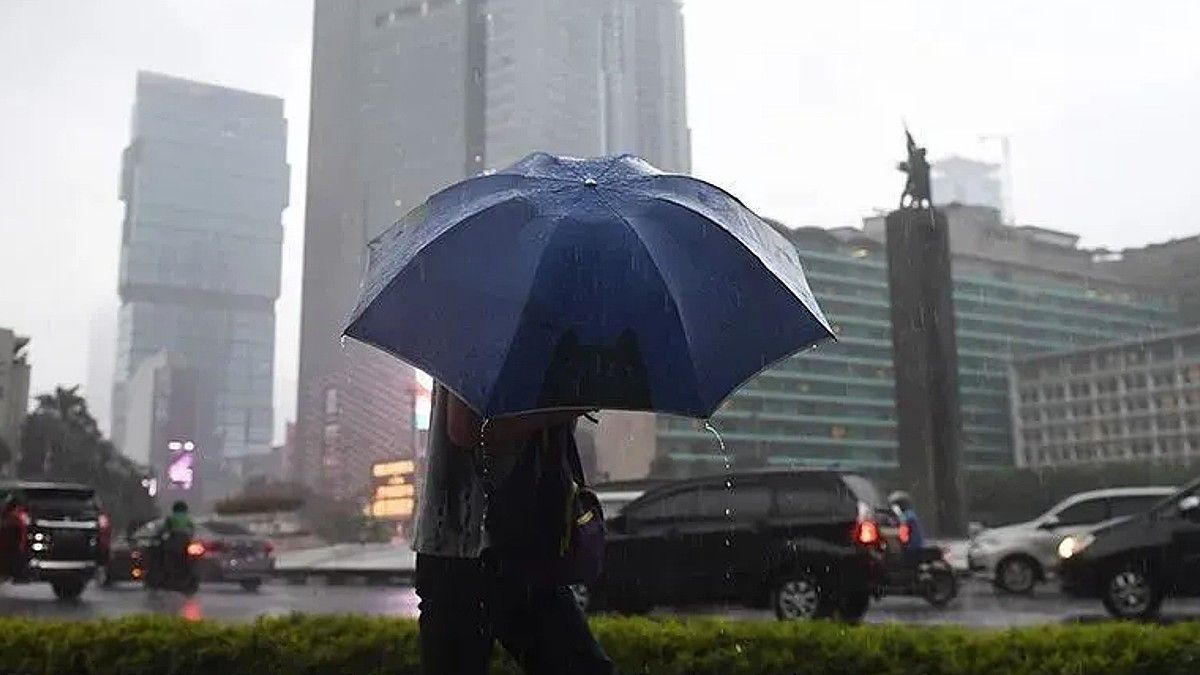


Minister of Health Budi Gunadi Sadikin appealed to Jakarta residents to increase their awareness of the potential for microplastic exposure in the air, especially when and after the rain fell.
Budi advised people to use masks when doing activities outdoors to minimize the risk of microplastic particles being inhaled into the body.
"So if this plastic goes inside, it will be a long stay. My appeal to the public is that if possible, it is the safest to protect it from wearing masks when traveling outside," said Budi at the Ministry of Health office, South Jakarta, Tuesday, October 28.
According to him, microplastics carried by rainwater can descend to the ground surface and return to the air with dust or water vapor. This condition makes microplastic exposure difficult to avoid, especially in urban areas with high levels of pollution.
"But if not, then try not to walk outside after it rains because it's falling near the rain, right, the particles," he said.
Budi assessed that the handling of microplastic pollution is not enough just through a health approach. The most effective prevention, he said, must start from the source, namely by reducing the use of single-use plastic and improving the waste management system upstream.
"Maybe other prevention is the best upstream. This means that we really have to reduce the source of pollution from this microplastic," he explained.
Furthermore, Budi assessed that local governments play an important role in controlling microplastic pollution, including through waste management policies and air pollution control.
"This is indeed the role of the Governor of DKI Jakarta, it is very important. Pak Gubnya plays a lot of roles, the pollution is reduced, we at the Ministry of Health will also have a very reduced burden," said Budi.
Microplastic threats in the air and rainwater cannot be taken lightly. Researcher of the National Research and Innovation Agency (BRIN) Muhammad Reza Cordova revealed, microplastic particles have the ability such as sponges that easily absorb other substances around them.
It is this trait that makes microplastics have the potential to bring various pollutants, even microorganisms and viruses, into the human body through the air inhaled.
"Microplastics in the air have characteristics such as sponge bearing, easy to absorb other substances in the vicinity. This means that microplastic particles can become a medium for carrying other pollutants, even microorganisms or viruses, which are then inhaled by humans," said Reza in a discussion at DKI Jakarta City Hall, Friday, October 24.
SEE ALSO:
-
 | BERITA
Komisi V DPR Dukung Perpres Ojol: Mitra Ojol Tulang Punggung Mobilitas Era Digital
28 Oktober 2025, 13:11 -
 | BERITA
Libya Jadi Transit Imigran Afrika Dijanjikan ke Eropa Tapi Justru Ditahan-Disiksa Milisi
28 Oktober 2025, 04:02 -
 | BERITA
Bawa Ekskavator-Buldoser, Mesir Bantu Hamas Cari Jenazah Bakal Diserahkan ke Israel
28 Oktober 2025, 03:03 -
 | BERITA
Jawaban Trump di Pesawat saat Ditanya Gaji Pengatur Lalin Udara AS Terdampak Shutdown
28 Oktober 2025, 02:02 -
 | BERITA
Helikopter-Jet Tempur AS Jatuh di Laut China Selatan, Seluruh Awak Selamat
27 Oktober 2025, 17:34
According to him, the impact of microplastics on the human body is still in the research stage. However, a number of findings show indications that these particles can cause irritation or inflammation, especially in the respiratory tract.
"If the size is smaller than 50 microns, even the size of a dust particle or bacteria, then microplastics have the potential to enter the circulation of blood, and from there it can lead to vital organs such as the heart," he said.
The English, Chinese, Japanese, Arabic, and French versions are automatically generated by the AI. So there may still be inaccuracies in translating, please always see Indonesian as our main language. (system supported by DigitalSiber.id)
Popular


