

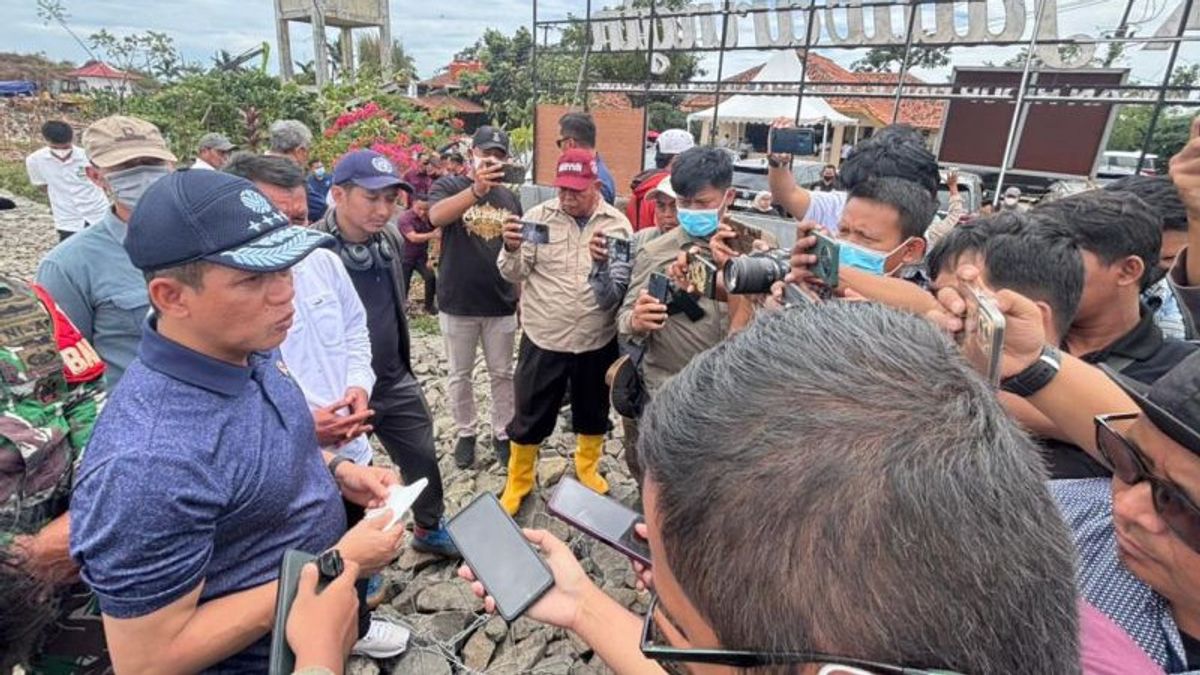


JAKARTA - Minister of Environment Hanif Faisol Nurofiq asked all managers of Final Processing Sites (TPA) in the Jabodetabek area to immediately cap or close piles of garbage to prevent environmental pollution and the spread of microplastics.
When reviewing the Jatiwaringin TPA in Tangerang Regency, Friday, October 24, Hanif expressed his appreciation for the steps taken by the local government for capping the TPA with an open dumping system, which had previously received sanctions from the Ministry of Environment (KLH).
"I will give time to all TPA managers in Jabodetabek to immediately comply with the Minister's directives, immediately cap the open dumping," said Hanif as quoted by Antara.
He emphasized that this step is important to suppress the spread of microplastics into the environment, which has the potential to enter the food chain and endanger human health.
According to data from the National Waste Management Information System (SIPSN), plastic waste occupies the second largest position, namely 19.52 percent of the total 34.9 million tons of national waste recorded in 2024.
Hanif explained that capping is a temporary step while waiting for the completion of open TPA management in various regions. This effort functions to avoid rainwater mixed with garbage, which can produce polluting lindies (water), prevent flying waste, and control methane gas from piles of garbage.
"If microplastics are not prevented, they can dissolve into the water, get carried away by the air, or enter the ground, and finally enter our bodies. So we have to stop it from the source," said Hanif.
Microplastics arise from imperfect degradation of plastic waste, as well as from the fibers of synthetic materials such as polyester, nylon, and polypropylene, including vehicle tire abrasion. Microplastic particles are now found in various media, from water to air.
SEE ALSO:
-
 | BERITA
Polda Jatim Tegaskan Penangkapan Aktivis Paul Sesuai Prosedur Hukum
30 September 2025, 21:09 -
 | BERITA
Wagub Jatim: Proyek KRL Surabaya Segera Masuk Tahap Perencanaan Teknis
06 Oktober 2025, 19:05 -
 | BERITA
Menag: Kehadiran Ditjen Pesantren Perkuat Koordinasi Ponpes Secara Nasional
22 Oktober 2025, 13:46

Researcher from the National Research and Innovation Agency (BRIN), Muhammad Reza Cordova, previously revealed that microplastics had been detected in rainwater in the Jakarta area, due to the process of depositivating the microplastic atmosphere. This phenomenon occurs when plastic particles are lifted into the air through street dust, combustion smoke, and industrial activity, then carried away by the wind and fell back with the rain.
The English, Chinese, Japanese, Arabic, and French versions are automatically generated by the AI. So there may still be inaccuracies in translating, please always see Indonesian as our main language. (system supported by DigitalSiber.id)
Popular


