

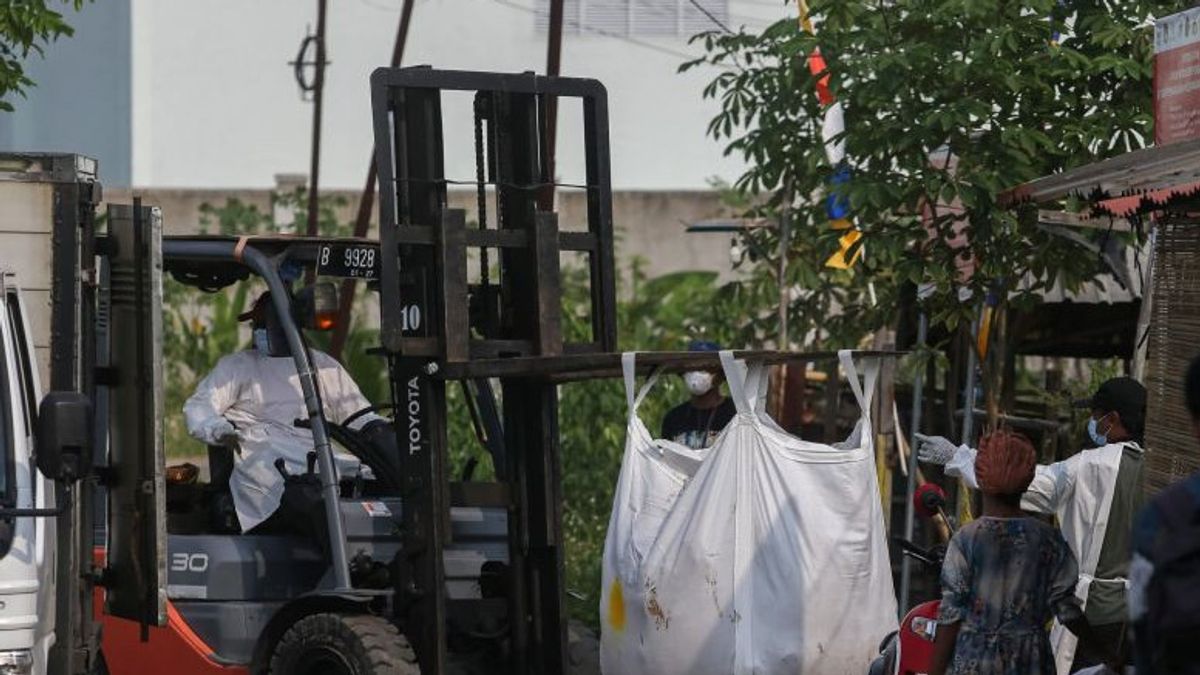


SERANG - The National Research and Innovation Agency (BRIN) received a number of soil samples from locations affected by radionuclide radiation Cesium-137 (Cs-137) in Cikande District, Serang Regency, Banten, to analyze the level of contamination to ensure that the dactination process runs effectively and safely for the community.
Deputy for Control of Pollution and Environmental Damage (PPKL) of the Ministry of Environment (KLH) Ratio Ridho Sani said laboratory tests are an important stage in verifying the results of decontamination.
The soil sample from the location of C1 and F has been sent to BRIN for testing. The results will show the extent to which the cleaning that has been carried out has succeeded in reducing the level of radiation," said Rasio as quoted by ANTARA, Monday, October 20.
The ratio of affirming scientific approaches through BRIN research is needed so that the government's decision has a strong technical basis.
"The handling of Cs-137 cannot be just administrative. It must be based on scientific data and laboratory results so that the decisions taken really ensure safety," he said.
The commander of the KBRN Unit (Kimia, Biology, Eadiology and Nuclear) Gegana Brimob Kombes Pol Yopie Indra Prasetya Sepang explained that the results of the BRIN test would later become a reference for the Nuclear Energy Supervisory Agency (Bapeten) in establishing a clear and clean status of a location.
"If the results show the radiation dose is below the threshold, Bapeten can state a clean location," he said.
Meanwhile, Colonel Czi Yudil Hendro from Nubika (Nuclear, Biological, and Chemical) of the Indonesian Army said the tightening and coring processes were carried out with great care in the field.
"We only stopped cleaning after the detection tool showed radiation doses below 2.5 microsieverts. After that, it was sent to BRIN for laboratory verification," he said.
The ratio said if laboratory results showed the level of radiation was still above standard, the government would carry out additional decontamination. "We don't want any risk left for the community. All locations must be completely safe before they are declared complete," he said.
SEE ALSO:
-
 | BERITA
Polisi Nigeria Tembakkan Gas Air Mata Bubarkan Demo Protes Penahana Pemimpin Separatis
20 Oktober 2025, 19:33

This step, said Rasio, shows the synergy between research institutions, security forces, and local governments, in handling Cs-137 cases.
"We work with the principles of prudence, science, and collaboration to ensure the safety of the community and the sustainability of industrial activities," he said.
The government ensures that all BRIN test results will be submitted to Bapeten before the final decision on regional security status is announced. "We want this process to be transparent, accountable, and scientific evidence-based," said Rasio.
The English, Chinese, Japanese, Arabic, and French versions are automatically generated by the AI. So there may still be inaccuracies in translating, please always see Indonesian as our main language. (system supported by DigitalSiber.id)
Popular


