
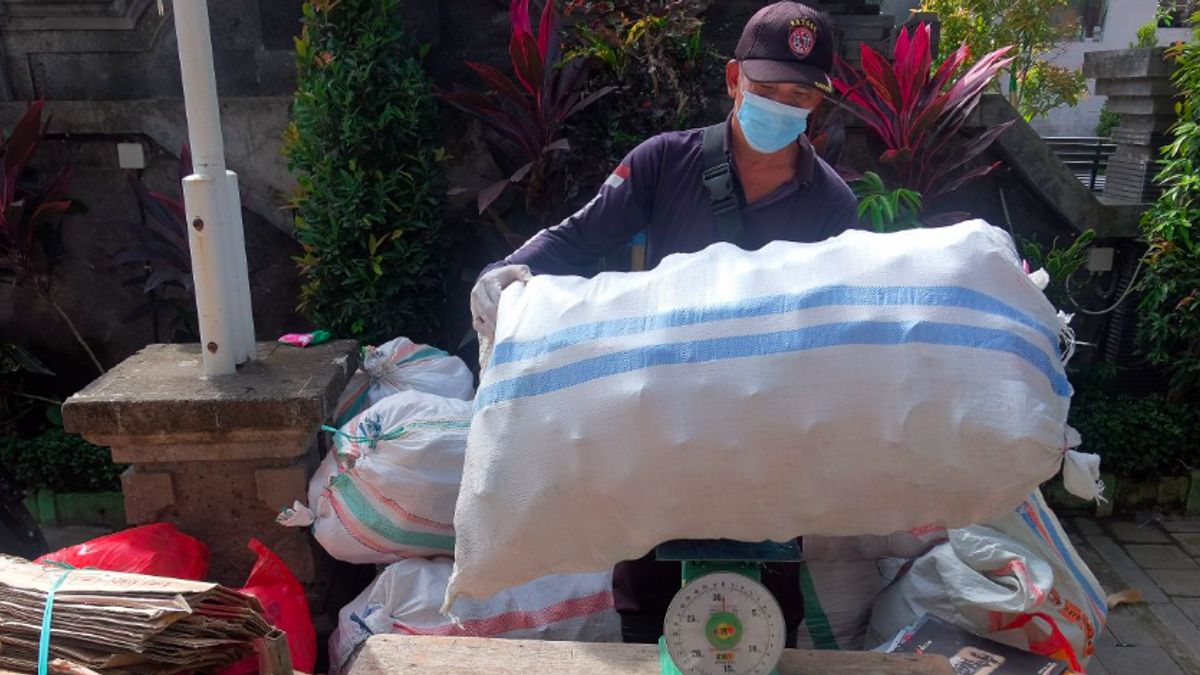


JAKARTA - The City Government (Pemkot) of Banjarmasin, South Kalimantan, is intensifying waste management by mobilizing 435 waste banks spread across all urban villages.
This step is part of the waste emergency handling strategy that has hit the city since the closure of the active zone of the Basirih Final Processing Site (TPA).
Banjarmasin Mayor Muhammad Yamin HR said that waste banks have an important role in strengthening sorting and waste management systems from their sources.
"Currently, 435 waste banks have been formed in all urban villages, this must be moved significantly," he said in Banjarmasin, Sunday.
According to him, the reactivation of these waste banks aims to increase public awareness to sort waste from home, optimize management to be more efficient, and reduce the amount of waste sent to the Basirih TPAS.
Yamin explained that the waste emergency conditions emerged after the Ministry of Environment and Forestry (KLHK) closed the Basirih TPAS active zone since February 1, 2025.
As a result, garbage from Banjarmasin City must now be transported to the Banjarbakula Regional TPA in Banjarbaru provided that it only accepts limited amount of residual waste.
"This condition requires all of us to synergize to reduce waste from sources. One of the efforts that has long been known is the 3R system (Reuse, Reduce, Recycle). In its development, a waste bank emerged which became a collective system to accommodate, sort and distribute economic-valued waste to the market, so that people would benefit financially and the environment would be cleaner," he said.
SEE ALSO:
-
 | EKONOMI
Menteri Trenggono Pastikan Kasus Radioaktif Cs-137 Tak Pengaruhi Ekspor Udang
10 Oktober 2025, 21:06

Data from the Environmental Service (DLH) of Banjarmasin City noted that of the 435 waste banks that have been formed, less than 200 units are still actively operating. Through the reactivation program, the government is currently conducting an inventory and mapping of obstacles in the field so that all units can function again.
The Mayor of Yamin also appealed to all waste bank managers to collaborate with the government in solving waste problems in this city.
"The existence of a waste bank is expected to make it easier for the community to carry out waste management with a 3R system. Because as a waste producer, we are responsible for the waste we produce. Let's change our behavior by building new literacy in waste management, namely 'My Responsibility'," he said.
He hopes that through this movement, more than 200 waste banks that were not active can operate gradually, so as to accelerate the reduction in waste volume in Banjarmasin City.
The English, Chinese, Japanese, Arabic, and French versions are automatically generated by the AI. So there may still be inaccuracies in translating, please always see Indonesian as our main language. (system supported by DigitalSiber.id)
Most Popular Tags
#Prabowo Subianto #donald trump #Febrie Adriansyah #8791 #giias 2026Popular


