

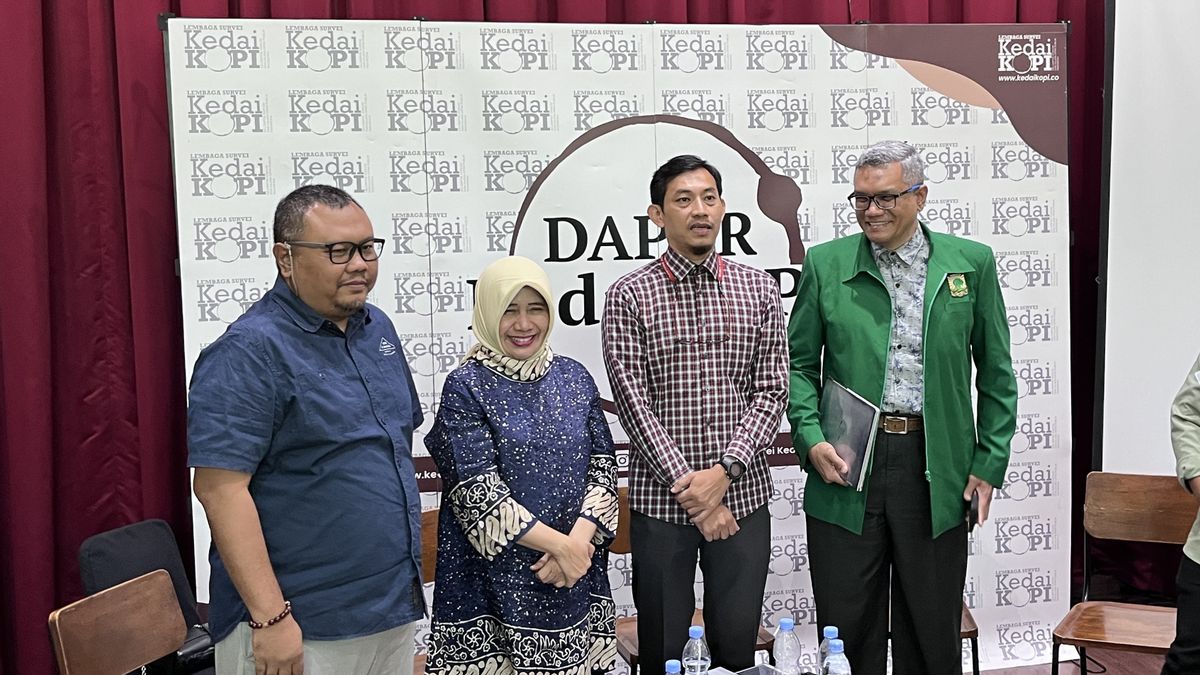


The issue of food security has returned to the public's attention in the country. Although it is considered to have moved in a more concrete direction, experts consider that there are still a number of homework, especially in expanding communication and equitable distribution of self-sufficiency achievements in various sectors.
Political communication analyst Hendri Satrio assessed that the government's attention to food issues was increasingly clearly visible in the first year of President Prabowo Subianto's administration.
"The issue of food security is interesting because it is President Prabowo's focus in bringing Indonesia towards food sovereignty," said Hendri in a discussion "1 Year of Prabowo's Government, What's the Food Security News?" held by the KedaiKOPI Survey Institute, Menteng, Central Jakarta, Saturday, October 11.
SEE ALSO:
-
 | BERITA
Menteri LH Sebut Pencampuran Etanol Bisa Kurangi Kandungan Sulfur BBM
11 Oktober 2025, 17:05 -
 | BERITA
Ragunan Dibuka Malam Hari, Satpol PP Dirikan Posko Awasi Tindakan Asusila
11 Oktober 2025, 15:55



Hendri reminded that the government's communication about food has not yet fully reached the middle class. He said that this layer actually has a big role in forming public opinion.
"Food communication rarely touches the middle class. In this middle class, he has one control of communication media, two of them are rarely touched by the government," said Hendri.
"This government takes a lot of care of the lower class. So that the middle class later, we will wait for when. But the problem is, if the middle class is not handled for a long time, it will make the government dizzy," he added.
In terms of public perception, the results of research presented by Kompas Daily Research and Development researcher, Budiawan Sidik Arifianto, show that the level of public satisfaction with the agricultural sector is relatively high.
"Their satisfaction with agricultural performance is relatively very high, around 71 percent. People still welcome it positively," explained Budiawan.
He added that the majority of the people also believe that the government's policy to increase the price of harvested dry unhulled rice (GKP) will have a positive impact on the welfare of farmers.
"The public believes as much as 77 percent that increasing the price of GKP can improve the welfare of farmers," he said.
Meanwhile, University of Indonesia economist Ninasapti Triaswati assessed that Indonesia's food self-sufficiency achievement has not been evenly distributed in all commodities. According to him, the success of self-sufficiency has only been seen in the rice sector, while soybeans and sugar are still big homework.
"Actually, what is the target of self-sufficiency? Actually, those who have reached self-sufficiency are rice, although there are still imports. But those who haven't and are still in trouble, soybeans and sugar actually," he said.
Ninaatti also highlighted that the focus of food policy so far is still more focused on the agricultural sector. "In general, if we focus on food self-sufficiency, it is still on agriculture, not livestock and plantations," he added.
Food expert at Andalas University, M. Makky, assessed that the government's attention to farmers has increased significantly in the past year. He assessed that the government's approach is now mostly carried out directly in the field through agricultural instructors.
"The government's attention is enormous. Farmers are now active and on standby in the lands. That's clear evidence that attention to farmers is increasing," said Makky.
According to him, food security is not enough to be built only through policies from the center, but also through the assistance and empowerment of farmers at the grassroots level. The field-based approach, he said, would be more effective in maintaining national production and food stability.
The English, Chinese, Japanese, Arabic, and French versions are automatically generated by the AI. So there may still be inaccuracies in translating, please always see Indonesian as our main language. (system supported by DigitalSiber.id)


