

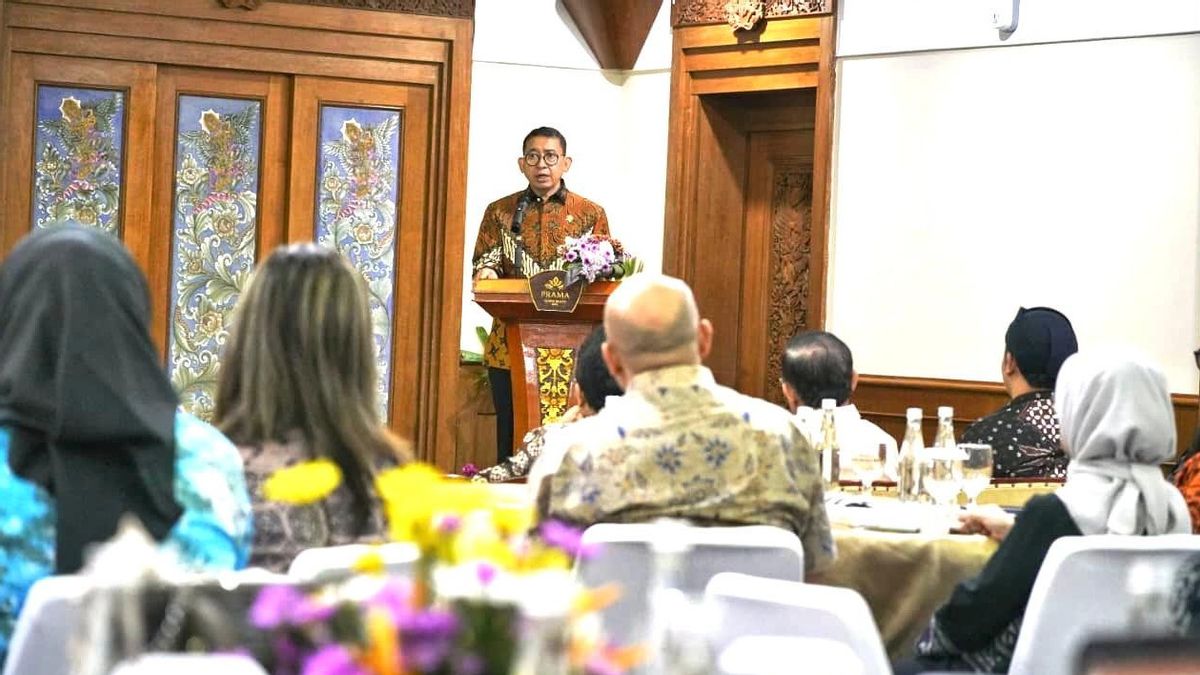


The Ministry of Culture of the Republic of Indonesia is organizing an agenda for the preparation of the Strategy for the Development and Utilization of Cultural Facilities and Infrastructure at the Prama Sanur Beach Hotel Bali, Denpasar, Bali. In his remarks, the Minister of Culture Fadli Zon emphasized the importance of the role of cultural facilities and infrastructure as the main infrastructure in the preservation, development, as well as utilization of national culture.
Art buildings, museums, cultural halls, cultural parks, and cultural archives are not just physical facilities, but a living space for culture itself. Menbud Fadli emphasized that the policy direction formulated by the Ministry of Culture is not only aimed at ensuring the availability of infrastructure, but also ensuring its function to be optimal for the community.
Furthermore, he highlighted the important role of cultural arts colleges. Campuses, according to him, are Indonesian cultural laboratories, places of various values, ideas, ideas, and experiments in the arts and culture are tested and developed. History records that cultural arts campuses in various parts of the world have also become the driving force for major changes. The Beat Generation movement in the United States was born from Columbia University, while Kala Bhavana, spearheaded Rabindranath Tagore in India, became the foundation of modern art as well as a symbol of resistance to colonialism.
Menbud Fadli emphasized the importance of synergy between the Ministry of Culture and higher education institutions in advancing Indonesian culture. He stated that universities have a vital role in institutionalizing cultural values, both intangible cultural heritage and objects.
"This is where experts will be born who are the pioneers of cultural promotion. We have a constitutional mandate, especially Article 32 Paragraph 1 of the 1945 Constitution, which emphasizes that the state is obliged to advance Indonesia's national culture in the midst of world civilization," said Menbud Fadli.
SEE ALSO:
-
 | BERITA
Menteri HAM Pigai soal Penanganan Demo: RI Lebih Cepat dari Imbauan PBB
02 September 2025, 15:51 -
 | BERITA
Komisi I DPR Desak Investigasi Tuntas Penembakan Diplomat Indonesia di Peru
02 September 2025, 15:34
Since the establishment of the Ministry of Culture in October 2024, this institution has faced various major challenges in a short time. However, Menbud Fadli emphasized that cross-sectoral collaboration is the key to success, including with local governments, cultural communities, and of course, arts and cultural campuses in Indonesia.
Indonesia is said to have great potential to become a super power in the field of culture. With more than 2,213 unregistered cultural heritages and thousands more that have not been recorded, Indonesia is considered to have unmatched cultural wealth in the world.
From dances, music, performing arts, traditional games, manuscripts, language, literature, to culinary, Indonesia has extraordinary cultural power. Our challenge is how to manage and use it to provide great benefits to the nation and the world," he said.
Menbud Fadli also highlighted the importance of a healthy and sustainable cultural ecosystem, as well as strengthening the cultural and Creative Industry (CCI)-based creative industry, which has proven to be a significant contributor to the national economy.
An example of the success of the Indonesian cultural industry, among others, is the development of national films that won more than 81 million viewers in 2024. However, Menbud Fadli also reminded the importance of maintaining the sustainability of the cinema ecosystem in the midst of competition with digital platforms or OTT.
Meanwhile, the Director of Facilities and Infrastructure, Feri Arlius, in his report said that the preparation of this strategy formulation was an important step for the Ministry of Culture to gather ideas and ideas from academics in efforts to develop, foster, and empower national culture in the future. We hope that the collaboration formulated today can produce concrete and applicative policy directions, in order to strengthen cultural infrastructure and encourage the birth of superior human resources in the arts and culture fields," added Feri.
This activity was also attended by a number of officials, including the Director General of Cultural Development, Utilization and Development, Ahmad Mahendra; Director General of Cultural and Traditional Protection of the Ministry of Culture, Restu Gunawan; Special Staff to the Minister for Culture Heritage and Protection, Basuki Teguh Yuwono; Director of Facilities and Infrastructure, Feri Arlius; Director of Film, Music and Art, Syaifullah Agam; Director of Digital Culture Development, Andi Syamsu Rijal; Chancellors of the Arts and Culture Institute throughout Indonesia, Deans of Faculty of Culture throughout Indonesia, academics, culturalists, and art activists.
The Minister of Culture invited all stakeholders to jointly strengthen the strategy for cultural promotion. Several important points that are the direction of discussion include revitalizing campus functions as a cultural public space, strengthening cultural facilities and infrastructure in arts universities and cultural faculties, increasing cross-sectoral cooperation in promoting culture, as well as facilitating access to funding and partnerships so that works of art and cultural research from campus can reach a wider community.
Ending his remarks, Menbud Fadli called for the spirit of national collaboration to advance Indonesian culture to the world level. The Ministry of Culture is an instrument. This instrument will only be useful if we all make good use of it. I am sure, with the cooperation and synergy of all parties, Indonesian culture will progress, become the nation's pride, as well as make a big contribution in the midst of world civilization," he concluded.
The English, Chinese, Japanese, Arabic, and French versions are automatically generated by the AI. So there may still be inaccuracies in translating, please always see Indonesian as our main language. (system supported by DigitalSiber.id)


