
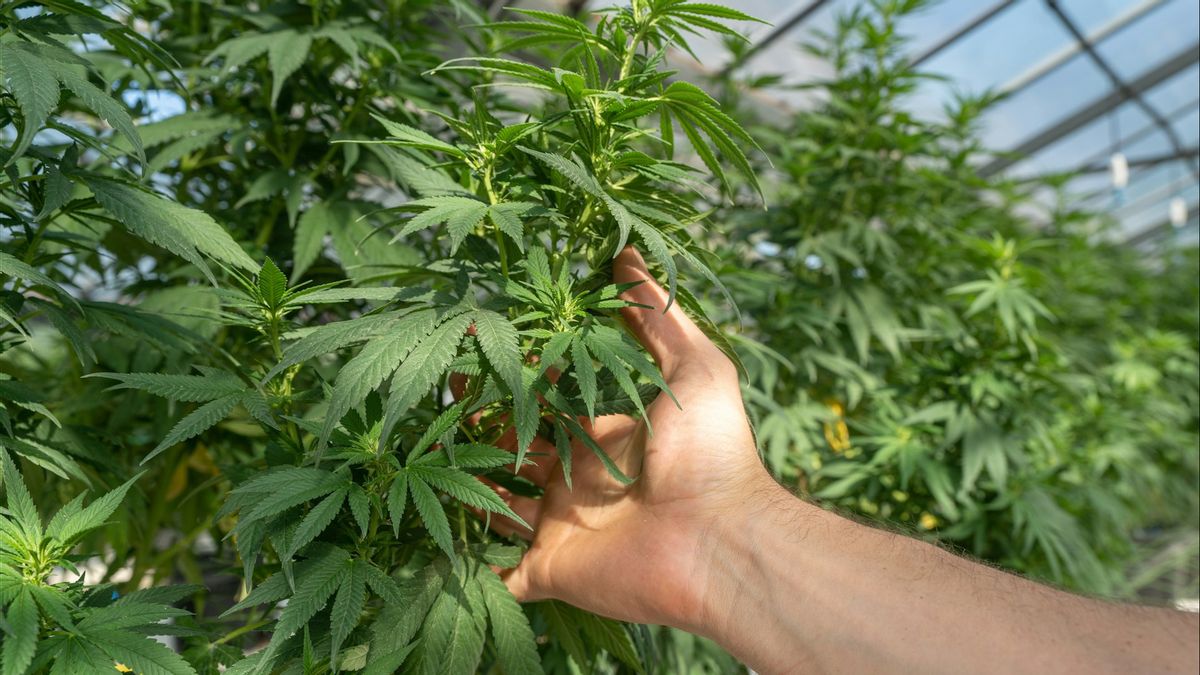


JAKARTA - Under the hot summer sun, Abderrahman Talbi watched rows of cannabis flowers bloom in his neat field near his house. He reflected on how his life had changed dramatically after entering Morocco's thriving legal cannabis industry.
Like many farmers in the northern Rif mountains who had long grown cannabis illegally, Talbi was relieved that raids and seizures by authorities were no longer a concern.
"I can now say that I am a cannabis farmer without fear," Talbi told Reuters.
"Peace of mind is priceless," he added.

Talbi's transition to becoming a legal cannabis farmer exemplifies what the Moroccan government hopes for. Morocco legalized cannabis cultivation not for recreational purposes, but for medical and industrial uses such as cosmetics in 2022.
Since then, the legal cannabis farming policy has brought hope for new income and economic revitalization to the impoverished Rif region.
This policy has also made Morocco one of the world's largest and leading cannabis producers, including the first in North Africa and the Middle East, according to the G8. Morocco's move inspired Canada, Germany, and Uruguay, which eventually legalized cannabis production and use.
This move is also expected to divert cannabis farmers in the Rif mountains from engaging in illegal distribution following the Moroccan government's policy.
The Allure of Illegal Marijuana and the Black Market
Morocco's cannabis regulator, ANRAC, noted that efforts to legalize cannabis have led to 5,000 farmers joining the industry since early 2025.
This situation has led to legal cannabis production soaring to nearly 4,200 tons in 2024 alone, a 14-fold increase compared to the first harvest in 2023.
However, the black market remains dominant in Morocco, driven by profits and high demand for recreational cannabis from Europe and Africa. This situation has the potential to undermine government efforts to regulate the legal cannabis sector.

Morocco is known to have 14,300 acres (5,800 hectares) of legal cannabis cultivation, according to ANRAC data. This figure is significantly smaller than the illegal cannabis cultivation, which covers more than 27,100 hectares, according to data from the Moroccan Ministry of the Interior.
The crackdown on the large number of illegal cannabis growers in Morocco has not deterred perpetrators. In fact, authorities continue to increase seizures. The Moroccan Ministry of the Interior recorded that 249 tons of cannabis resin were confiscated from illegal cannabis growers from 2023 to September 2024.
Moroccan Policy
In addition to the high demand and higher profitability of the black market, farmers choose to cultivate cannabis illegally in Morocco due to the prohibition on the distribution and use of cannabis for recreational purposes, complicated agricultural licensing processes, harvest restrictions, and the requirement for special permits from ANRAC for distribution of agricultural products.
Farmers who wish to cultivate cannabis legally are also required to join a licensed cooperative. The cooperative purchases cannabis growers' produce and processes it into derivative products or sells the resin to other licensed producers.
Talbi, a legal cannabis grower, also has a licensed cooperative for this purpose, Biocannat. The cooperative's headquarters are in the town of Bab Berred, 300 km north of Rabat.
In 2024, Biocannat purchased approximately 200 tons of cannabis from approximately 200 farmers in Morocco. The cooperative then processes the legally grown cannabis into resin, supplements, capsules, oils, and powders for medical and cosmetic purposes.

Unlike Talbi, marijuana farmer Mohamed El Mourabit, who initially had high hopes for marijuana legalization in Morocco, now feels pessimistic about implementing government procedures for legal sales.
"The process is too complicated," said the farmer from Issaguen, Morocco.
El Mourabit ultimately chose to grow marijuana and distribute it illegally. He was also tempted by the higher selling price of marijuana on the black market.
On the one hand, if he farmed and sold it legally to a cooperative, the process of disbursing the proceeds would take months.
Furthermore, the cooperative could only price raw marijuana plants at 50 dirhams, or IDR 224,000, per kilogram. Meanwhile, on the black market, processed marijuana resin could fetch up to 2,500 dirhams, or IDR 11 million, per kilogram.
This disparity in selling prices has been criticized by Moroccan farmers and marijuana legalization activists. They are pushing for the Moroccan government to allow farmers to grow marijuana and distribute it for recreational use. However, this is unlikely to materialize anytime soon.
ANRAC head Mohamed Guerrouj emphasized that legalizing recreational marijuana use would only be considered within a medical framework.
"The goal is to develop Morocco's pharmaceutical industry... not coffee shops," Guerrouj said.
The English, Chinese, Japanese, Arabic, and French versions are automatically generated by the AI. So there may still be inaccuracies in translating, please always see Indonesian as our main language. (system supported by DigitalSiber.id)
Most Popular Tags
#Prabowo Subianto #donald trump #firearm #8791 #giias 2026Popular


