
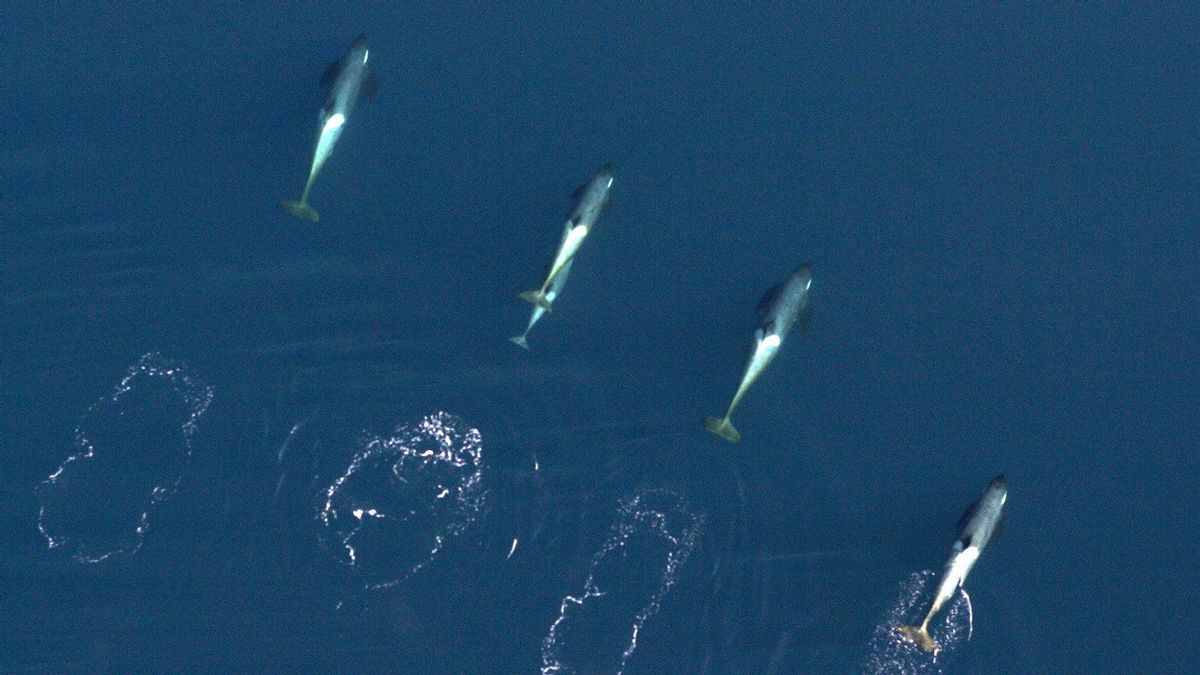


JAKARTA - Killer whales are known as water mammals with extraordinary intelligence, showing complex social structure and sophisticated communication.
New research provides new evidence for this, documenting how these marine mammals use seaweed stalks as a tool to care for each other - as in, "You scratched your nose, I scratched your nose."
Using drones to observe a population of killer whales in the Salish Sea, part of the Pacific Ocean between the State of Washington and British Columbia, researchers noticed these predators performing behaviors they called "allokelping", one of the few examples of using tools by known marine mammals.
Killer whales find large stalks of seaweed called bull kelps, both attached to the ocean floor and floating on the surface. They then bite the end of the stalk, place it between them and other killer whales, then rolling the kelp between their bodies.
The researchers hypothesized that this behavior increases skin health while strengthening social bonds. Other killer whale populations have been observed sneering their bodies on smooth rocky beaches, likely to remove dead skin cells.
"Most examples of using tools in animals involve solving ecological problems, such as getting food. For example, chimpanzees use sticks to lure termites. What's amazing about this discovery is that the kelp is used not to get food, but to facilitate social interaction," said marine biologist Darren Croft of the University of Exeter in the UK, co-author of a study published in the journal "Current Biology" as reported by Reuters July 8.
"The use of social-motivated tools like this is very rare in mammalian animals and previously only observed in small numbers of primates, usually in captivity," added Crook, who is also executive director of the Center for Whale Research, a scientific organization based in the State of Washington and has been studying the population of killer whales since the 1970s.
Researchers documented the behavior among male and female killer whales of all ages. This behavior may play an important role in their social life, said Croft.
There are several other examples of using tools among marine mammals. Sea crossings use rocks and other hard objects to break shells and get meat in them. And certain dolphins use marine sponges to protect their muzzles and stir up the seabed while looking for food. The researchers say killer whales are one step ahead because they modify an object to be used as a tool.
"While this is not the first documented case of the use of tools by cetaceans or marine mammals, as far as we are concerned, this is the first case of the manufacture of tools by cetaceans using a tool. These whales not only found perfect kelps in the environment, but also actively modified larger intact kelps to create pieces they use for allocelping," said study co-author Rachel John, a graduate student at Exeter University who studied the behavior of killer whales.
"Another important part that makes this behavior so unique is the fact that they manipulate the kelp cooperatively with their partner without using hands or additional hand-like tools. They use the mouth to position the kelp at first, but after that they only use the momentum and pressure of their body's cores to maintain contact with each other and the kelp between them," added John.
This behavior is known only among this killer whale population.
"We found that individuals with peeling skin that are more visible are more likely to do allocelping, suggesting that this behavior may have a skin care function. Brown marine grass such as kelp is known to have antibacterial properties, so it makes sense to rub with kelp can improve skin health," explained Crook.
"Secondly, we think this behavior may play a role in maintaining social ties. Physical contact is known to be important to social cohesion in many species, including humans. As we may hug friends we haven't seen in a long time, allocelping may also serve to strengthen social relations among whales," added Crook.
SEE ALSO:


It is known, this kelp grows in cold, nutrient-rich coastal and ups and ups and downs, and thrives off the west coast of North America, which is the cruising area of this killer whale.
This population is at a serious risk of extinction, said Croft, with only 73 individuals counted in the last census. They are highly specialized salmon hunters, mainly dependent on salmonjug. As the salmon population declines, in part due to the construction of dams in rivers where the colony is located, the whales struggle to find sufficient food.
"In short, they are starving," said Croft.
The English, Chinese, Japanese, Arabic, and French versions are automatically generated by the AI. So there may still be inaccuracies in translating, please always see Indonesian as our main language. (system supported by DigitalSiber.id)
Most Popular Tags
#Prabowo Subianto #donald trump #Febrie Adriansyah #8791 #giias 2026Popular


